speech
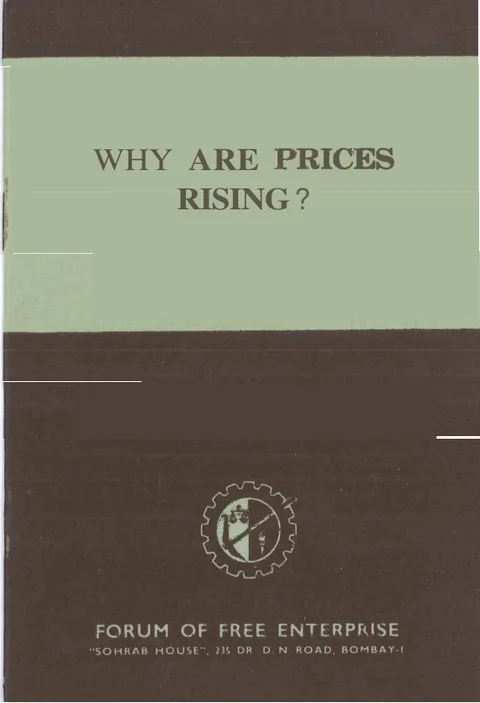
Why Are Prices Rising?
Published by M. R. Pai for the Forum of Free Enterprise, 235, Dr. Dadabhai Naoroji Road, Bombay 1, and Printed by Michael Andrades at The Bombay Chronicle Press, Horniman Circle. Bombay-1. · Bombay · 1962
15 pages
Why Are Prices Rising?
By G. D. Somani
Summary
This Forum of Free Enterprise booklet, issued in November 1962, gathers business-community responses to the wholesale price rise that accompanied India’s Third Five-Year Plan. The lead text is an excerpt from G. D. Somani’s vice-presidential address to the Indian Merchants’ Chamber (Bombay, 7 September 1962), which argues that the price rise is not the product of external shocks but the ‘normal follow-up of a built-in inflationary situation’ created by deficit-financed planning. Somani contends that the combined Second- and Third-Plan deficit financing of roughly Rs. 950 crores and Rs. 210 crores respectively has run monetary demand ahead of real output, and that the only durable remedies are restraining government and state expenditure to reasonable tax revenues and raising productivity, not administrative controls.
Key points
-
Frames the post-1961 wholesale price rise as the predictable result of deficit-financed planning rather than external or seasonal factors.
-
Cites the wholesale price index rising from 128.7 to 131.8 year-on-year, and food-article index movements, drawn from Indian Merchants’ Chamber statements.
-
Rejects state trading, co-operative distribution, and price controls as remedies, arguing they raise costs to the consumer and distort trade structure.
-
Argues the real cure is cutting government/state spending to fit reasonable tax revenues and borrowing only at free-market rates, plus raising productivity.
-
The booklet compiles several pro-market voices: Somani (IMC), an IMC memorandum to the Planning Commission, S. Venkataraman (Andhra Chamber of Commerce), and economist B. R. Shenoy.
-
B. R. Shenoy’s contribution attributes the price spiral to over-investment by government beyond the growth an ‘infant economy’ can absorb without inflationary upset.
-
Interspersed quote boxes invoke Eugene Black, Colin Clark, Graham Hutton, and A. D. Shroff to reinforce the free-enterprise framing.
Generated by the v1.5 extraction pipeline. Awaiting editorial review.
Metadata and summary are AI-extracted from the source PDF and reviewed for editorial accuracy. The original work is available via the Read PDF tab above (where present); paragraph-level citation inside the PDF is deferred to a future engagement.