edited volume · anthology
Why Scarcities?
By D. R. Pendse
Forum of Free Enterprise, Sohrab House, 235 Dr. D. N. Road, Bombay-1 · Bombay · 1974
20 pages
Why Scarcities?
Summary
This 1974 Forum of Free Enterprise booklet diagnoses the shortages then gripping the Indian economy, treating inflation and scarcity as ‘two sides of the same coin’ rooted in defective economic policy rather than mere bad luck. An unsigned editorial introduction frames the volume and narrows the inquiry to three essential commodities in short supply, while an opening survey article sets the general problem of scarcities in perspective. The four contributors - D. R. Pendse on scarcities and inflation, C. V. Mariwala on vanaspati, B. D. Somani on paper, and M. R. Meher on coal - argue from a free-enterprise standpoint that government controls, licensing restrictions on large industrial houses, and nationalisation are the principal causes of shortages and high prices, and that the remedy lies in more production rather than more controls.
Key points
-
D. R. Pendse argues scarcity and inflation persist because vested interests, including black marketeers, certain producers, political parties and even governments, benefit from perpetuating them.
-
Pendse cites the National Development Council’s 1973-74 paddy procurement price of about Rs. 110 per quintal against the Agricultural Prices Commission’s recommended Rs. 63, and Uttar Pradesh sugarcane fixed at Rs. 12-13 versus the Centre’s Rs. 8.
-
C. V. Mariwala, chairman of the Vanaspati Manufacturers’ Association, argues that price control imposed as a temporary 1963 measure under the Defence of India Rules became permanent and is itself a major cause of production instability.
-
Mariwala contends vanaspati usefully extends the country’s fat resources by turning non-traditional oils such as cottonseed and imported palm, soya and sunflower into accepted edible fat.
-
B. D. Somani attributes stagnant paper output of roughly eight lakh tonnes across 1971-73 to government policy that ideologically blocks large industrial houses from expanding or setting up new units.
-
Somani notes India was importing newsprint at Rs. 3,500-4,000 per tonne even as administrative delays held up clearance for domestic capacity expansion.
-
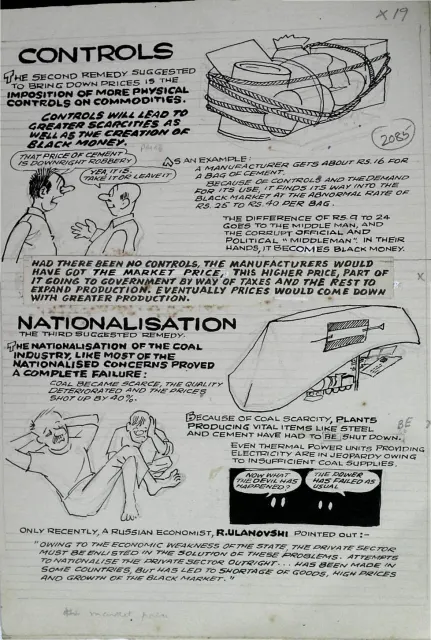
M. R. Meher’s essay on coal, reproduced from the Financial Express, presents nationalised coal corporations as running at a loss while railways, power and steel industries pay higher prices, calling nationalisation an “egregious blunder.”
-
Meher blames wage-board awards and union pressure, rather than economic logic, for cost increases of 31 to 43 percent by coal grade after nationalisation.
Essays
Scarcities and Inflation
By D. R. Pendse
Pendse argues that the scarcity-and-inflation crisis persists not because it is poorly understood but because vested interests - black marketeers, certain producers, political parties, and even governments - benefit from perpetuating it. He illustrates how administered prices for foodgrains and sugarcane, set by political bodies like the National Development Council above the Agricultural Prices Commission’s expert recommendations, keep prices high, and contends that during inflation industry stops bothering about quality or marketing because scarcity makes profits easy.
- Frames scarcity and inflation as mutually reinforcing and structurally sustained by their beneficiaries.
- Cites NDC paddy procurement prices of ~Rs. 110/quintal in 1973-74 against the APC’s recommended Rs. 63, and UP sugarcane fixed at Rs. 12-13 vs the Centre’s Rs. 8.
- Argues producers and even political parties lose the incentive to improve output or quality when scarcity guarantees profit.
Vanaspati
By C. V. Mariwala
Mariwala, chairman of the Vanaspati Manufacturers’ Association of India, defends vanaspati as a useful processed edible oil that extends the country’s fat resources, then argues that government price control - imposed in 1963 as a temporary measure under Defence of India Rules and never lifted - has itself become a major cause of instability in production. Reviewing vanaspati prices every fortnight against volatile oil costs, he says, distorts the industry; the answer to high prices is more oilseed output, not controls.
- Vanaspati turns non-traditional oils (cottonseed, imported palm/soya/sunflower) into accepted edible fat, easing shortage.
- Temporary 1963 price control under Defence of India Rules became permanent, with 7-8 price changes a year.
- Price control itself, requiring constant cost-data review, is a major cause of fluctuation; the cure is more output.
Paper
By B. D. Somani
B. D. Somani, an industrialist and past president of the All-India Manufacturers’ Organisation, attributes the paper shortage to stagnant production (8.03, 8.04 and 7.96 lakh tonnes in 1971-73) caused by government policies that ideologically refuse to let large industrial houses expand or set up new units. He notes the country is importing newsprint at Rs. 3,500-4,000 per tonne while administrative delays in clearing projects block domestic capacity, and urges the government to take a realistic view and permit the large houses to invest.
- Paper output stagnated/fell over 1971-73 despite rising demand.
- Government’s refusal to let large houses expand, plus licensing delays, is the chief obstacle to new capacity.
- India wastes foreign exchange importing newsprint while domestic newsprint projects await clearance for over a year.
Coal
By M. R. Meher
Meher’s essay, reproduced from the Financial Express, presents the coal industry as a leading example of the heavy price the nation pays for nationalisation: the government coking- and non-coking-coal corporations run at a loss, coal-consuming industries (railways, power, steel) pay dearly, and the only beneficiaries are the coal-mine workers. He blames union pressure and a wage board that ignored the industry’s capacity to pay, calling nationalisation an ‘egregious blunder’ and a warning against indiscriminate state takeover.
- Post-nationalisation coal corporations make losses while railways, power and steel bear higher coal prices.
- Wage-board awards and union pressure, not economic logic, drove nationalisation and cost increases of 31-43% by grade.
- Treats coal nationalisation as a cautionary case against indiscriminate state ownership.
Generated by the v1.5 extraction pipeline. Awaiting editorial review.
Metadata and summary are AI-extracted from the source PDF and reviewed for editorial accuracy. The original work is available via the Read PDF tab above (where present); paragraph-level citation inside the PDF is deferred to a future engagement.