pamphlet
Why Swatantra?
To Save Freedom, To Preserve Family Economy, To Restore Fundamental Rights
Swatantra Party
19 pages
Part of Swatantra Party
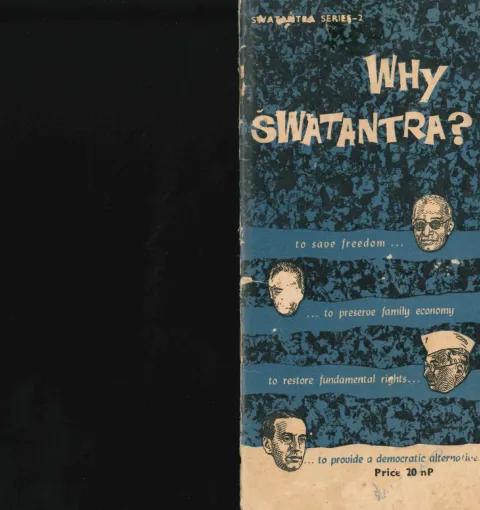
Why Swatantra?
By the Swatantra Party
Summary
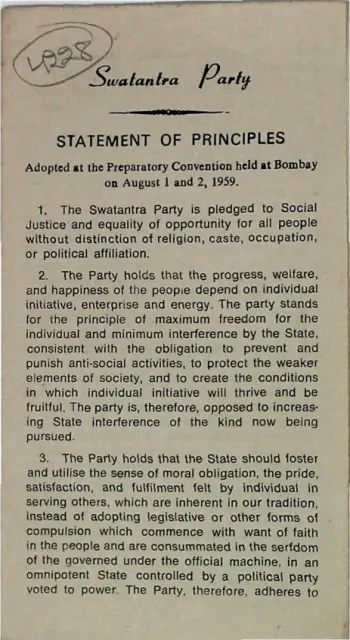
Why Swatantra? is a founding-era pamphlet of the Swatantra Party (issued in the “Swatantra Series” as No. 2), gathering several short pieces that together explain and justify the new party, which was born in Bombay in August 1959 under the leadership of the elder statesman C. Rajagopalachari, with Professor N. G. Ranga as its chairman. Its three stated aims give the pamphlet its shape: to save freedom, to preserve family economy, and to restore fundamental rights. Presenting itself as a “party of freedom,” Swatantra promises a genuine democratic opposition and a novel experiment in party discipline — restricting whip-bound control to essential issues and letting members vote according to their own conscience on all other matters, as an answer to what it calls the “suppression of opinion and rule by a minority in the name of a majority” in the ruling Congress.
The economic heart of the pamphlet argues that twelve years of Congress “Swaraj Government” have drifted, under Nehru’s planning, toward a “Sovietism” that threatens the traditional Indian family economy. It reads the Congress’s Nagpur Resolution of January 1959 as a three-pronged attack on the village: ceilings on landholdings, the coercion of peasants into cooperative or “joint” farming, and a state monopoly over the wholesale trade in foodgrains that would eliminate thousands of traders and leave the farmer at the mercy of the state. Against this the party defends peasant proprietorship, self-employment, cottage industry and free trade, grounding its case in dharma and in Gandhian ideas of trusteeship and decentralisation, and insisting that society is sustained by the moral sense of the people rather than by state compulsion.
On the political side, the pamphlet charges that the Congress has “lost the right to speak as a democratic body,” reducing its own processes to a farce in which the Working Committee, the president and the leader dominate an “inverted pyramid,” and whittling down the fundamental rights enshrined in the Constitution — above all the right to property, with taxation turned into a form of expropriation. Swatantra therefore stands, “first and foremost,” for the restoration of freedom and real parliamentary control, for meeting the elementary needs of the common people (food, water, housing and clothing) at easy prices, for private initiative and employment, and for placing India’s security beyond the grasp of ambitious world powers.
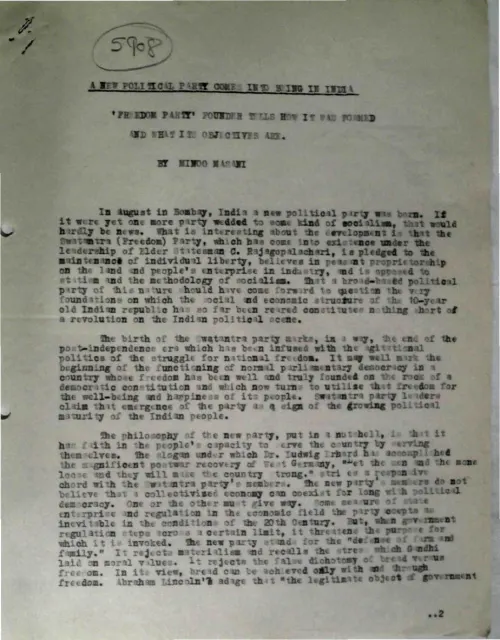
The closing essay, “To Provide a Democratic Alternative” (reprinted from LIFE International), introduces the party to an international readership as a broad-based, non-socialist force pledged to individual liberty, peasant proprietorship and people’s enterprise, and opposed to statism and the methodology of socialism. It notes that the Congress won only about 32 per cent of the vote and presents Swatantra as a sign of India’s growing political maturity, aiming to break the “Congress or Communist” strait-jacket and to keep India off the “Chinese path” before the general elections due in 1962. The pamphlet ends with a set of free-market maxims — “You cannot bring about prosperity by discouraging thrift… You cannot help men permanently by doing for them what they could do for themselves” — which it attributes to Abraham Lincoln.
Key points
-
A founding-era Swatantra Party pamphlet (Swatantra Series, No. 2) collecting several essays on why the party was formed; its three stated aims are to save freedom, to preserve family economy, and to restore fundamental rights.
-
The party was born in Bombay in August 1959 under C. Rajagopalachari, with Professor N. G. Ranga as chairman; it lets members vote by conscience on all but the party’s fundamentals, breaking with rigid whip-bound party discipline.
-
Attacks the Congress’s Nagpur Resolution (January 1959) as a three-pronged assault on the village: ceilings on landholdings, coercion into cooperative or “joint” farming, and a state monopoly on the wholesale foodgrain trade.
-
Defends peasant proprietorship, self-employment, cottage industry and trade — the traditional Indian “family economy” — against a drift toward “Sovietism,” grounding its case in dharma and Gandhian trusteeship and decentralisation.
-
Charges that the Congress has “lost the right to speak as a democratic body,” reducing its processes to rubber-stamping, and has whittled down fundamental rights (especially property) while turning taxation into expropriation.
-
Positions Swatantra as a democratic, non-socialist alternative opposed to statism, aiming to break the “Congress or Communist” strait-jacket and forestall India’s slide toward the “Chinese path” before the 1962 elections.
-
The closing essay, reprinted from LIFE International, notes the Congress won only about 32 per cent of the vote and casts the party’s emergence as a sign of India’s growing political maturity.
-
Ends with a set of free-market maxims (“You cannot bring about prosperity by discouraging thrift…”) that the pamphlet attributes to Abraham Lincoln.
Ingested 2026-07-21 from the CCS source archive. AI-drafted summary awaiting editorial review.
Metadata and summary are AI-extracted from the source PDF and reviewed for editorial accuracy. The original work is available via the Read PDF tab above (where present); paragraph-level citation inside the PDF is deferred to a future engagement.