non liberal
Joseph Stalin
1878–1953
Also known as: Stalin, स्टालिन
How Joseph Stalin is discussed in this archive
Referenced in 10 other works , including Minoo Masani's Disenchantment with the Soviet Economic Model - In Coversation with Zareer Masani , The Indian Libertarian , and Minoo Shroff on Doing Business in Nehru's India .
In Minoo Masani's Disenchantment with the Soviet Economic Model - In Coversation with Zareer Masani : Stalin's purges and gulags are referenced as the substantive object of Minoo Masani's disenchantment with the Soviet model.
In Minoo Shroff on Doing Business in Nehru's India : Stalin's Soviet reforms are invoked as the formative influence on Nehru's economic thinking during the early 1930s visit.
In Agriculture in Asia : Stalin appears as the architect of autarkic policy in Clark's catalogue of cautionary failures, paired with Franco's Spain as a non-communist autarky that also suffered.
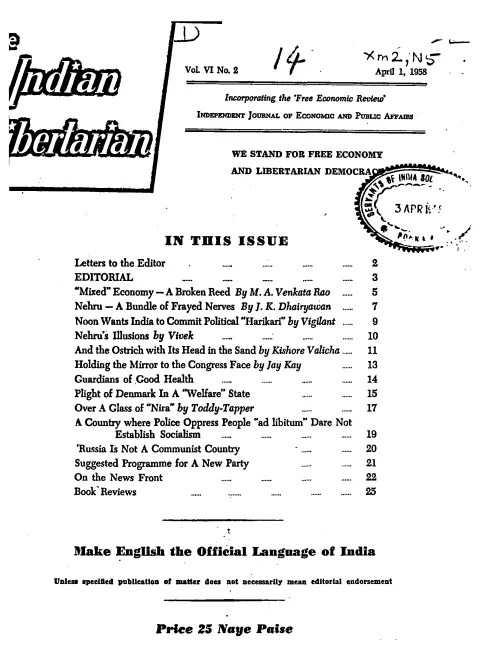
In The Indian Libertarian : Stalin figures as the embodiment of Soviet state violence that Khrushchev's own denunciations confirmed — used by the Clark-Rimanoczy piece to argue the USSR is not genuinely communist but a new tyranny that Indian fellow-travellers wilfully defend.
In Acharya N G Ranga: The Farmer’s Friend and Swatantra Party Stalwart : Stalin's regime is cited as the direct cause of Ranga's disillusionment with socialism: witnessing the oppression of Soviet peasants turned Ranga away from Marxist ideology.
Mentioned in (11)
Primary works (4)
- Minoo Masani's Disenchantment with the Soviet Economic Model - In Coversation with Zareer Masani · 2018
- "one didn't know the full extent then of Stalin's purges and the gulags and how many people were killed" · Discussion of repression Minoo glimpsed in the USSR
- "his, you know, reasons for disenchantment with the Soviet model and Stalin's purges" · Linking Stalin's repression to the argument of Socialism Reconsidered
- Minoo Shroff on Doing Business in Nehru's India · 2015
- "the reforms which Stalin brought in — though he shut people up and there was no freedom, what they wanted was some economic development" · Shroff acknowledging the trade-off Stalin's model embodied
- Agriculture in Asia · 1971
- "autarkic policies under Stalin and Franco are presented as cautionary failures" · Clark names Stalinist autarky alongside Maoist agriculture as evidence that trade-retreating regimes underperform export-oriented ones
- The Indian Libertarian · 1958
- "Khrushchev's admission of Stalinist crimes is cited as evidence of endemic state violence rather than aberration." · Stalin invoked as the proper-noun anchor for the USSR's documented brutality
- "Khrushchev's own denunciations of Stalin are used to show the system's brutality is structural, not incidental." · key-points distillation framing Stalin as systemic-not-aberrant
Opinion pieces (1)
- Acharya N G Ranga: The Farmer’s Friend and Swatantra Party Stalwart
- "his belief in socialism was short-lived, as the Stalin regime's oppression of peasants and the initiation of Soviet land reforms such as forced collectivisation led to Ranga's departure from Marxist ideology." · Stalin's agrarian terror is identified as the pivotal event that broke Ranga's faith in socialism
Excerpts (5)
- A Democracy at War
- "They are very frank, these gentlemen- Hitler, Stalin, Khrushchev and Mao Tse-tung. They tell us what they are going to do, but we are so naïve that we will not believe them!" · Stalin is part of a list of authoritarian leaders used to indict Indian foreign-policy blindness
- De-Stalinisation Versus Communism
- "Nikita Khrushchev's denouncement of Stalin and his criminal rule at the 20th Congress of the Communist Party in 1956 remains an important milestone in the history of the now-discarded project." · Stalin's criminal rule is the starting point for the essay's analysis of whether de-Stalinisation is possible within the Communist framework
- Economics of Freedom
- "as had developed under Stalin. "We shall not allow it to happen," he kept repeating with great sincerity but with what appeared to me to be a singular lack of realism" · Stalin's totalitarian state is the cautionary historical reference point for Masani's warning about statism in India
- Farmers Need Freedom, Not a Guardian Angel
- "the kind of economic theory that prompted Stalin to send tanks against kulaks in Russia" · Joshi traces India's deliberate depression of farm prices back to the same agrarian-extractive logic that drove Stalinist collectivisation
- Socialism or State Capitalism
- "Stalin wanted to make dictatorship absolute and totalitarian and, therefore, made State Capitalism the exclusive form of economic development in the USSR" · Stalin presented as the decisive agent in transforming Soviet socialism into state capitalism