essay
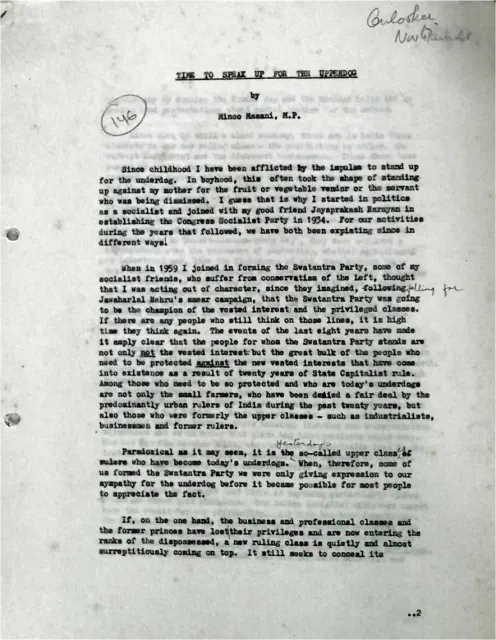
TIME TO SPEAK UP FOR THE UPPERDOG
1967
3 pages
Summary
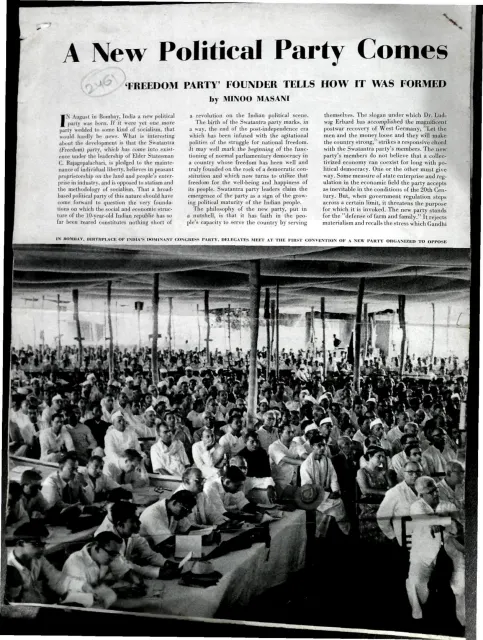
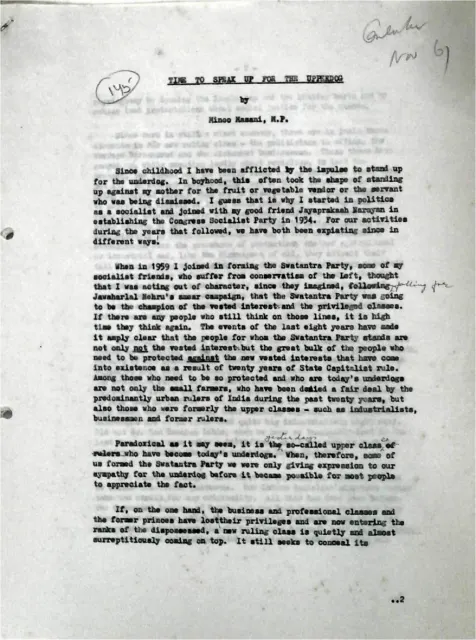
In this three-page essay, Minoo Masani argues that political debate should recognize a newly disadvantaged “upperdog” rather than treating socialism as the only language of social justice. He traces his own movement from the Congress Socialist Party, founded with Jayaprakash Narayan in 1934, to the Swatantra Party in 1959, and contends that the latter represents not only small farmers but also formerly privileged groups—industrialists, businessmen, and former rulers—who have become targets of post-independence policy.
Masani’s central criticism is directed at India’s emerging “new ruling class,” comprising politicians, corrupt businessmen, and state-connected entrepreneurs. He argues that licensing, quotas, nationalisation, and state control have enabled these groups to extract surplus from peasants, workers, and the middle class while presenting themselves as socialists. Drawing on Karl Marx’s concept of “extracting surplus value” and Milovan Djilas’s account of a privileged Communist “new class,” Masani calls for a government committed to free enterprise, vigorous peasant proprietorship, and social justice. He concludes by urging socialists and other advocates of justice to stop defending obsolete vested interests and speak for former “upperdogs” who have become the underdogs.
Key points
- Masani presents the Swatantra Party as an expression of sympathy for groups that have become disadvantaged under post-independence state policy.
- He identifies small farmers, industrialists, businessmen, and former rulers among those whom he describes as today’s underdogs.
- The essay criticizes the politicalisation of economic life through nationalisation, licensing, quotas, and state control.
- Masani argues that politicians and state-connected business interests extract value from peasants, workers, and the middle class.
- He uses Karl Marx’s concept of surplus value and Milovan Djilas’s analysis of the Communist “new class” to interpret India’s political economy.
- The proposed alternative is a government supporting free enterprise in industry and business and vigorous peasant proprietorship on the land.
- The essay calls on socialists and other believers in social justice to redirect their criticism toward the new ruling class.
Metadata and summary are AI-extracted from the source PDF and reviewed for editorial accuracy. The original work is available via the Read PDF tab above (where present); paragraph-level citation inside the PDF is deferred to a future engagement.