Summary
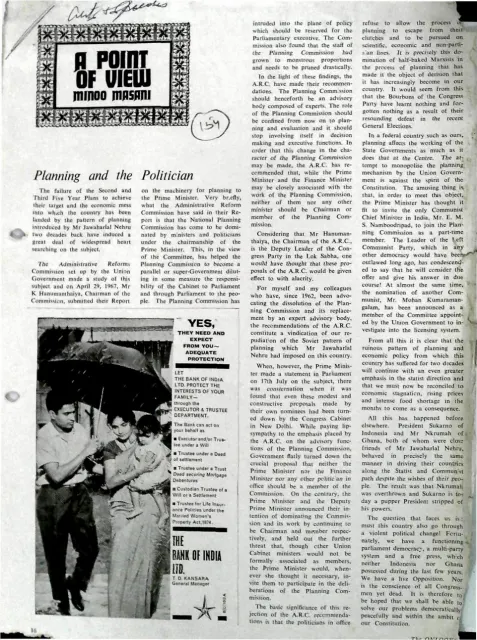
In the rendered pages, Minoo Masani argues that India’s planning system has failed to deliver the objectives of the Second and Third Five-Year Plans and has instead allowed the Planning Commission to become a parallel, super-government institution. Drawing on the Administrative Reforms Commission’s recommendations, he proposes reducing the Commission to an advisory body focused on planning and evaluation rather than decision-making and execution. He also criticises the Prime Minister’s resistance to these reforms and the proposed inclusion of Communist ministers in the Commission.
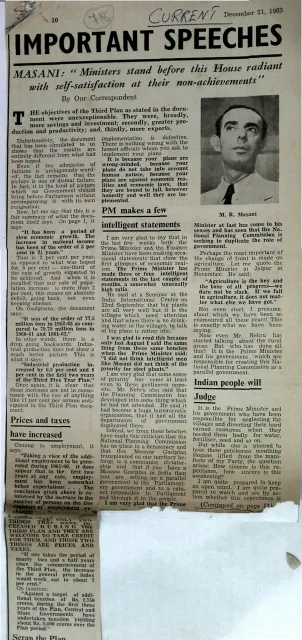
In the rendered pages, Masani presents planning as both an economic and constitutional problem. He argues that centralised planning has produced economic stagnation, rising prices, and food shortages, while Union control over planning machinery violates the federal principle. Comparisons with Indonesia and Ghana are used to warn against the concentration of power and the erosion of democratic institutions. The second rendered page consists of unrelated magazine editorial and advertising material rather than a continuation of the essay.
Key points
- Masani attributes the failure of the Second and Third Five-Year Plans to the planning system introduced under Jawaharlal Nehru.
- The Administrative Reforms Commission’s report is presented as evidence that the Planning Commission had become a parallel or super-government institution.
- Masani supports converting the Planning Commission into an advisory body limited to planning and evaluation.
- The essay criticises political control over planning and the Prime Minister’s resistance to the proposed reforms.
- Masani argues that Union monopolisation of planning violates India’s federal constitutional structure.
- The essay links centralised planning to economic stagnation, rising prices, and food shortages.
- Comparisons with Indonesia and Ghana frame democratic institutions as safeguards against concentrated political power.
Metadata and summary are AI-extracted from the source PDF and reviewed for editorial accuracy. The original work is available via the Read PDF tab above (where present); paragraph-level citation inside the PDF is deferred to a future engagement.