speech · convention address
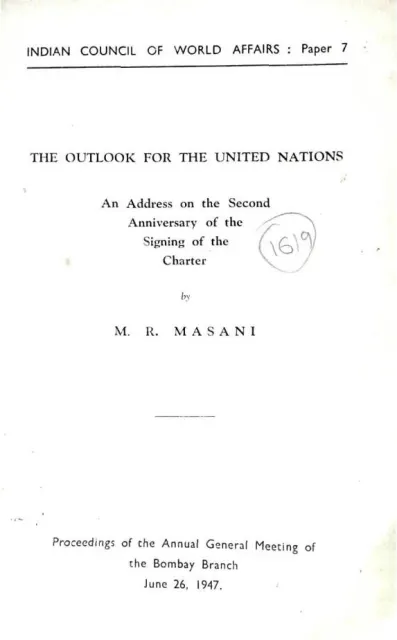
THE OUTLOOK FOR THE UNITED NATIONS
An Address on the Second Anniversary of the Signing of the Charter
By Minoo Masani
Bombay · 1947
22 pages
Summary
In the rendered pages, M. R. Masani evaluates the United Nations two years after the signing of its Charter. He contrasts the Charter’s commitments to human rights, peaceful change, international law, collective security, and economic and social advancement with the practical record of the new organisation. The address presents the UN’s expanding network of specialised agencies and its handling of Palestine, South Africa, disarmament, atomic control, and other international disputes as evidence of meaningful progress, while warning that its success depends on whether nations accept limits on sovereignty and work through common institutions.
In the rendered pages, Masani’s central criticism is directed at the Great Power veto, especially Russia’s repeated use of it in disputes involving Iran, Albania, Greece, and Hungary. He argues that the veto can make collective security ineffective and leave smaller nations exposed to aggression or political coercion. The address therefore defends democratic vigilance and cooperation among free nations, treats the Truman Doctrine and Marshall Plan as provisional responses to UN paralysis, and calls for a constructive international order extending beyond Europe to Asia. The final rendered pages do not include the conclusion of the address.
Key points
- Masani revisits the UN Charter’s promises of peace, human rights, justice, social progress, and international cooperation.
- He describes the UN’s specialised agencies as a significant advance over the League of Nations in promoting peaceful change.
- The address examines the UN’s responses to Palestine and the treatment of people of Indian origin in South Africa.
- Masani argues that disputes over atomic control and disarmament reveal the difficulty of creating effective collective security.
- He presents the Great Power veto as a structural weakness that can paralyse the Security Council.
- Examples from Iran, Albania, Greece, and Hungary are used to show how the veto can shield aggression or suppress smaller states.
- Masani links the UN crisis to the emerging division between democratic and authoritarian political systems.
- He regards the Truman Doctrine and Marshall Plan as interim measures and urges more decisive collective action, especially in relation to Asia.
Metadata and summary are AI-extracted from the source PDF and reviewed for editorial accuracy. The original work is available via the Read PDF tab above (where present); paragraph-level citation inside the PDF is deferred to a future engagement.