
speech
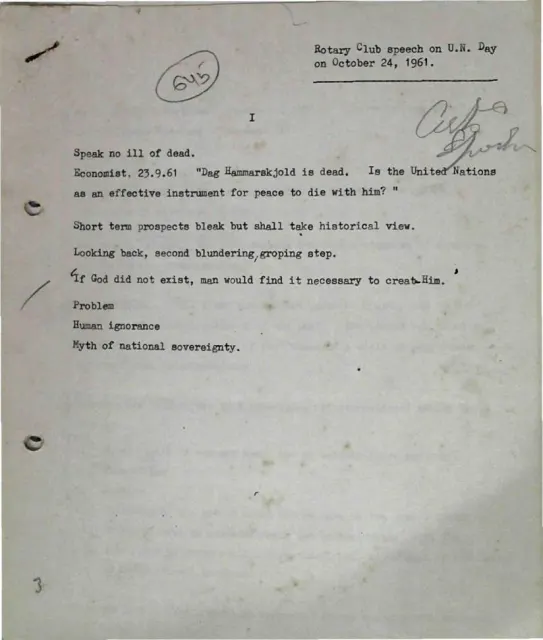
Rotary Club speech on U.N. Day on October 24, 1961.
1961
10 pages
Summary
These typed notes for a Rotary Club speech delivered on United Nations Day, 24 October 1961, begin by questioning whether the UN’s effectiveness died with Secretary-General Dag Hammarskjold. The speaker contrasts two conceptions of the organisation: a standing conference of sovereign states and a developing supranational world organisation. Drawing on Hammarskjold’s testament and annual-report introduction, the notes emphasise international ethics, equal rights, the rule of law, justice, restrictions on armed force, and peaceful settlement of disputes. They warn that weakening the UN’s capacity for effective action could return the world to the dangerous conditions that preceded the First World War.
The subsequent sections examine the proposed replacement of the Secretary-General by a three-member “Troika,” nuclear-test negotiations, and the Berlin crisis. The notes take a strongly anti-Soviet position, arguing that veto power and demands for politically controlled inspections would paralyse international institutions and undermine security. They present disarmament as inseparable from credible guarantees and the construction of UN security forces. The final section treats Berlin and German reunification as tests of self-determination, freedom, and the credibility of the Western alliance, rejecting any settlement that would trade away the freedom of East Germany or legitimise Soviet occupation. The closing appeal links the UN’s survival to the preservation of a world of “live and free men,” rather than survival at any moral cost.
Key points
- The speech opens with the question of whether the United Nations can remain an effective instrument for peace after Hammarskjold’s death.
- It distinguishes between the UN as a conference of sovereign states and the UN as an emerging supranational world organisation.
- It lists international-ethical principles including equal rights, the rule of law, justice, limits on armed force, and peaceful dispute settlement.
- It criticises the proposed Troika arrangement as a mechanism for obstructing the UN Secretariat and extending great-power veto power.
- It argues that nuclear disarmament requires inspection, control, and credible security guarantees rather than unilateral suspension of tests.
- It presents the Berlin crisis as a struggle over East German freedom, German reunification, and the legitimacy of Soviet occupation.
- It concludes that the UN can survive only as an organisation of free people and cannot preserve peace by abandoning liberty.
Metadata and summary are AI-extracted from the source PDF and reviewed for editorial accuracy. The original work is available via the Read PDF tab above (where present); paragraph-level citation inside the PDF is deferred to a future engagement.
Related across the archive
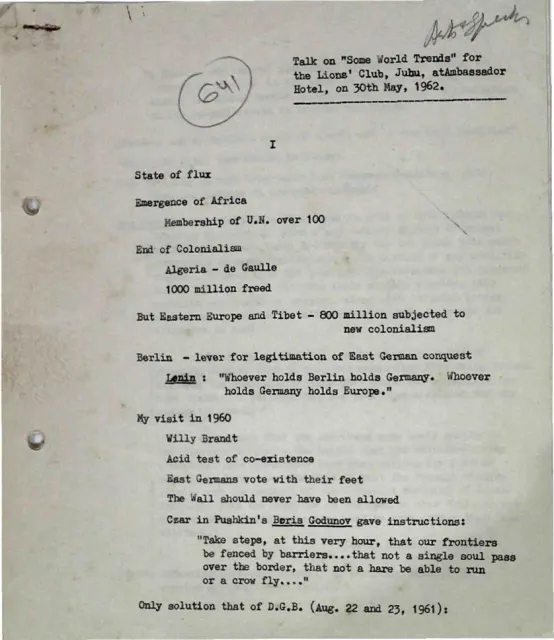 Primary workTalk on \"Some World Trends\" for the Lions' Club, Juhu, at Ambassador Hotel, on 30th May, 1962.
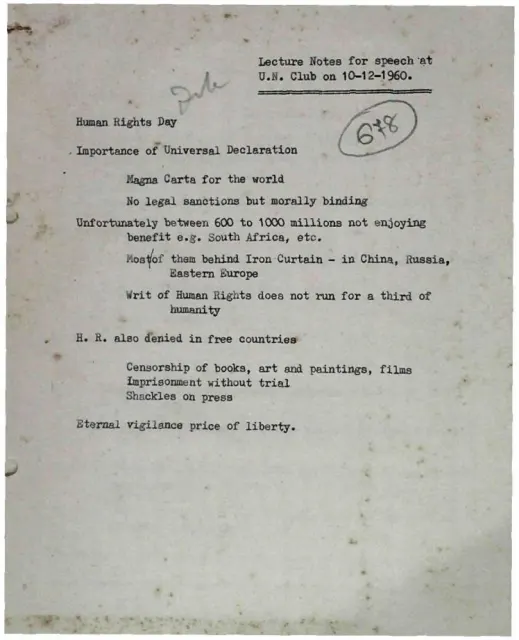 Primary workLecture Notes for speech at U.N. Club on 10-12-1960
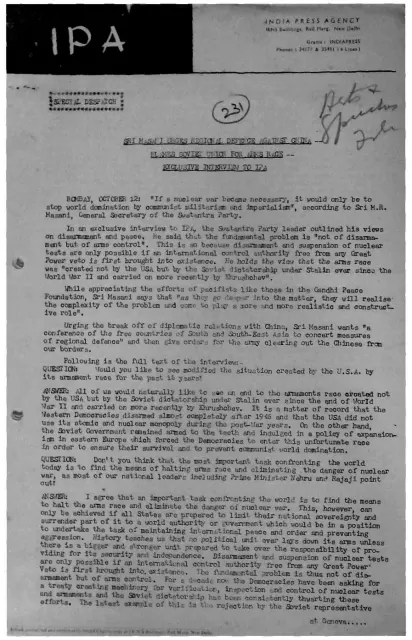 Primary workSRI M.R. MASANI URGES REGIONAL DEFENCE AGAINST CHINA
 OpinionRajaji's Views on Nuclear Bomb
 OpinionIndia's Nuclear Ambitions: Minoo Masani as a Liberal Peacenik