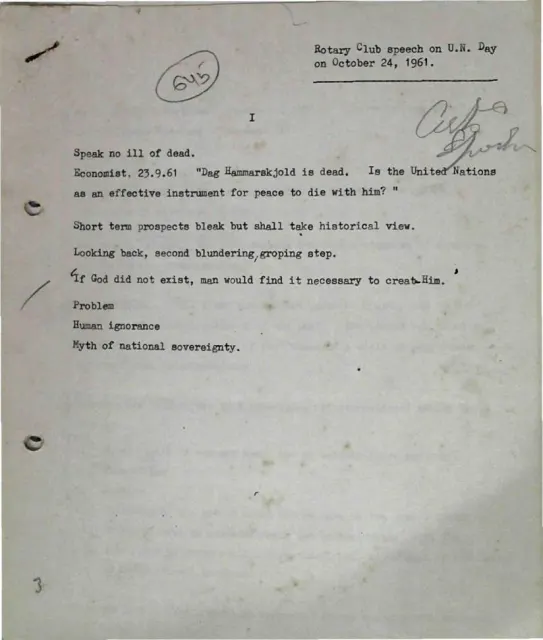
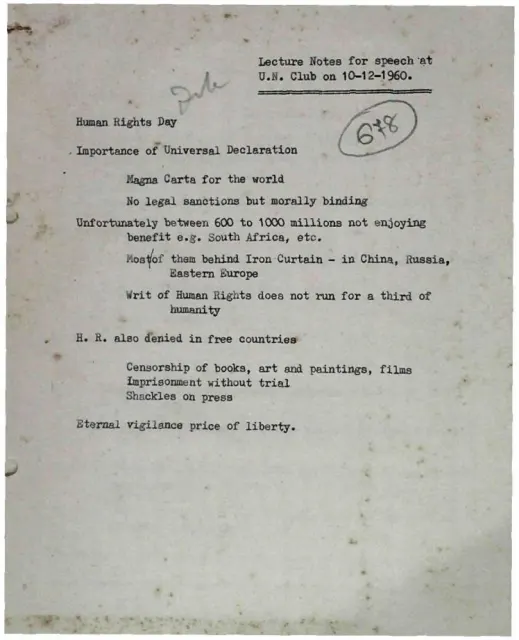
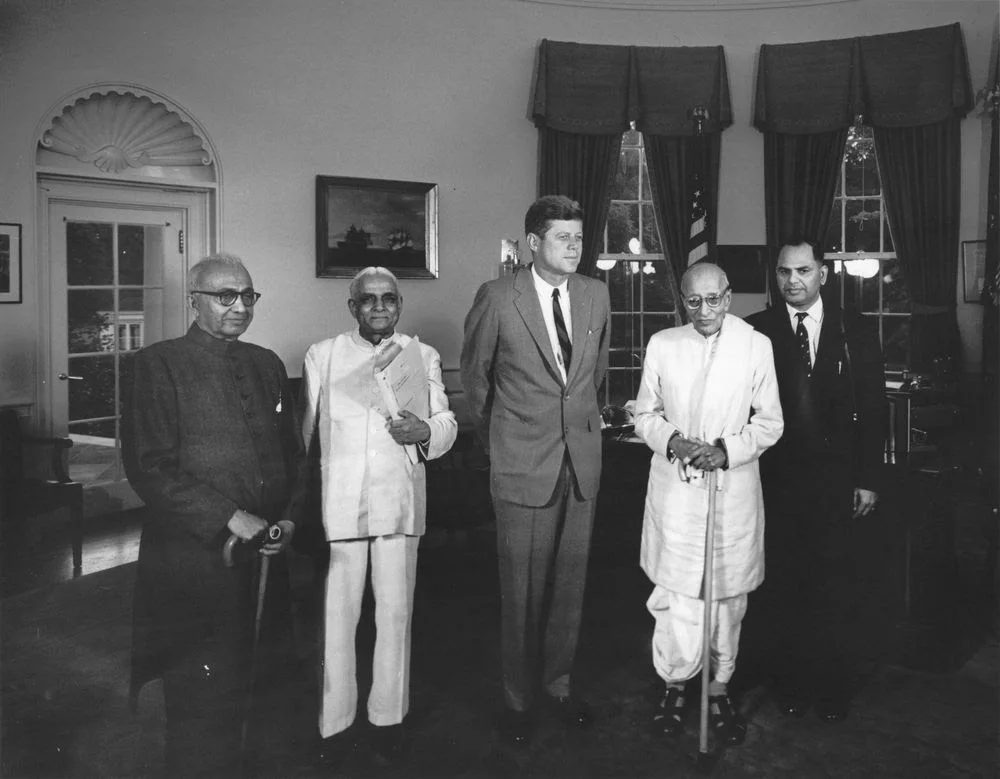
speech · convention address
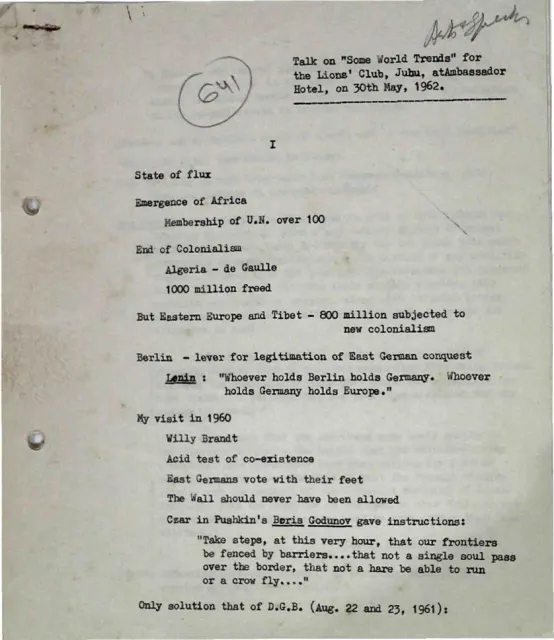
Talk on "Some World Trends" for the Lions' Club, Juhu, at Ambassador Hotel, on 30th May, 1962.
Juhu · 1962
9 pages
Summary
These nine pages are typed speaking notes for a 30 May 1962 Lions’ Club address on “Some World Trends.” The notes move from decolonisation and the emergence of Africa to the division of Germany, the Berlin Wall, Laos, Vietnam, and the competing pressures of the United States, the Soviet Union, and China. The speaker treats Eastern Europe and Tibet as examples of a continuing “new colonialism,” and argues for German reunification through a United Nations-supervised plebiscite. The discussion of Laos presents American policy as a failed gamble on Soviet restraint and criticises the handling of the neutralist coalition.
The later sections turn to China’s Great Leap, the Sino-Soviet cleavage, India’s proposed purchase of Soviet MiG aircraft, changes in Soviet society, youth culture, and disarmament. The notes contrast Soviet ideological claims with evidence of shortages, corruption, consumer aspirations, and movement away from collectivisation. On nuclear policy, the speaker argues that the central problem is not disarmament in the abstract but effective arms control, inspection, and international security guarantees. The notes conclude that disarmament must proceed alongside the construction of stronger United Nations security institutions, while rejecting the binary choice between being “Red or dead.”
Key points
- The notes frame postcolonial geopolitics through the emergence of Africa, the end of formal colonialism, and alleged Soviet domination in Eastern Europe and Tibet.
- Germany and Berlin are presented as central tests of coexistence, self-determination, and the legitimacy of the postwar settlement.
- The Laos discussion argues that American pressure weakened the pro-Western side and that reliance on Soviet restraint proved misplaced.
- China is described as politically and economically troubled, while the Sino-Soviet dispute is treated as real but insufficient to eliminate their shared ideological interests.
- The notes criticise Indian official denials concerning a proposed Soviet MiG purchase, citing contemporary newspaper commentary on Krishna Menon.
- Evidence from Soviet consumer life, corruption, production delays, and labour-time comparisons is used to challenge the claim that the Soviet system delivers prosperity efficiently.
- The argument on nuclear weapons distinguishes disarmament from arms control and links any safe reduction of weapons to inspection, reciprocal action, and international security guarantees.
Metadata and summary are AI-extracted from the source PDF and reviewed for editorial accuracy. The original work is available via the Read PDF tab above (where present); paragraph-level citation inside the PDF is deferred to a future engagement.