
lecture
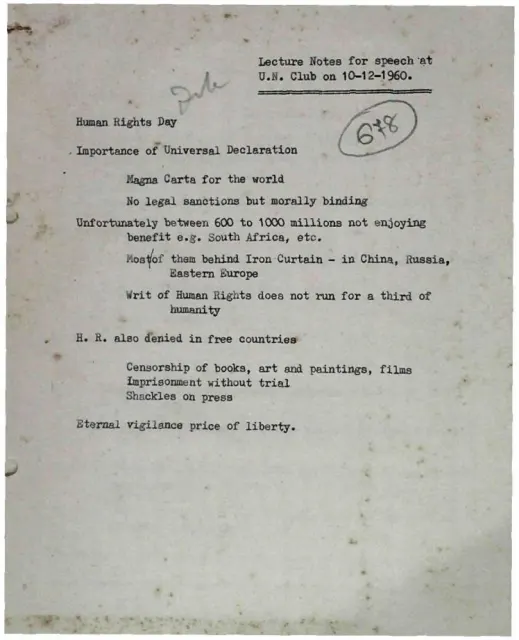
Lecture Notes for speech at U.N. Club on 10-12-1960
1960
7 pages
Summary
These lecture notes for a speech at the U.N. Club on 10 December 1960 begin with Human Rights Day and the Universal Declaration of Human Rights, presented as a morally binding “Magna Carta for the world” despite its lack of legal sanctions. The notes stress that human rights are denied both under communist regimes and in formally free countries, where censorship, imprisonment without trial, and restrictions on the press remain possible. Liberty therefore requires constant vigilance.
The notes then turn to the United Nations, nuclear weapons, disarmament, and the conditions for international peace. Disarmament is described as unattainable without a world authority capable of protecting states and enforcing sanctions; the speaker proposes strengthening international inspection and reducing the great-power veto rather than relying on slogans. The discussion of decolonisation, Tibet, and the Congo combines support for national freedom with a case for stable international trusteeship and federal structures in newly independent societies. The concluding pages argue that the U.N. must be grounded in collective security and that “peace with freedom and justice,” rather than peace maintained through coercive domination, is the proper goal.
Transcript
Summary
These lecture notes for a speech at the U.N. Club on 10 December 1960 begin with Human Rights Day and the Universal Declaration of Human Rights, presented as a morally binding “Magna Carta for the world” despite its lack of legal sanctions. The notes stress that human rights are denied both under communist regimes and in formally free countries, where censorship, imprisonment without trial, and restrictions on the press remain possible. Liberty therefore requires constant vigilance.
The notes then turn to the United Nations, nuclear weapons, disarmament, and the conditions for international peace. Disarmament is described as unattainable without a world authority capable of protecting states and enforcing sanctions; the speaker proposes strengthening international inspection and reducing the great-power veto rather than relying on slogans. The discussion of decolonisation, Tibet, and the Congo combines support for national freedom with a case for stable international trusteeship and federal structures in newly independent societies. The concluding pages argue that the U.N. must be grounded in collective security and that “peace with freedom and justice,” rather than peace maintained through coercive domination, is the proper goal.
Key points
- The Universal Declaration of Human Rights is treated as a morally binding global charter despite lacking direct legal sanctions.
- Human rights violations are identified in communist states and in free countries through censorship, detention without trial, and restraints on the press.
- Nuclear disarmament requires an effective international authority capable of protecting states and enforcing sanctions.
- The notes favour practical international inspection machinery and reform of the great-power veto over rhetorical calls for disarmament.
- Decolonisation is welcomed, while Soviet domination in Eastern Europe and Asia is presented as a form of new colonialism.
- The Congo is discussed as a test of U.N. authority, with support for international assistance and stable government.
- Federal and confederal arrangements are recommended for Asian and African societies emerging from colonial rule.
- The speech closes by linking collective security with freedom, justice, and resistance to coercive interpretations of coexistence.
Metadata and summary are AI-extracted from the source PDF and reviewed for editorial accuracy. The original work is available via the Read PDF tab above (where present); paragraph-level citation inside the PDF is deferred to a future engagement.
Related across the archive
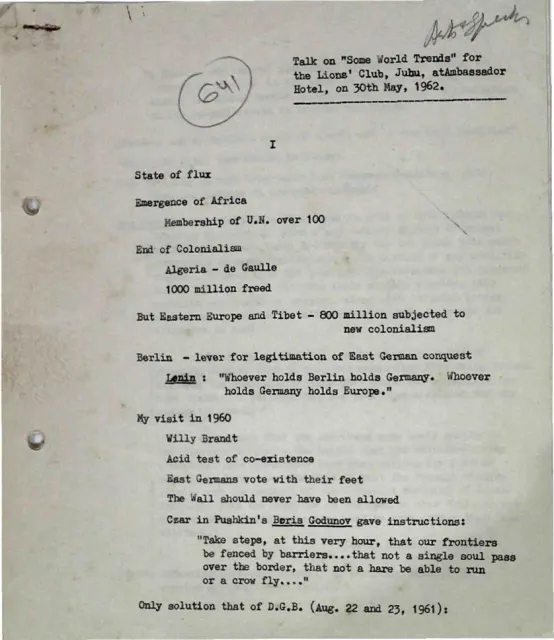 Primary workTalk on \"Some World Trends\" for the Lions' Club, Juhu, at Ambassador Hotel, on 30th May, 1962.
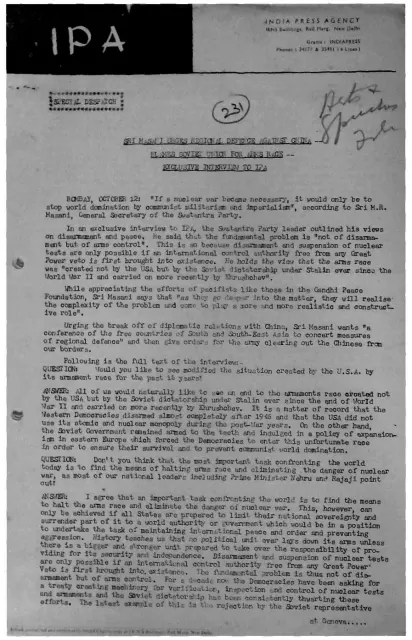 Primary workSRI M.R. MASANI URGES REGIONAL DEFENCE AGAINST CHINA
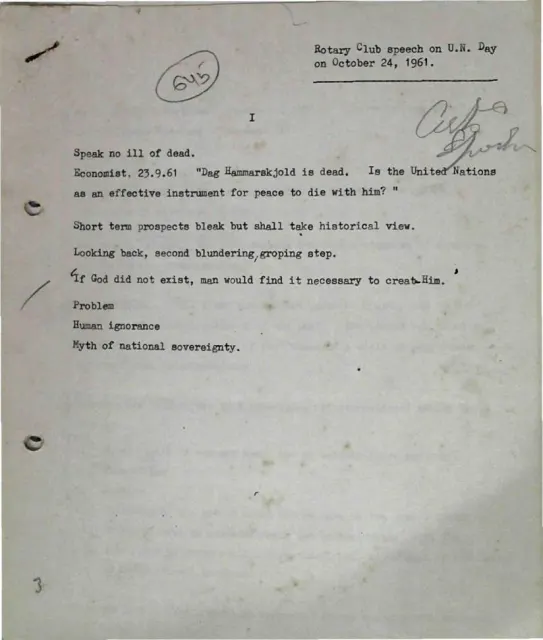 Primary workRotary Club speech on U.N. Day on October 24, 1961.
 OpinionRajaji's Views on Nuclear Bomb
 ExcerptFreedom and Economic Freedom - Bibek Debroy, 2008