speech · convention address
Inaugural Address
By Minoo Masani
SWATANTRA PARTY · Madras · 1973
26 pages
Summary
In this inaugural address to the Swatantra Party’s Sixth National Convention, M. R. Masani reviews the political, constitutional, economic, and foreign-policy developments since the 1968 Bhubaneswar convention. He criticises Indira Gandhi’s consolidation of power, the Opposition’s failure to form an effective alternative government, the distortion produced by India’s first-past-the-post electoral system, and the 24th and 25th Constitutional Amendments. He presents restrictions on the press, cinema, books, travel, academic institutions, minority rights, and trade unions as mounting threats to a free society, alongside what he describes as a serious decline in public morality and political integrity.
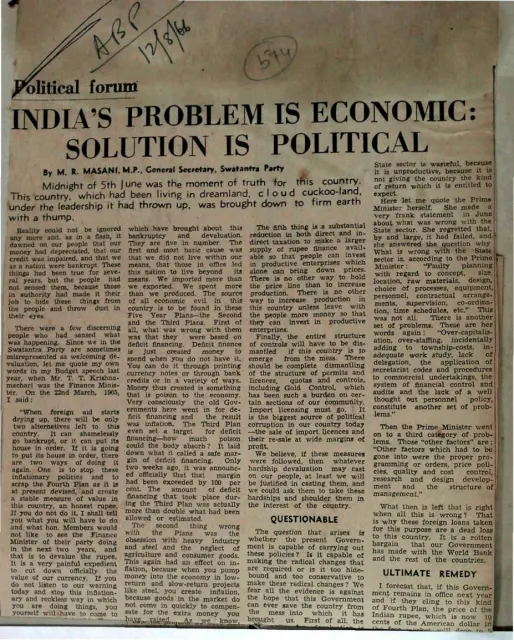
The address then argues that socialist economic policy has produced unemployment, inflation, shortages, inefficient public enterprises, and agricultural stagnation. Masani attacks heavy-industry-led planning, state monopolies, land-ceiling policies, and the expansion of collective and state farming, while invoking Soviet criticism of excessive concentration in heavy industry and the experience of better-managed Asian economies. In foreign affairs, he condemns India’s growing dependence on the Soviet Union and resulting isolation in South-East Asia. The closing sections reject political fatalism and outline an alternative programme centred on lower taxation, monetary stability, labour-intensive development, an end to further nationalisation, competition, reduced controls, and population policy. The address ends by calling for a pragmatic, middle-of-the-road government and renewed civic effort rather than resignation.
Key points
- Masani surveys the period since the 1968 Bhubaneswar convention and attributes India’s political crisis to Congress centralisation and Opposition disunity.
- He argues that the 1971 election gave the ruling Congress a highly inflated parliamentary majority despite receiving only just over 43% of the popular vote and less than 24% of the total electorate’s vote.
- The address identifies threats to press, cultural, academic, minority, and trade-union freedoms, warning that constitutional amendments could legalise despotism.
- Masani links population growth, unemployment, inflation, shortages, deficit financing, and public-sector waste to socialist economic policy and central planning.
- He opposes land ceilings, collective farming, and government monopolies in foodgrain and other consumer-goods trade, defending private producers and dealers.
- He contends that India’s Soviet alignment has damaged its independence, distorted foreign trade, encouraged domestic communist influence, and isolated the country in South-East Asia.
- His proposed alternative includes tax and expenditure cuts, monetary stabilisation, labour-intensive investment, competition, fewer controls, an end to new nationalisations, and more serious population policy.
- Despite his bleak diagnosis, Masani argues that rising public expectations and historical change leave room for a pragmatic democratic alternative.
Metadata and summary are AI-extracted from the source PDF and reviewed for editorial accuracy. The original work is available via the Read PDF tab above (where present); paragraph-level citation inside the PDF is deferred to a future engagement.