Summary
In this inaugural address to the Swatantra Party’s Sixth National Convention in Madras in April 1973, M. R. Masani reviews the political developments since the 1968 Bhubaneswar convention and argues that the Congress government has used an inflated parliamentary majority to weaken constitutional protections, centralise authority, and erode democratic standards. He criticises the breakdown of opposition cooperation, the dissolution of the Lok Sabha, restrictions affecting the press, films, books, travel, universities, minorities, and trade unions, and what he describes as a broader decline in public morality and political integrity.
Masani links these political failures to economic regression. He attacks population growth, unemployment, inflation, shortages, deficit financing, state monopolies, nationalisation, excessive planning, public-sector losses, land-ceiling legislation, and the collectivist direction of agricultural policy. He also warns that India’s 1971 defence treaty with the Soviet Union has compromised its non-aligned position and contributed to diplomatic isolation in South-East Asia. Despite this bleak diagnosis, the address rejects fatalism: Masani sees rising public expectations and historical limits to authoritarian leadership as grounds for hope. He calls for a principled, peaceful, programmatic opposition and presents the Swatantra Party as a possible vehicle for restoring pluralist democracy and pragmatic economic policy.
Key points
- Masani situates the address in the political crisis following the Congress split, opposition fragmentation, and the 1971 general election.
- He argues that the ruling Congress converted a minority share of the popular vote into a disproportionate parliamentary majority through India’s electoral system.
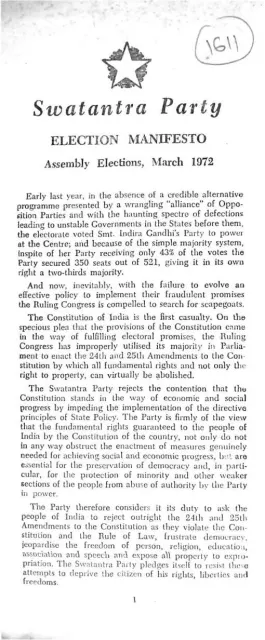
- The address presents constitutional amendments, centralisation, and restrictions on the press, education, books, films, travel, and trade unions as threats to freedom.
- Masani attributes economic deterioration to inflationary finance, excessive state ownership, planning errors, shortages, unemployment, and counterproductive regulation.
- He criticises land ceilings and proposed collective or state farming as threats to agricultural incentives and private ownership.
- He argues that India’s close alignment with the Soviet Union has damaged its international independence and isolated it in South-East Asia.
- The proposed opposition should be principled, peaceful, administratively credible, and committed to positive policies rather than merely anti-Congress slogans.
- The address concludes that India’s crisis is serious but reversible if citizens and political organisations redouble their efforts.
Metadata and summary are AI-extracted from the source PDF and reviewed for editorial accuracy. The original work is available via the Read PDF tab above (where present); paragraph-level citation inside the PDF is deferred to a future engagement.