essay · report
Extracts from the official hand-out on the proceedings of the A.I.C.C. Planning Seminar at Ooty
Ooty · 1959
1 pages
Summary
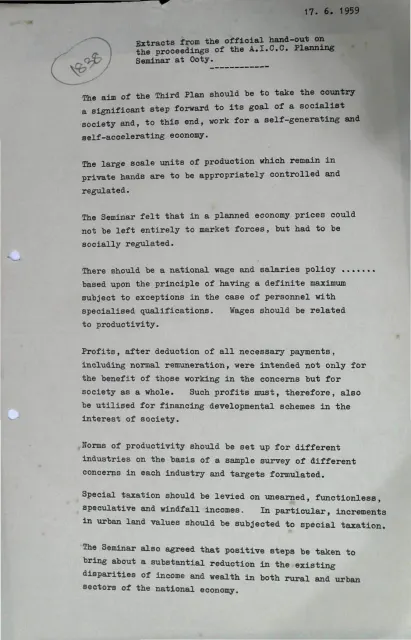
This one-page extract from the official hand-out of the A.I.C.C. Planning Seminar at Ooty, dated 17 June 1959, sets out policy positions for India’s Third Plan. It presents planning as a means of advancing toward a socialist society through a “self-generating and self-accelerating economy,” while retaining large-scale private production under public control and regulation. Prices in a planned economy, the extract states, should not be left entirely to market forces but should be socially regulated.
The hand-out also advocates a national wage and salaries policy with a defined maximum, wage levels linked to productivity, and productivity norms based on industry-wide surveys. It treats profits as having a social as well as a private purpose, including the financing of developmental schemes. The proposals further include special taxation of unearned, speculative, and windfall incomes—especially increases in urban land values—and positive measures to reduce rural and urban disparities in income and wealth.
Key points
- The Third Plan is framed as a step toward a socialist society and a self-generating economy.
- Large-scale private production is to remain under appropriate public control and regulation.
- Prices in a planned economy should be socially regulated rather than determined entirely by market forces.
- A national wage and salaries policy should establish a definite maximum, with exceptions for specialised qualifications.
- Wages should be related to productivity, supported by industry-specific productivity norms and targets.
- Profits should contribute to social development by financing developmental schemes.
- Unearned, speculative, and windfall incomes—including urban land-value increments—should face special taxation.
- The seminar called for reducing income and wealth disparities in both rural and urban areas.
Metadata and summary are AI-extracted from the source PDF and reviewed for editorial accuracy. The original work is available via the Read PDF tab above (where present); paragraph-level citation inside the PDF is deferred to a future engagement.