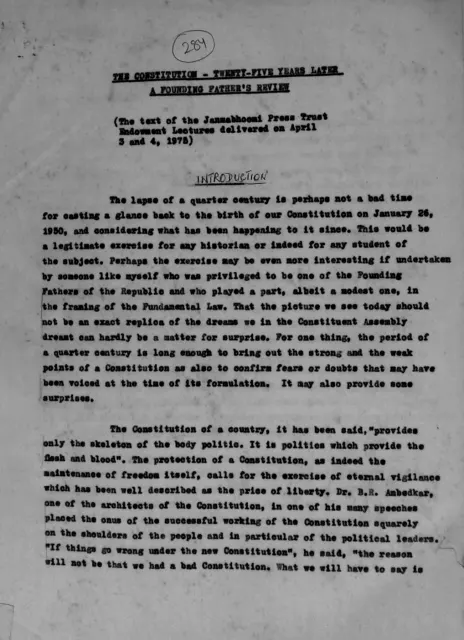
speech
The Constitution
Twenty-five Years Later
By Minoo Masani
Department of Publications and Extension Lectures, BANGALORE UNIVERSITY, BANGALORE 560056 · Bangalore · 1975
64 pages
Summary
In the rendered pages, M. R. Masani uses the Constitution’s twenty-fifth anniversary to assess how India’s constitutional arrangements have operated since 1950. In the rendered pages, he stresses that constitutional success depends not only on institutional design but also on the political conventions, administrative conduct, and personal integrity of those who operate the system. He rejects the view that the Constitution has become fundamentally obsolete and argues instead for restoring its original balance through better conventions and more faithful practice.
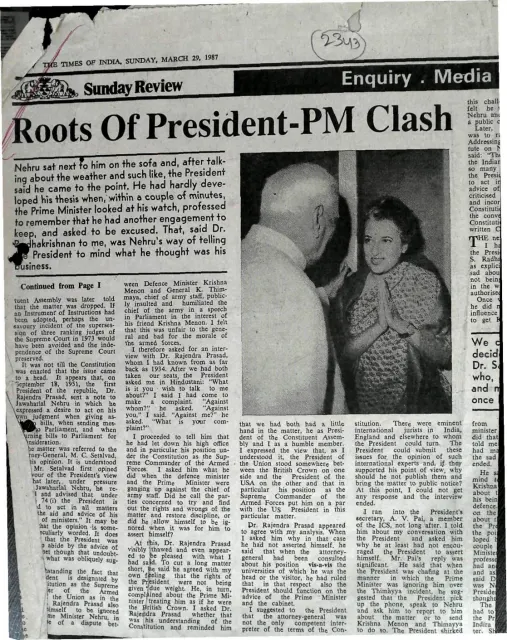
In the rendered pages, Masani concentrates first on federalism and States’ rights, electoral reform, and the position of the President and Governors. In the rendered pages, he criticises the growth of central control over industry, planning, broadcasting, and financial resources, linking that centralisation to weakened State autonomy and democratic accountability. In the rendered pages, he advocates genuine consultation with the States, a more predictable allocation of resources, an independent and advisory Planning Commission, and Governors who function as heads of their States rather than as agents of the Union. The discussion then turns to presidential discretion, cabinet responsibility, constitutional conventions, and examples involving President Rajendra Prasad, Prime Minister Nehru, and the 1967 presidential election.
Key points
- Masani presents the twenty-fifth anniversary as an opportunity to compare the Constitution’s founding intentions with its operation since 1950.
- He argues that constitutional performance depends substantially on the character and conduct of political leaders and administrators.
- He opposes excessive amendment and favours recovering the Constitution’s original balance through appropriate conventions and respect for its spirit.
- He contends that centralisation has eroded federalism by expanding Union control over industry, planning, broadcasting, and financial assistance.
- He recommends stronger State participation, predictable resource transfers, regional and multi-tier planning, and an independent advisory Planning Commission.
- He argues that Governors should act as heads of their States, not as agents of the President or the Union Government.
- He examines the President’s relationship with the Council of Ministers and uses constitutional text and political episodes to discuss presidential discretion.
- He defends parliamentary democracy while arguing that the President need not be reduced to a purely ceremonial or rubber-stamp office.
Metadata and summary are AI-extracted from the source PDF and reviewed for editorial accuracy. The original work is available via the Read PDF tab above (where present); paragraph-level citation inside the PDF is deferred to a future engagement.