speech
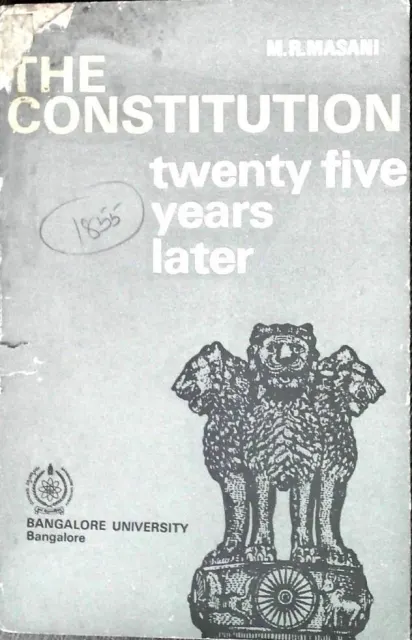
THE CONSTITUTION - TWENTY-FIVE YEARS LATER
A FOUNDERING FATHER'S REVIEW
1975
27 pages
Summary
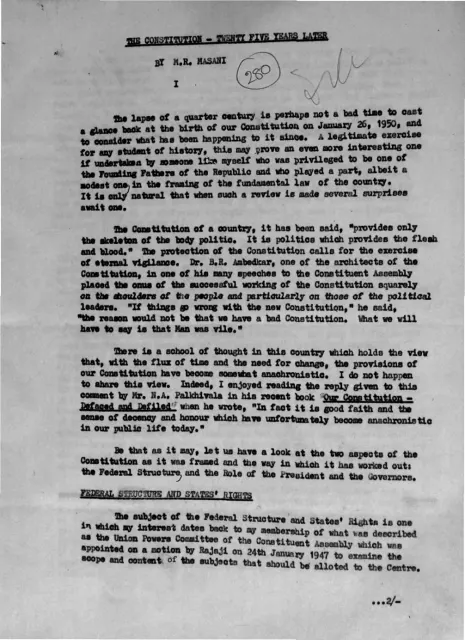
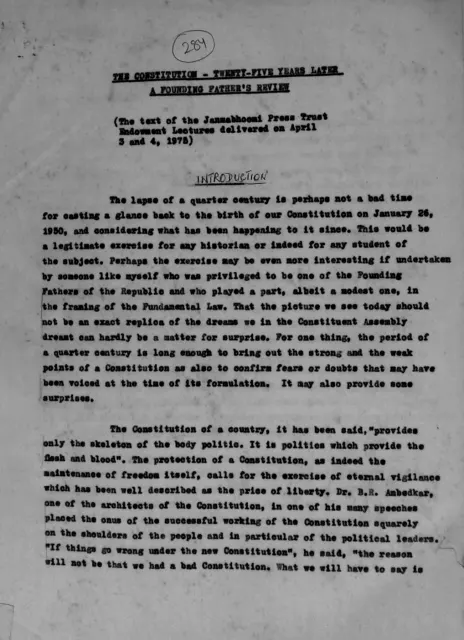
The visible pages present the Janashakti Press Trust Endowment Lectures delivered on April 3 and 4, 1975, as a retrospective examination of the Indian Constitution after twenty-five years. The speaker argues that constitutional success depends less on the text alone than on the people and political conventions through which it is administered. The opening rejects the view that the Constitution has become obsolete and instead calls for a return to its original spirit, vigilance in defence of liberty, and restraint in the use of constitutional powers.
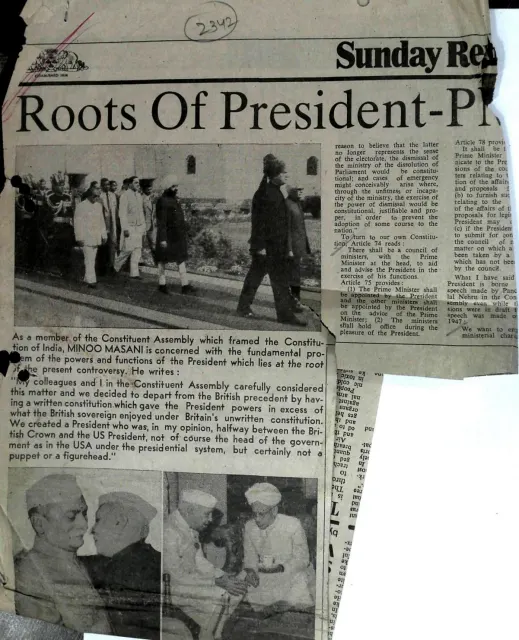
The discussion focuses especially on federalism, the distribution of legislative powers, planning, the relationship between the Union and the States, and the roles of the President and Governors. The speaker contends that socialist planning and the expansion of Union control over industry have weakened State autonomy, while arguing that strong Union and State governments should reinforce rather than undermine one another. The later pages examine presidential discretion, the dismissal of governments, the dissolution of legislatures, prolonged Emergency powers, and the need for an independent President who acts as a constitutional check rather than a ceremonial “rubber stamp.” The rendered sequence ends during the discussion of dismissal powers; the final seven PDF pages were not available.
Key points
- The Constitution should be judged through twenty-five years of political practice, not solely by its wording.
- Constitutional government requires honest administrators, vigilant citizens, and respect for both the letter and spirit of the Constitution.
- The speaker criticizes the centralization of legislative and economic authority through planning and the transfer of industries from the State List to the Union List.
- Federalism is presented as essential to preserving India’s plural society, while regional alienation must be addressed through consultation and sympathy.
- The President and Governors possess constitutional dignity and responsibility, but their powers must be exercised within a parliamentary framework.
- The speaker argues for objective, rule-bound financial transfers to the States and a more independent, advisory Planning Commission.
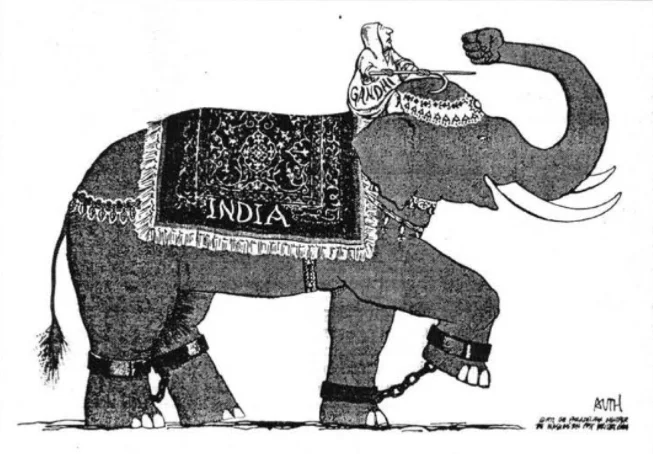
- The prolonged use of Emergency powers and executive ordinances is treated as a serious threat to civil liberties and constitutional accountability.
- Political plurality and the existence of State governments led by parties different from the Union are described as necessary conditions for a functioning federal system.
Metadata and summary are AI-extracted from the source PDF and reviewed for editorial accuracy. The original work is available via the Read PDF tab above (where present); paragraph-level citation inside the PDF is deferred to a future engagement.