Summary
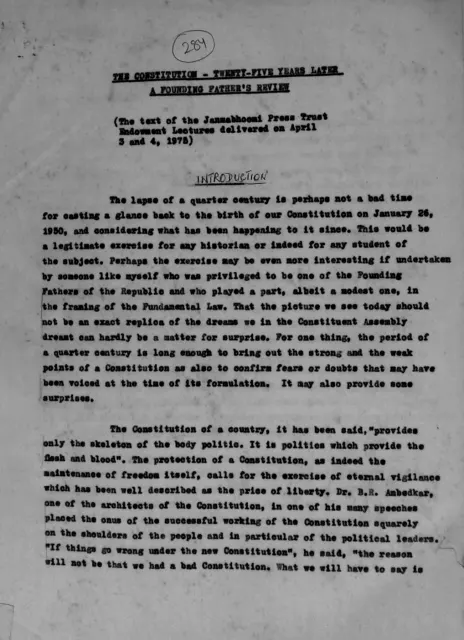
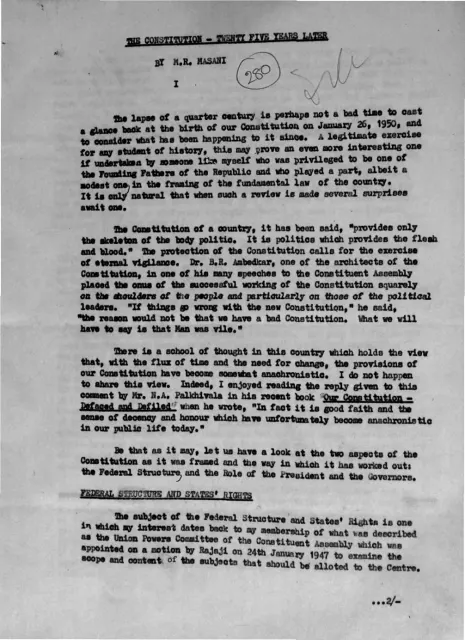
In the rendered pages, M. R. Masani reviews the Indian Constitution twenty-five years after its commencement, arguing that the document itself is less responsible for political failures than the way governments and parties have used it. He rejects the claim that constitutional provisions have simply become obsolete, citing N. A. Palkhivala’s view that what has become “anachronistic” is the good faith and decency of public life. The essay focuses first on federalism and states’ rights, then turns to the constitutional roles of the President and Governors.
In the rendered pages, Masani contends that planning, industrial regulation, the expansion of Union ministries, and the centralisation of broadcasting have weakened the States’ autonomy. He argues that India’s diversity requires genuine federalism, consultation, predictable financial transfers, and autonomous broadcasting institutions. The later discussion maintains that a “strong Centre” should not mean an all-powerful government, and that one-party dominance has damaged both democracy and the federal system. In the rendered pages, Masani also criticises presidential deference to ministerial advice, the use of ordinances, and the continuation of emergency powers after the conditions justifying them have disappeared, concluding that constitutional conventions and political pluralism are needed more than formal amendment.
Key points
- Masani distinguishes defects in the Constitution from failures of political conduct and constitutional conventions.
- He argues that planning and industrial regulation have shifted practical authority from the States to the Union.
- The expansion of Union ministries into primarily State subjects is presented as an inefficient and centralising development.
- Masani links India’s regional, linguistic, religious, and cultural diversity to the need for stronger federal safeguards.
- He argues that State autonomy and an effective Union are mutually supportive rather than opposed.
- One-party dominance is identified as a major cause of the erosion of States’ rights and federal accountability.
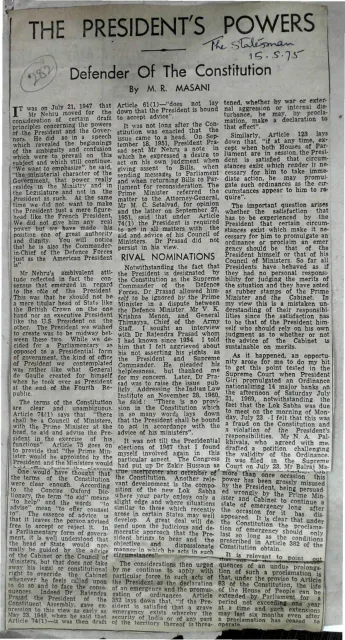
- The President should exercise independent constitutional judgment rather than act as a rubber stamp for the Prime Minister and Cabinet.
- The continuation of emergency powers and the use of ordinances are criticised as threats to parliamentary government.
Metadata and summary are AI-extracted from the source PDF and reviewed for editorial accuracy. The original work is available via the Read PDF tab above (where present); paragraph-level citation inside the PDF is deferred to a future engagement.