
office record · report
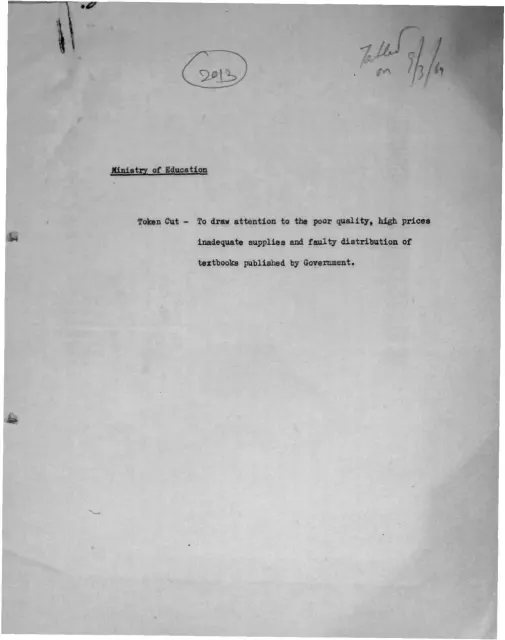
Ministry of Education
9 pages
Summary
This nine-page, untitled English-language office-paper compilation presents short “Token Cut” notices criticising government performance. The visible notices from the Ministry of Education focus on the poor quality, high prices, inadequate supplies, and faulty distribution of government-published textbooks, as well as the widespread circulation of counterfeit and spurious textbooks. A further notice from the Ministry of Information & Broadcasting criticises the failure to develop television for the education and entertainment of the Indian people.
The final pages record Professor Ranga’s explanation, on behalf of the Swatantra Party, of the party’s position on an anti-corruption initiative associated with the Home Minister. The statement accepts that citizen vigilance can help combat corruption but identifies shortages and administrative control over scarce resources through permits, licences, and quotas as its main causes. It argues that discrimination exercised by officials is a central source of corruption, while maintaining that vigilance should remain a voluntary, non-party activity. The packet contains duplicate typescript or carbon-copy pages and handwritten editorial alterations; no printed title, author, date, publisher, or formal sequence is visible.
Key points
- Ministry of Education notices criticise the quality, prices, supply, and distribution of government-published textbooks.
- The compilation calls attention to the widespread circulation of counterfeit and spurious textbooks.
- A Ministry of Information & Broadcasting notice criticises the failure to develop television for education and entertainment.
- Professor Ranga presents the Swatantra Party’s view that shortages and administrative allocation systems foster corruption.
- Permits, licences, and quotas are identified as mechanisms through which official control over scarce resources produces corruption.
- The statement argues that anti-corruption vigilance should be undertaken voluntarily by individual citizens rather than by political parties.
- The pages include duplicate office copies and handwritten revisions, and provide no printed title, author, date, or publisher.
Metadata and summary are AI-extracted from the source PDF and reviewed for editorial accuracy. The original work is available via the Read PDF tab above (where present); paragraph-level citation inside the PDF is deferred to a future engagement.
Related across the archive
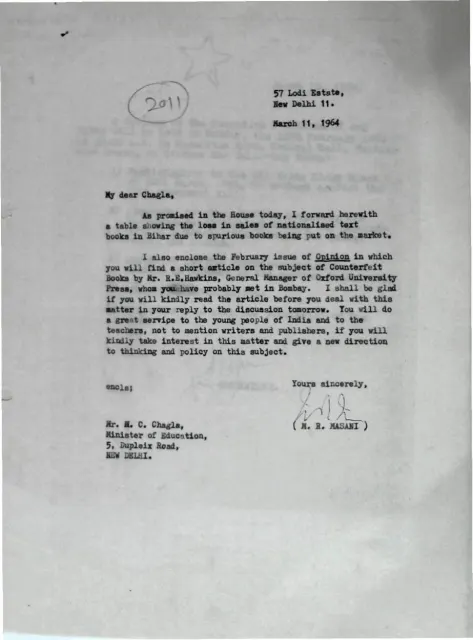 Primary workLetter from Mr Minoo Masani
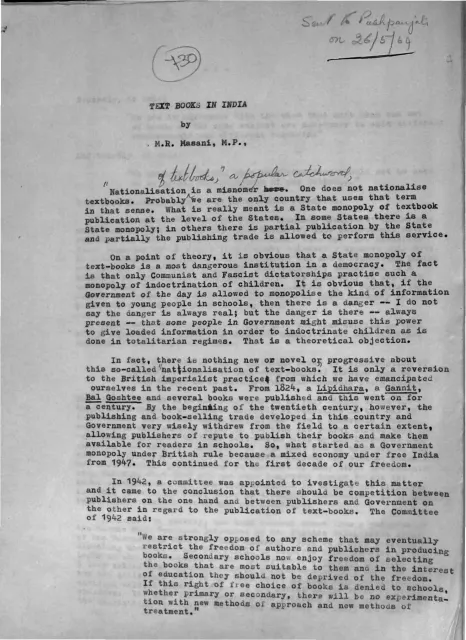 Primary workTEXT BOOKS IN INDIA
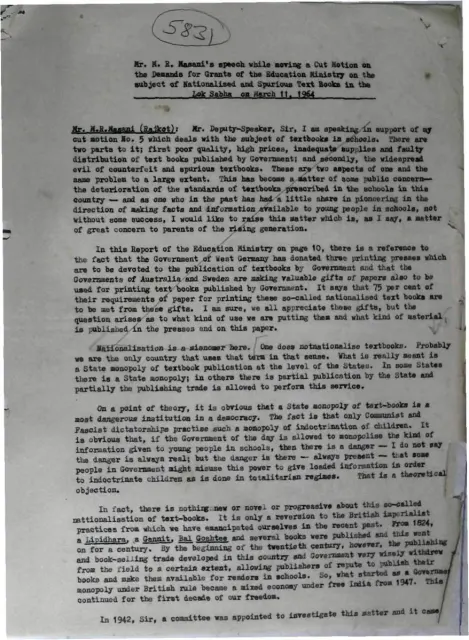 Primary workMr. K. R. Masani's speech while moving a Cut Motion on the Demands for Grants of the Education Ministry on the subject of Nationalised and Spurious Text Books in the Lok Sabha on March 11, 1964
 ExcerptStatement of the Principles of Swatantra Party
 ExcerptAccountability in Public Service