
Summary
In this six-page pamphlet, M. R. Masani argues that the “nationalisation” of school textbooks is in fact a State monopoly over textbook publication, and that such a monopoly is dangerous in a democracy because it gives governments control over the information supplied to children. He presents the policy as neither novel nor progressive, but as a return to a practice associated with British rule, and contrasts it with the earlier availability of books from reputable private publishers. The pamphlet cites the 1942 committee on textbooks, which recommended competition between government and private publishers and warned that education should not become an instrument of propaganda.
Masani then contends that State textbook monopolies have produced poor-quality books, high prices, profiteering, and chronic failures of distribution. He links these failures to the growth of counterfeit and pirated textbooks, citing reports of losses to State governments and concentrating especially on Bihar. The proposed remedy is not simply stronger criminal law but the ending of the State monopoly: private publishers should be allowed to compete, while government publications should remain available alongside privately produced books. The pamphlet closes by arguing that monopoly textbook policy and the problem of spurious textbooks are connected parts of the same institutional failure.
Key points
- Masani characterises textbook “nationalisation” as a State monopoly rather than genuine nationalisation.
- He argues that government control over textbooks creates a risk of political indoctrination in schools.
- The pamphlet invokes the 1942 committee’s support for competition, multiple textbooks, and freedom from propaganda.
- State-produced textbooks are criticised for poor quality, high prices, profiteering, and inadequate distribution.
- The text presents textbook piracy as a consequence of monopoly pricing, poor availability, and weak commercial incentives.
- Bihar is presented as a particularly serious case, with reported shortfalls in sales and substantial losses to the government.
- Masani recommends opening textbook publishing to private competition while maintaining minimum standards.
Metadata and summary are AI-extracted from the source PDF and reviewed for editorial accuracy. The original work is available via the Read PDF tab above (where present); paragraph-level citation inside the PDF is deferred to a future engagement.
People in this work
Related across the archive
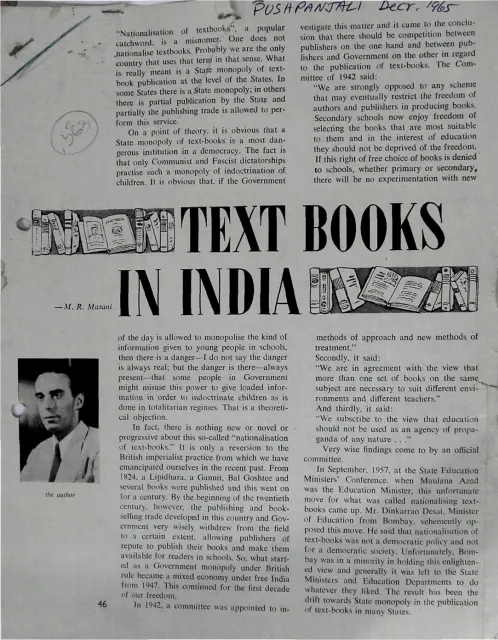 Primary workTEXT BOOKS IN INDIA
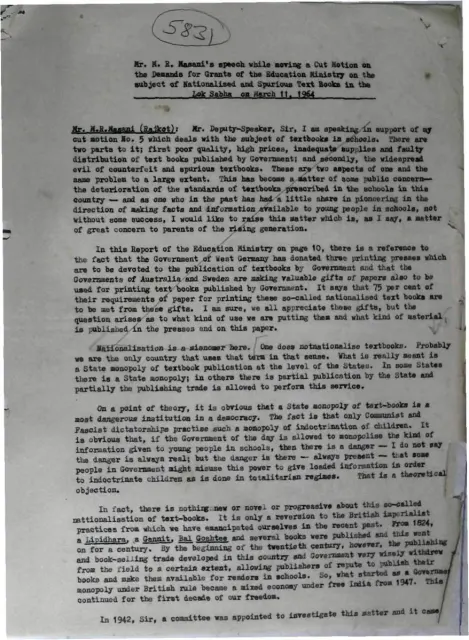 Primary workMr. K. R. Masani's speech while moving a Cut Motion on the Demands for Grants of the Education Ministry on the subject of Nationalised and Spurious Text Books in the Lok Sabha on March 11, 1964
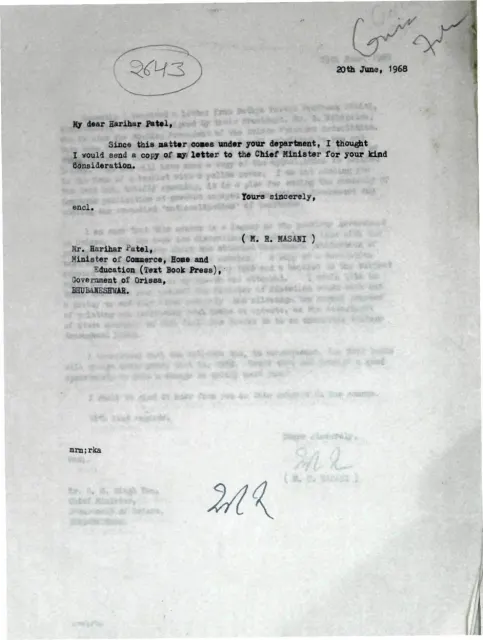 Primary workLetter to Mr Harihar Patel
 ExcerptEconomic Reforms In India: Where Are We And Where Do We Go?
 ExcerptDemocracy in India