
Summary
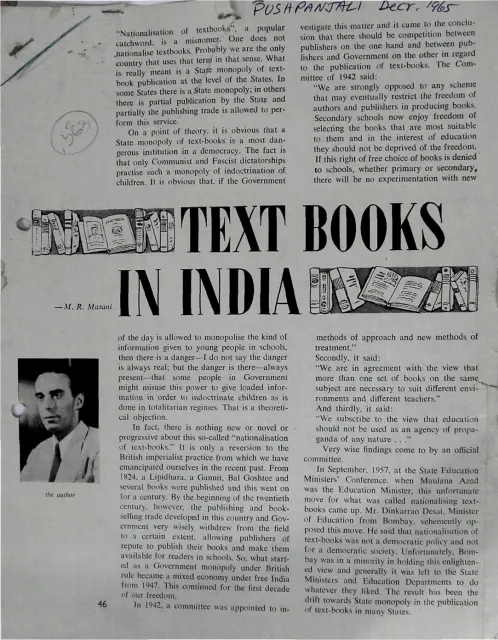
In the rendered pages, M. R. Masani argues that “nationalisation of textbooks” is a misleading label for State monopolies over textbook publication. He presents such monopolies as dangerous in a democracy because they can restrict authors, publishers, school choice, and experimentation, while creating the possibility of government-controlled indoctrination. He also traces the policy to British imperial practice, contrasting it with the later development of a mixed system in which private publishers supplied books alongside government publications.
In the rendered pages, Masani supports his case with committee warnings, court observations, press commentary, and examples from several Indian states. He claims that State-produced textbooks are often poor in quality, expensive, late, unavailable, and vulnerable to profiteering and counterfeiting. The Bihar example is used to show how shortages and high prices encouraged piracy, allegedly costing the government about Rs. 35 lakhs annually. Masani’s proposed remedy is competition: State publications should compete with private publishers, while the central Education Ministry should ensure that both remain available and that minimum standards are maintained. The final page also contains an adjacent “On Books” quotation section and an illustration, which are not part of the essay’s argument.
Key points
- The phrase “nationalisation of textbooks” is presented as a misnomer for State monopolies or partial State control of textbook publication.
- Masani argues that a textbook monopoly is especially dangerous in a democracy because it may enable official indoctrination and restrict intellectual choice.
- He maintains that State textbook systems reproduce aspects of British imperial publishing practice rather than representing a new or progressive policy.
- Committee findings and judicial and newspaper commentary are cited as warnings against monopoly, poor quality, restricted choice, and regimentation of thought.
- The rendered pages claim that State textbooks are frequently costly, badly written, unavailable on time, and effectively financed through disguised fees or profiteering.
- Counterfeiting is attributed to high prices, shortages, weak distribution, poor-quality originals, and unfavorable terms offered to the book trade.
- Masani recommends ending the monopoly and opening textbook publication to private competition, with government oversight limited to maintaining standards and access.
Metadata and summary are AI-extracted from the source PDF and reviewed for editorial accuracy. The original work is available via the Read PDF tab above (where present); paragraph-level citation inside the PDF is deferred to a future engagement.
People in this work
Related across the archive
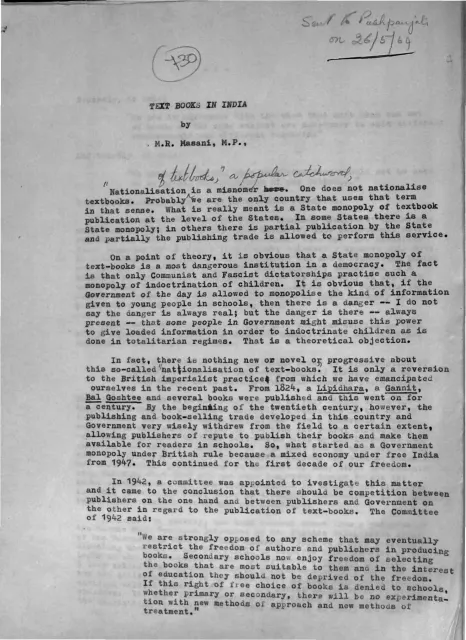 Primary workTEXT BOOKS IN INDIA
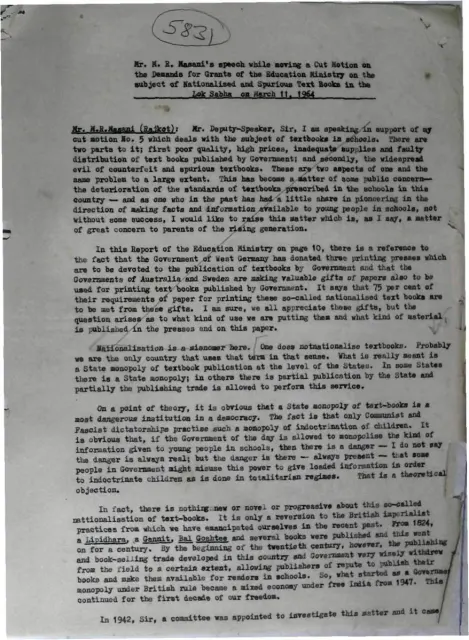 Primary workMr. K. R. Masani's speech while moving a Cut Motion on the Demands for Grants of the Education Ministry on the subject of Nationalised and Spurious Text Books in the Lok Sabha on March 11, 1964
 Primary workSTATE MONOPOLY OF TEXT-BOOKS
 ExcerptSTATE MONOPOLIES AND THE CITIZEN IN A DEMOCRACY
 ExcerptManifesto for Indian Liberals