speech · parliamentary
Mr. K. R. Masani's speech while moving a Cut Motion on the Demands for Grants of the Education Ministry on the subject of Nationalised and Spurious Text Books in the Lok Sabha on March 11, 1964
By Minoo Masani
1964
7 pages
Summary
In this Lok Sabha speech of 11 March 1964, Minoo Masani moves a cut motion on the Education Ministry’s demands for grants, focusing on two connected problems: the poor quality, high cost, and inadequate distribution of government-issued school textbooks, and the spread of counterfeit and spurious editions. He argues that “nationalisation” is misleading shorthand for state monopolies over textbook publication and warns that controlling the information supplied to children creates a danger of official indoctrination. Drawing on the 1942 committee’s recommendations and subsequent official warnings, he advocates competition among private publishers and between private publishers and government presses.
Masani then presents evidence from court judgments, newspapers, and committee reports concerning badly written or printed books, faulty grammar, inaccurate content, and textbook shortages. He claims that state monopolies encourage piracy because official books are expensive, unavailable on time, and distributed through trade arrangements that give booksellers weaker incentives than private publishers do. He cites losses to Bihar and other states from pirated editions, explains how photographic and letterpress counterfeiting reproduce or worsen defects, and concludes that legal penalties alone will not solve the problem. In the pages read, his principal remedy is to end the state monopoly, open textbook publishing to competent private firms, and preserve standards through simultaneous availability of public and private editions.
Key points
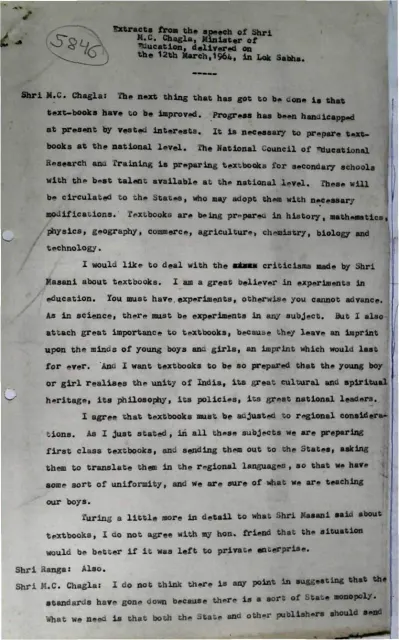
- Masani identifies textbook quality, price, supply, distribution, and counterfeiting as linked failures in educational administration.
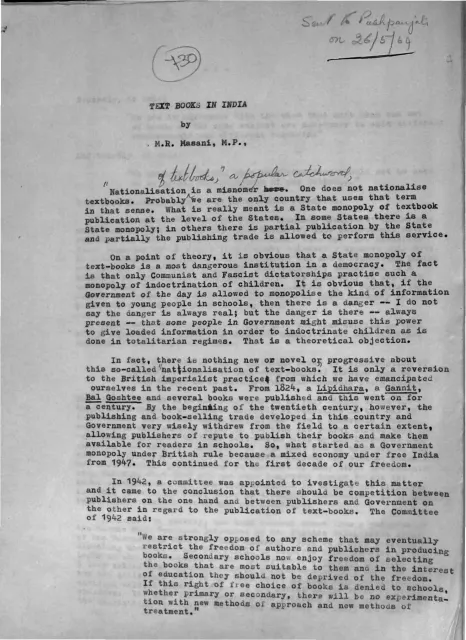
- He distinguishes textbook publication monopolies at the state level from the misleading language of “nationalisation.”
- He argues that monopolised textbook systems are institutionally dangerous because governments control the information given to schoolchildren.
- He invokes the 1942 committee’s support for authorial and publisher freedom, multiple books on the same subject, and non-propagandist education.
- He reports examples of poor editing, printing, grammar, factual content, and availability in books approved by state authorities.
- He attributes textbook piracy to high official prices, delayed or inadequate supply, and unfavourable margins and credit terms for booksellers.
- He proposes ending state monopoly and allowing competition while retaining educational standards and using stronger legal provisions only as a supplementary remedy.
Metadata and summary are AI-extracted from the source PDF and reviewed for editorial accuracy. The original work is available via the Read PDF tab above (where present); paragraph-level citation inside the PDF is deferred to a future engagement.