
speech
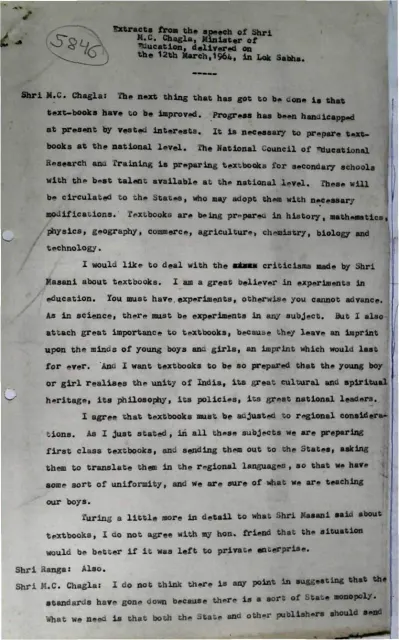
Extracts from the speech of Shri M.C. Chagla, Minister of Education, delivered on the 12th March, 1964, in Lok Sabha.
1964
3 pages
Summary
This three-page extract from M. C. Chagla’s 12 March 1964 Lok Sabha speech addresses the production, quality, price, and regulation of educational textbooks. Chagla argues for nationally coordinated textbook preparation through the National Council of Educational Research and Training, while allowing regional adaptation and translation into regional languages. He presents textbooks as formative instruments that should communicate India’s unity, cultural and spiritual heritage, philosophy, policies, and national leadership.
Responding to M. R. Masani’s criticisms, Chagla rejects leaving textbook production entirely to private enterprise, but supports competition between State and other publishers under a proper textbook committee. He identifies specialist knowledge, experienced teachers, skilled illustrators, and high-quality printing and paper as the four conditions of a first-class textbook. The extract also describes efforts to provide cheap university reprints through cooperation with the United States, the United Kingdom, and the USSR, and measures to reduce prices through donated paper and new printing presses. Chagla concludes by supporting legal action against book piracy, including making the offence cognisable.
Key points
- Chagla calls for nationally prepared textbooks in major school subjects, circulated to States for adoption and regional modification.
- He argues that textbooks leave a lasting imprint on young minds and should convey India’s unity and cultural and spiritual heritage.
- He supports regional-language translation and some regional adjustment while maintaining educational uniformity.
- He rejects the claim that textbook production should be left wholly to private enterprise, but endorses competition among publishers.
- He identifies specialist subject knowledge, experienced teachers, illustrators, and quality printing and paper as essential to good textbooks.
- The government is pursuing inexpensive university reprints through international cooperation and is expanding printing capacity.
- Chagla treats high prices and piracy as connected problems and advocates legal measures against pirated editions.
Metadata and summary are AI-extracted from the source PDF and reviewed for editorial accuracy. The original work is available via the Read PDF tab above (where present); paragraph-level citation inside the PDF is deferred to a future engagement.
Related across the archive
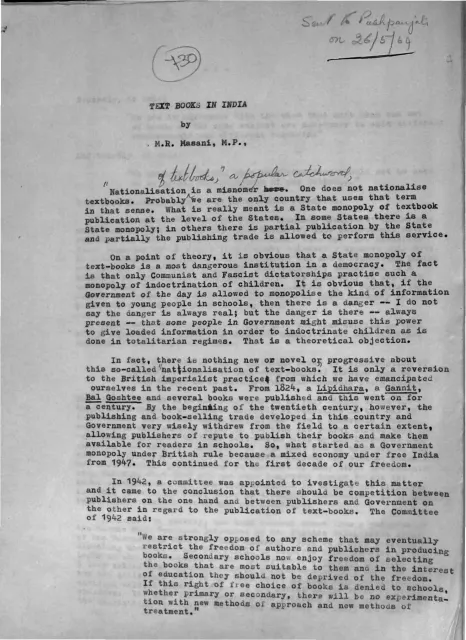 Primary workTEXT BOOKS IN INDIA
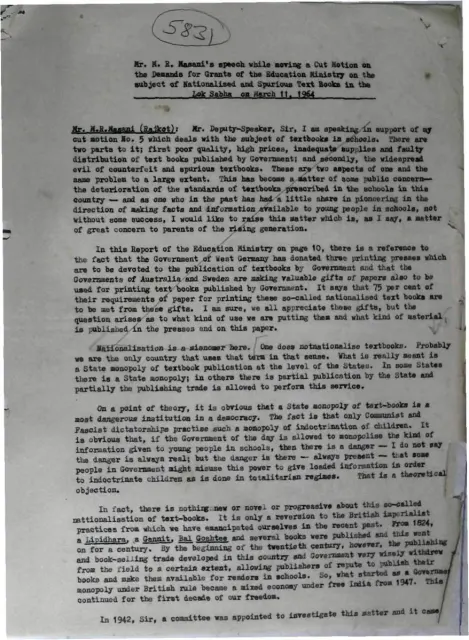 Primary workMr. K. R. Masani's speech while moving a Cut Motion on the Demands for Grants of the Education Ministry on the subject of Nationalised and Spurious Text Books in the Lok Sabha on March 11, 1964
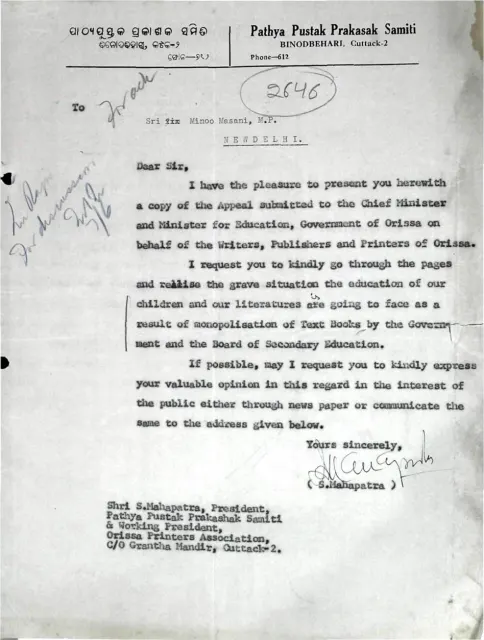 Primary workAN APPEAL
 ExcerptEconomic Reforms In India: Where Are We And Where Do We Go?
 ExcerptThe Emerging Scenario in Education