essay
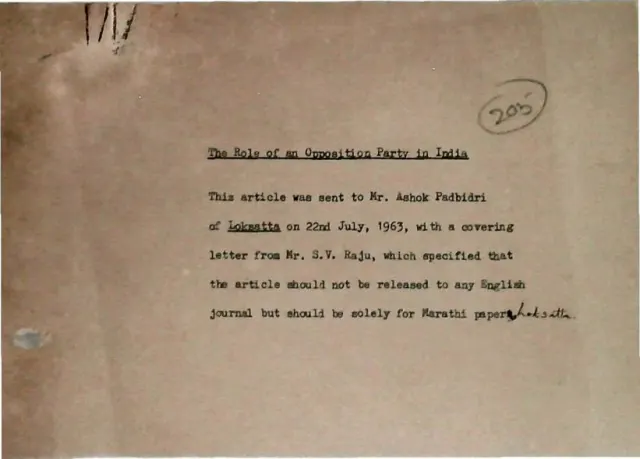
The Role of Opposition Party in India
1963
10 pages
Summary
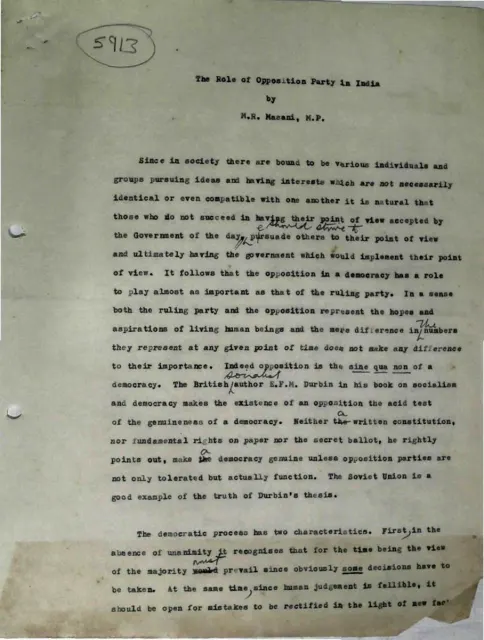
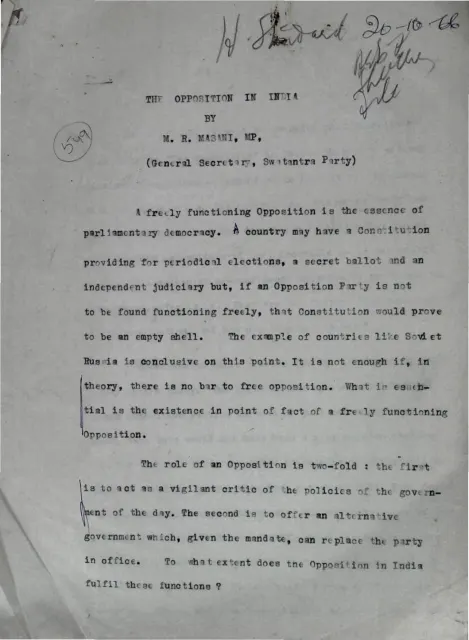
In this essay, M. R. Masani argues that an opposition is indispensable to democratic government. Because citizens and groups pursue interests that may conflict, those whose views do not prevail must be able to persuade others and eventually form a government of their own. Opposition therefore has an importance nearly equal to that of the ruling party: it represents minority hopes, tests whether democracy is genuine, scrutinizes constitutional principles, and keeps open the possibility that majority decisions can be corrected in light of new facts.
Key points
- Opposition is presented as a necessary feature of democracy, not merely a tolerated institutional presence.
- The opposition must represent minority interests while also criticizing the majority and monitoring constitutional principles.
- Masani describes the opposition’s work as partly negative and partly constructive because it identifies problems and offers alternative solutions.
- The essay argues that India had failed to develop a satisfactory two-party system.
- Masani considers a three-party arrangement more feasible while Soviet dictatorship and its alleged fifth column remain factors in Indian politics.
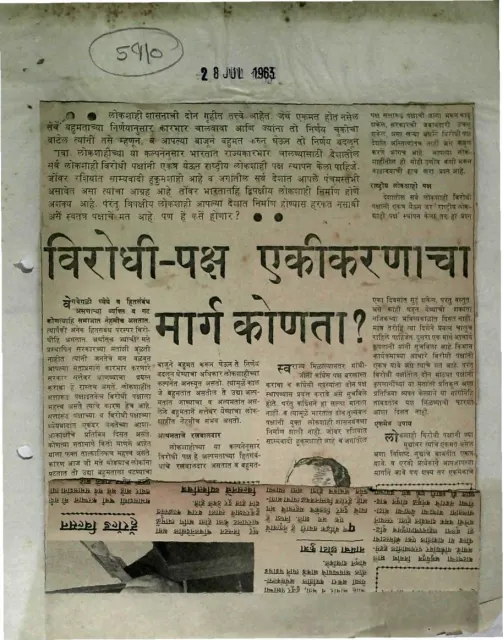
- He discusses three possible forms of democratic cooperation: a unified National Democratic Party, common functioning around a minimum programme, and issue-based cooperation among otherwise independent parties.
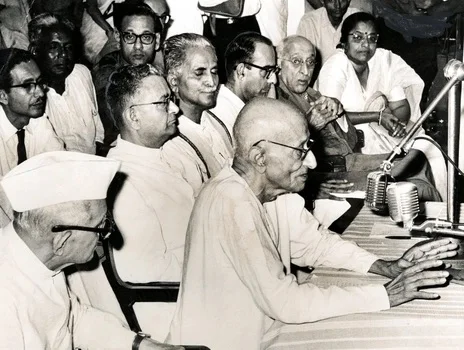
- The essay favors practical unity in action among opposition parties and links this strategy to opposition victories in by-elections at Dohad, Aroha, Farrokhabad, and Rajkot.
- It urges opposition parties to move toward a single opposition candidate against the ruling party or the Communist Party in the 1967 general election.
Metadata and summary are AI-extracted from the source PDF and reviewed for editorial accuracy. The original work is available via the Read PDF tab above (where present); paragraph-level citation inside the PDF is deferred to a future engagement.