Summary
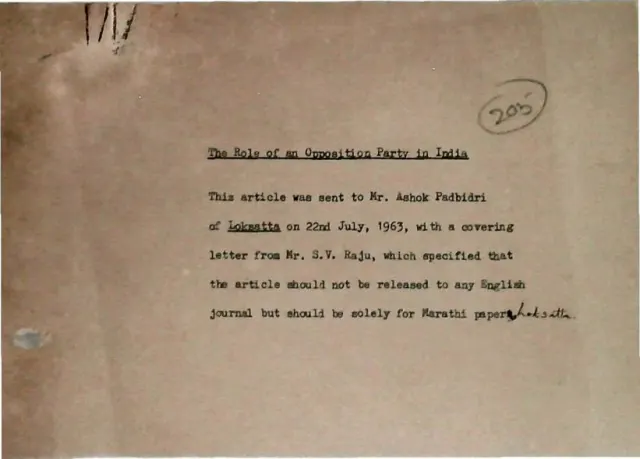
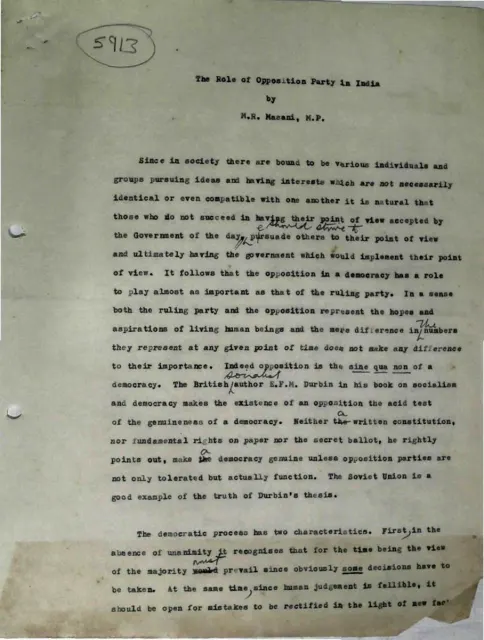
In the rendered pages, M. R. Masani argues that an effective opposition is indispensable to democratic government. Because citizens and groups hold competing interests, those who are not represented by the government of the day must be able to pursue their views and ultimately seek office. Opposition is therefore not merely a negative force: it protects minority interests, scrutinizes the majority, watches over the Constitution and the principles of a free society, draws attention to public issues, and offers alternative solutions. Masani invokes E. F. M. Durbin’s test of democratic genuineness and points to the Soviet Union as a contrasting example where opposition does not function.
Key points
- The essay presents opposition as nearly as important to democracy as the ruling party.
- An opposition party should represent minority interests while accepting that the majority governs for the time being.
- Democratic government requires openness to correcting mistakes and allowing minorities to become future majorities.
- Opposition parties act as watchdogs of the Constitution and the fundamental principles of a free society.
- Masani describes the opposition’s role as partly negative and partly constructive, including the development of alternative policies.
- The essay criticizes India’s failure to develop a satisfactory two-party system.
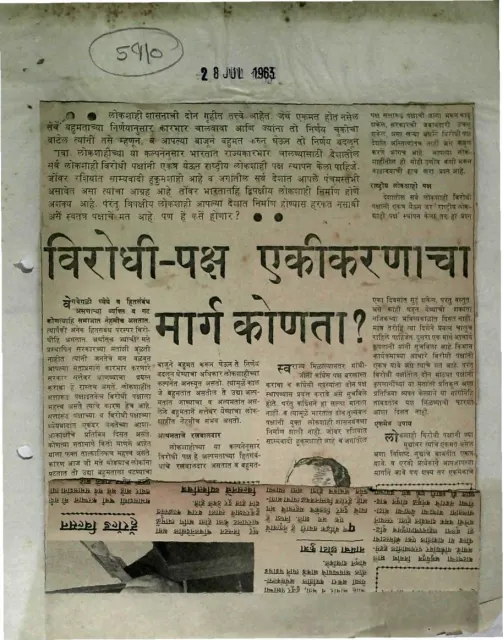
- Masani proposes democratic unity through a common national opposition, a minimum programme, or cooperation on specific issues.
- The third alternative—opposition parties working together on agreed issues while retaining their separate identities—is presented as having produced electoral successes since 1960.
Metadata and summary are AI-extracted from the source PDF and reviewed for editorial accuracy. The original work is available via the Read PDF tab above (where present); paragraph-level citation inside the PDF is deferred to a future engagement.