essay
THE CONCEPT OF THE PUBLIC GOOD
26 pages
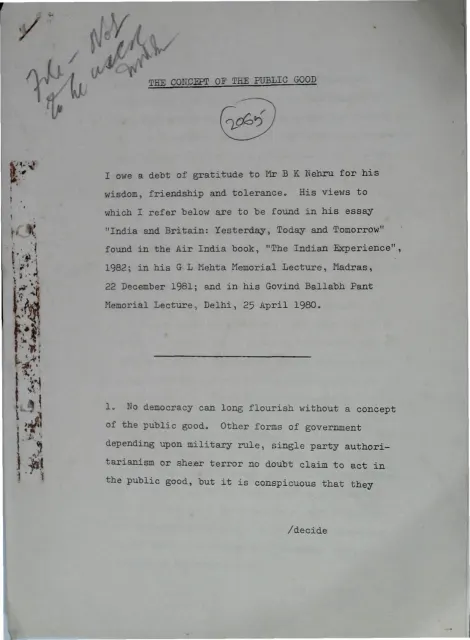
Summary
In the rendered pages, “The Concept of the Public Good” argues that democracy cannot flourish without a shared conception of the public good, while warning that democracy alone does not guarantee that governments will act for it. The concept is presented as historically variable but anchored in enduring democratic principles such as peaceful change of government, impartial law, community, competent administration, and the willingness to subordinate narrow self-interest to wider and longer-term goals. The author distinguishes this position from enforced equality or authoritarian planning, arguing that some inequality may have to be tolerated in a democracy and that public good is best sustained through service, sacrifice, and a social ethos.
Key points
- The public good is treated as a necessary condition of durable democracy, not as an automatic product of elections.
- Self-interest may generate economic improvement but can also produce conflict, ruin, and social disorder.
- The content of the public good varies across societies and historical periods, although the concept itself is more durable than any particular list of policies.
- The author proposes to compare Britain, India, and the United States, with particular attention to their interactions and constitutional arrangements.
- The discussion of India examines British rule, Hindu-Buddhist traditions of sacrifice and service, nationalism, Gandhi, and the difficulty of sustaining a common good amid hierarchy and caste.
- Constitutional mechanisms matter, but political ethos, conventions, administrative integrity, and public attitudes matter more in determining how institutions work.
- The author questions whether constitutional engineering or indirect elections can by themselves remedy corruption and selfishness in public life.
- The later discussion compares American checks and balances with Britain’s evolved conventions and considers the importance of an honest, impartial civil service.
Metadata and summary are AI-extracted from the source PDF and reviewed for editorial accuracy. The original work is available via the Read PDF tab above (where present); paragraph-level citation inside the PDF is deferred to a future engagement.