Summary
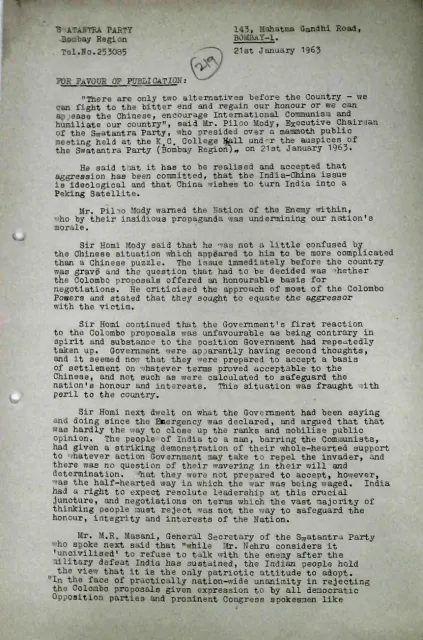
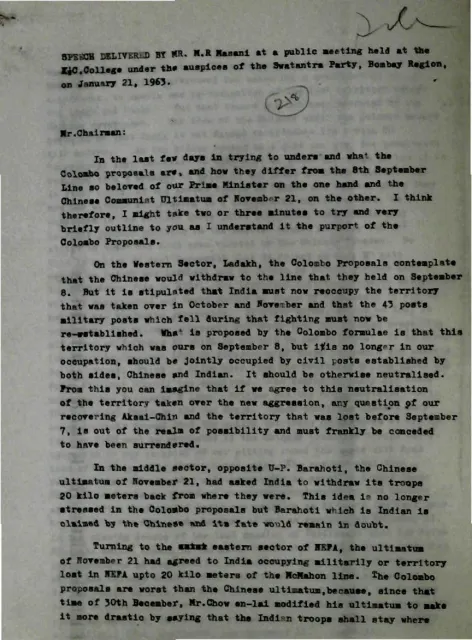
This six-page transcript records M. R. Masani’s speech at an Elphinstone College public meeting in Bombay on January 21, 1963, held under the auspices of the Swatantra Party. Masani focuses on the Colombo proposals for settling the India-China border conflict and argues that they concede too much to China. He contrasts the proposals with the Chinese ultimatum of November 21, 1962, describing the proposed neutralisation and mutual withdrawal arrangements in Ladakh, Barahoti, and NEFA as an abandonment of India’s September 8 position and of the country’s resolve to recover territory occupied by Chinese forces.
Key points
- Masani argues that the Colombo proposals would require India to accept neutralised territory and abandon claims to areas lost during the 1962 conflict.
- He treats the proposals as more damaging than the Chinese cease-fire ultimatum of November 21, particularly because they would prevent India from reoccupying lost territory in NEFA.
- He frames rejection of the proposals as a matter of national self-respect, honour, and fidelity to the unanimous Lok Sabha resolution of November 14.
- Masani rejects negotiations with China while Chinese forces retain territory seized after September 8, but leaves open the possibility of talks after India restores a more favourable balance of power.
- He warns that negotiating after military defeat would amount to accepting defeat and could reduce India to a satellite of China in Asia.
- The speech urges the Bombay meeting and Parliament to reaffirm the November 14 resolution and categorically reject the Colombo proposals.
- Masani presents the issue as both a foreign-policy dispute and a test of democratic accountability, accusing the government of reversing its publicly declared position.
Metadata and summary are AI-extracted from the source PDF and reviewed for editorial accuracy. The original work is available via the Read PDF tab above (where present); paragraph-level citation inside the PDF is deferred to a future engagement.