essay
Jana Sangh and Muslim Politics
1971
8 pages
Summary
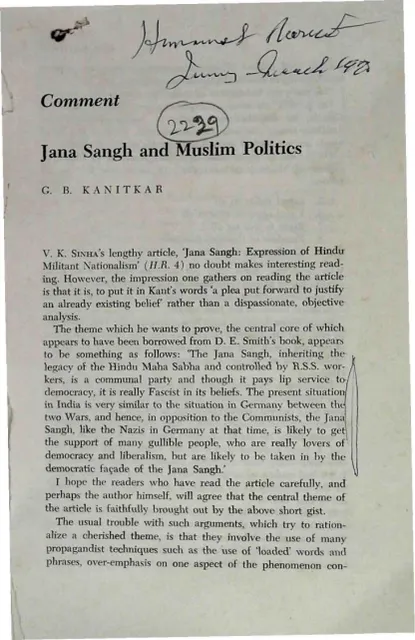
In the rendered pages, G. B. Kanitkar criticizes V. K. Sinha’s comparison of the Jana Sangh with Nazism and argues that Sinha’s article relies on a predetermined thesis, loaded language, and selective emphasis. Kanitkar points to the Jana Sangh’s stated commitments to equal rights, equal opportunities, freedom of thought, tolerance, and the right to live, as well as Dr. Shyama Prasad Mookerjee’s disagreements with the Hindu Mahasabha, to challenge the identification of the Jana Sangh with fascism. He maintains that the Jana Sangh treats the state as “important but not supreme” and that Indian political tradition contains a strong element of tolerance of dissent.
Key points
- Kanitkar argues that Sinha’s analysis of the Jana Sangh is a justification of an existing belief rather than an objective assessment.
- He criticizes Sinha’s use of loaded terms such as “tradition-haunted” and his selective treatment of Bharatiya cultural values.
- The comment emphasizes the Jana Sangh’s stated commitments to equal rights, equal opportunities, freedom of thought, tolerance, and character.
- Kanitkar distinguishes the Jana Sangh from Nazism by stressing its rejection of state worship and its doctrine of “Integral Humanism.”
- He presents Bharatiya nationalism as historically assimilative and adaptable rather than equivalent to European fascist nationalism.
- Sinha’s reply defends the comparison by arguing that nationalism can become an idol and that the Jana Sangh’s ideological logic could give the state supreme importance.
- M. R. A. Baig’s concluding comment links Hindu-Muslim communalism to reciprocal identity formation, political polarization, obscurantism, and the unresolved effects of colonial policy and Partition.
Metadata and summary are AI-extracted from the source PDF and reviewed for editorial accuracy. The original work is available via the Read PDF tab above (where present); paragraph-level citation inside the PDF is deferred to a future engagement.