essay
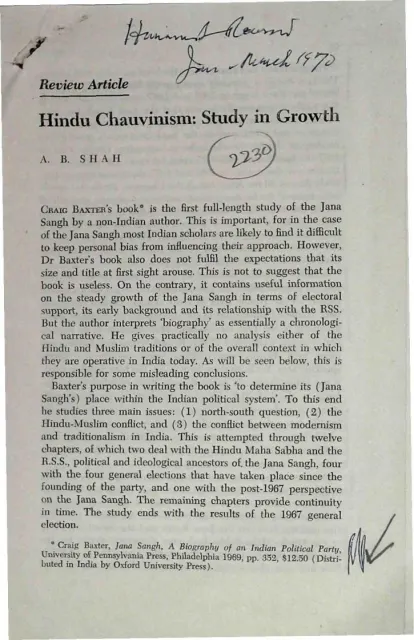
Hindu Chauvinism: Study in Growth
1970
6 pages
Summary
A. B. Shah reviews Craig Baxter’s Jana Sangh, A Biography of an Indian Political Party, the first full-length study of the Jana Sangh by a non-Indian author. Shah credits Baxter with useful empirical information on the party’s early background, electoral growth, and relationship with the RSS, including quantitative evidence of its increasing strength in Hindi-speaking areas. He argues, however, that Baxter treats biography as a largely chronological narrative and provides little analysis of Hindu and Muslim traditions or of the wider political context in which they operate.
The review challenges Baxter’s interpretation of the Jana Sangh as potentially evolving into a secular nationalist party. Shah contends that the party’s persistent identification of Hindu Rashtra with Bharatiya Rashtravad, its RSS ideological leadership, and its combination of economic radicalism with cultural chauvinism make such a transformation unlikely. He also criticizes Baxter’s treatment of communalism, cow protection, alleged persecution of Hindus in Pakistan, Muslim “infiltration” into Assam, and the 1965 conflict, arguing that Baxter is sometimes unfair to the Jana Sangh on well-established facts while failing to understand the reciprocal sources of Hindu-Muslim conflict. The visible excerpt ends with Shah listing factual, analytical, and editorial shortcomings in Baxter’s book; the review’s conclusion is not shown.
Key points
- The review regards Baxter’s book as valuable for its factual and quantitative account of Jana Sangh electoral growth.
- The Jana Sangh’s support was concentrated in Hindi-speaking areas and rose relative to Congress between 1957 and 1967.
- The review argues that the party’s RSS roots and commitment to Hindu Rashtra undermine the prospect of genuine secularisation.
- Shah presents the Jana Sangh’s combination of economic statism and cultural chauvinism as a serious threat to democracy.
- The review criticizes Baxter’s handling of communalism, cow protection, Hindu refugees, Muslim migration, and India-Pakistan tensions.
- Shah argues that Hindu and Muslim exclusivism mutually sustain the atmosphere in which communal violence can occur.
- The excerpt concludes with a catalogue of factual errors, questionable judgments, and typographical mistakes in Baxter’s book.
Metadata and summary are AI-extracted from the source PDF and reviewed for editorial accuracy. The original work is available via the Read PDF tab above (where present); paragraph-level citation inside the PDF is deferred to a future engagement.