essay
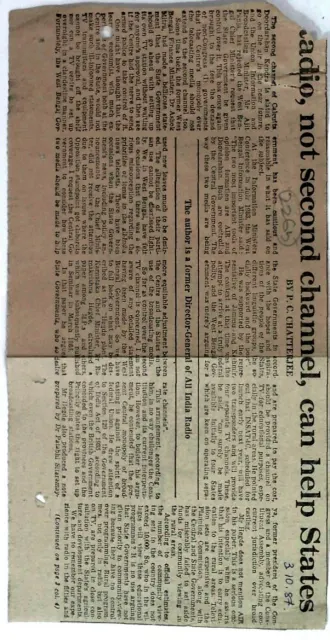
Radio, not second channel, can help States
1987
4 pages
Summary
In the rendered pages, P. C. Chatterjee argues that India’s states should rely on radio rather than a proposed second Doordarshan channel to communicate development programmes and public information. He presents All India Radio as a relatively inexpensive and already distributed medium, especially valuable for rural audiences and community listening. The article points to the use of radio in Five-Year Plans, adult education, agricultural communication, and local broadcasting, and urges the expansion of local radio stations rather than a costly television expansion.
In the rendered pages, Chatterjee also criticises the proposal associated with Mr Hegde to give states control over at least one radio channel in addition to television. He contends that such a plan would weaken the Centre’s broadcasting monopoly without creating genuinely independent or locally responsive media, and suggests that non-Congress state governments might welcome it mainly as a way to publicise their political positions. The scanned item includes unrelated advertising and news material on other pages; the article itself appears across pages 1 and 3.
Key points
- The article argues that radio is a more practical medium than a second television channel for state-level public communication.
- All India Radio is presented as comparatively inexpensive and capable of reaching rural communities through local stations and community listening.
- Radio’s existing and potential roles include development publicity, adult education, agricultural information, and support for Five-Year Plan programmes.
- The proposed expansion of television is criticised as costly and insufficiently suited to local production and participation.
- The proposal to give states control over a radio channel is portrayed as an unsatisfactory compromise that would not produce real broadcasting autonomy.
- The article suggests that state-controlled broadcasting could become a vehicle for party propaganda rather than a genuinely decentralised public service.
Metadata and summary are AI-extracted from the source PDF and reviewed for editorial accuracy. The original work is available via the Read PDF tab above (where present); paragraph-level citation inside the PDF is deferred to a future engagement.