essay
SOME RECOLLECTIONS OF SARDAR PATEL
By Minoo Masani
Arnold Heinemann Publishers (India) Private Limited, New Delhi · New Delhi · 1978
7 pages
Summary
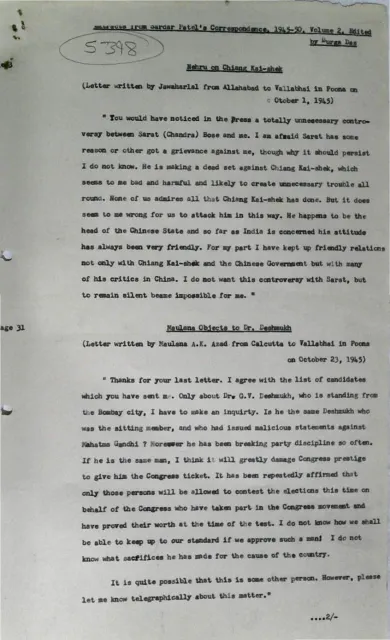
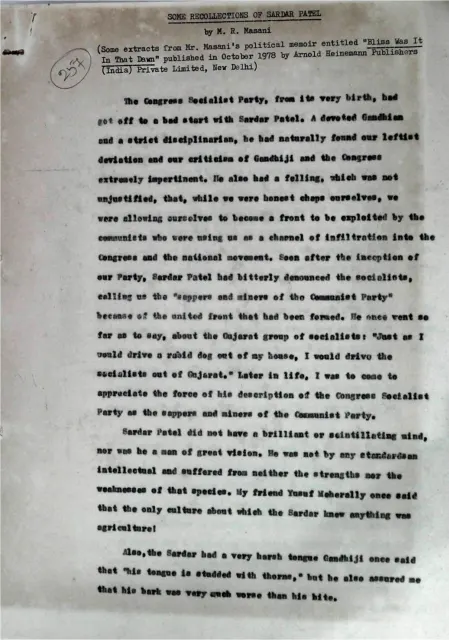
In this recollection, M. R. Masani presents Sardar Vallabhbhai Patel as a stern, practical, and politically consequential figure whose relationship with the Congress Socialist Party began in hostility. Patel regarded the socialists as a possible communist front within the Congress and denounced them as the “uppers and miners of the Communist Party.” Masani recalls Patel’s harsh speech and disciplinarian temperament, but also emphasizes his loyalty, personal courage, capacity for unpleasant decisions, and willingness to protect those who worked with him. Gandhi’s observation that Patel’s tongue was “studded with thorns” is balanced by the claim that his bark was worse than his bite.
The later pages describe Masani’s increasing political closeness to Patel, including Patel’s role in securing Masani’s 1945 Congress nomination and election to the Indian Legislative Assembly. Masani then recounts disagreements between Patel and Jawaharlal Nehru during the Interim Government, especially over Liaquat Ali Khan’s 1947 budget and its taxation proposals. He interprets the budget dispute as the first visible divergence between the two leaders and contrasts their respective political instincts: Nehru was associated with minority questions and modernization, while Patel was closer to Masani on foreign policy and economic issues. The extract ends with Masani’s opposition to banning the Rashtriya Swayam Sevak Sangh after Gandhi’s assassination, on the grounds that suppressing political parties by law would be incompatible with democracy.
Key points
- Patel distrusted the Congress Socialist Party and believed it could serve as a channel for communist infiltration into Congress and the national movement.
- Masani depicts Patel as intellectually unspectacular but politically practical, disciplined, loyal, and willing to undertake unpopular work.
- The recollections include Gandhi’s efforts to reconcile Masani and Patel and illustrate Gandhi’s pragmatic approach to choosing political personnel.
- Patel supported Masani’s candidacy for the Indian Legislative Assembly in 1945; Masani recalls winning decisively despite limited campaign finances.
- The Liaquat Ali Khan budget of 1947 produced a major dispute over taxation and marked, in Masani’s account, the first visible divergence between Patel and Nehru.
- Masani associates Patel with a more business-conscious and economically pragmatic position than Nehru’s leftist and anti-business orientation.
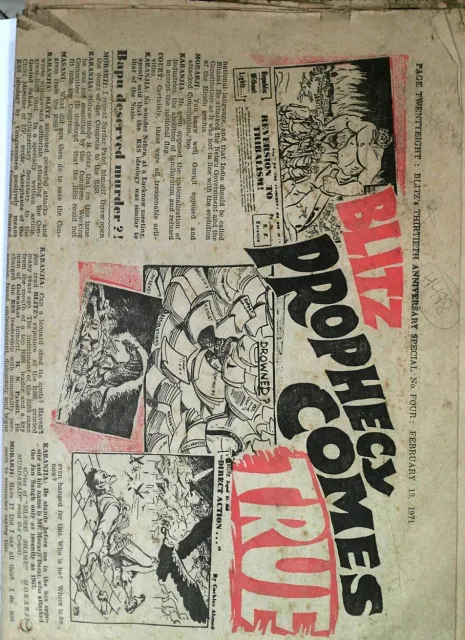
- After Gandhi’s assassination, Masani opposed legally banning the Rashtriya Swayam Sevak Sangh, warning that such a policy could turn democracy into a system of licensed political parties.
Metadata and summary are AI-extracted from the source PDF and reviewed for editorial accuracy. The original work is available via the Read PDF tab above (where present); paragraph-level citation inside the PDF is deferred to a future engagement.