essay
India: Problems With the Sixth Five-Year Plan
1978
7 pages
Summary
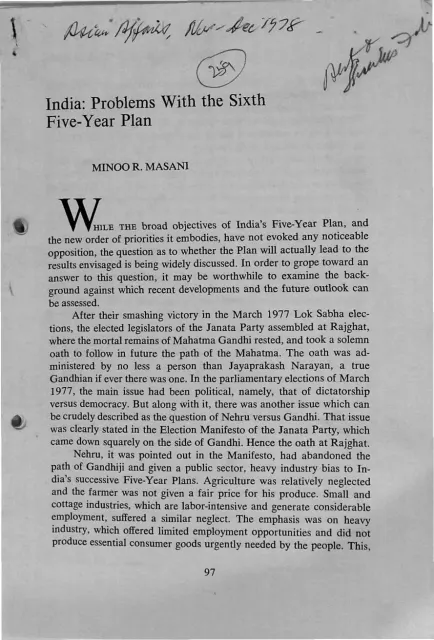
In the rendered pages, Minoo R. Masani examines the economic premises and political context of India’s Sixth Five-Year Plan. He contrasts the Nehru-era emphasis on centralized planning, heavy industry, and public-sector expansion with the Janata Party’s promised Gandhian alternative: greater emphasis on agriculture, wage goods, cottage and small industries, employment generation, and decentralized rural development. Masani accepts the direction of this shift, arguing that agriculture and labor-intensive production offer more employment and better fit India’s scarcity of capital, but he doubts whether the Plan’s targets are economically realistic.
In the rendered pages, Masani’s critique focuses especially on the limitations of state-sponsored small industry. He cites underused capacity, sick units, weak quality control, dependence on large firms, inadequate markets, technological obsolescence, and the questionable economics of mini-steel and mini-cement plants. He also argues that taxation, transport costs, municipal octroi, and bureaucratic controls obstruct genuine decentralization. The article then connects these economic shortcomings to Janata’s internal political conflict: although the party claims to have rejected the Nehru line, Masani sees substantial policy continuity, limited fiscal room for agricultural and small-industry investment, and a growing risk that political instability will encourage renewed populist controls and nationalization. The supplied article ends at printed page 107; printed page 108 begins a different article, so any continuation beyond page 107 was not available.
Key points
- Masani frames the Sixth Plan as a contest between the Nehru model of centralized heavy-industrial planning and a Gandhian, agriculture- and small-industry-oriented model.
- He argues that agriculture, cottage industries, and labor-intensive production have greater employment potential than organized large-scale industry.
- The Plan’s promised expansion of small-scale output and village employment is presented as financially and administratively difficult to achieve.
- Masani identifies unused capacity, sick units, weak quality control, technological obsolescence, market dependence, and poor investment choices as structural weaknesses of the small-industry sector.
- Mini-steel and mini-cement plants are used as examples of projects promoted for ideological or political reasons despite doubtful economic viability.
- Taxes, transport costs, octroi, and bureaucratic practices undermine the decentralization that the Janata Party claims to support.
- The article links economic policy to Janata’s internal conflict and warns that coalition instability may produce renewed protectionism, nationalization, and populist economic controls.
Metadata and summary are AI-extracted from the source PDF and reviewed for editorial accuracy. The original work is available via the Read PDF tab above (where present); paragraph-level citation inside the PDF is deferred to a future engagement.