interview
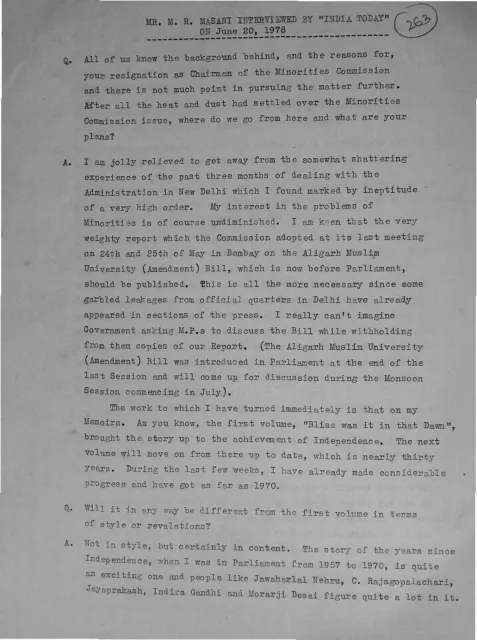
MR. M. R. MASANI INTERVIEWED BY "INDIA TODAY"
ON June 20, 1978
By Minoo Masani
1978
6 pages
Summary
In this 20 June 1978 interview, Minoo Masani discusses his resignation as chairman of the Minorities Commission, arguing that the Commission’s report on the Aligarh Muslim University (Amendment) Bill should be published before Parliament debates the measure. He says his interest in minority issues remains undiminished, while also describing his return to writing his memoirs, whose planned second volume would cover the period from Independence through his years in Parliament, 1957–1970.
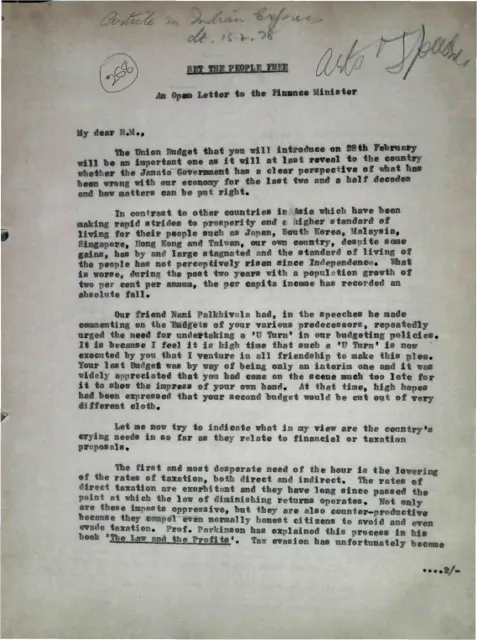
Masani views contemporary Indian politics through a cyclical lens. He compares the unstable coalition governments that followed the 1967 elections with the Janata Government, warning that political disorder, declining law and order, and weak labour discipline could again produce an authoritarian regime. He distinguishes the 1978 situation from the pre-Emergency period, but insists that democratic critics should not remain silent. On economic policy, he attacks the Janata Government for continuing what he regards as Nehru-era fiscal errors, including high taxation, deficit finance, and monetary expansion. He endorses Nani Palkhivala’s call for a tax-policy “U Turn” and concludes by advocating a non-partisan middle-class movement inspired by California’s property-tax revolt.
Transcript
Summary
In this 20 June 1978 interview, Minoo Masani discusses his resignation as chairman of the Minorities Commission, arguing that the Commission’s report on the Aligarh Muslim University (Amendment) Bill should be published before Parliament debates the measure. He says his interest in minority issues remains undiminished, while also describing his return to writing his memoirs, whose planned second volume would cover the period from Independence through his years in Parliament, 1957–1970.
Masani views contemporary Indian politics through a cyclical lens. He compares the unstable coalition governments that followed the 1967 elections with the Janata Government, warning that political disorder, declining law and order, and weak labour discipline could again produce an authoritarian regime. He distinguishes the 1978 situation from the pre-Emergency period, but insists that democratic critics should not remain silent. On economic policy, he attacks the Janata Government for continuing what he regards as Nehru-era fiscal errors, including high taxation, deficit finance, and monetary expansion. He endorses Nani Palkhivala’s call for a tax-policy “U Turn” and concludes by advocating a non-partisan middle-class movement inspired by California’s property-tax revolt.
Key points
- Masani defends publication of the Minorities Commission’s report on the Aligarh Muslim University (Amendment) Bill before parliamentary debate.
- He says he has begun a second volume of memoirs covering India from Independence through his parliamentary career between 1957 and 1970.
- He interprets the Janata Government as a fragile coalition and compares it with the unstable post-1967 state governments.
- He warns that political breakdown and declining law and order could cause the pendulum to swing back toward authoritarian government.
- He rejects a direct equivalence between 1978 and 1975, describing the Emergency as a response to earlier lawlessness and calling it a “phony Emergency.”
- He criticises Janata economic policy for high taxation, deficit finance, monetary expansion, and continuity with Nehru-era policies.
- He advocates tax cuts and a non-partisan middle-class front, drawing encouragement from California’s grassroots property-tax revolt.
Metadata and summary are AI-extracted from the source PDF and reviewed for editorial accuracy. The original work is available via the Read PDF tab above (where present); paragraph-level citation inside the PDF is deferred to a future engagement.