interview
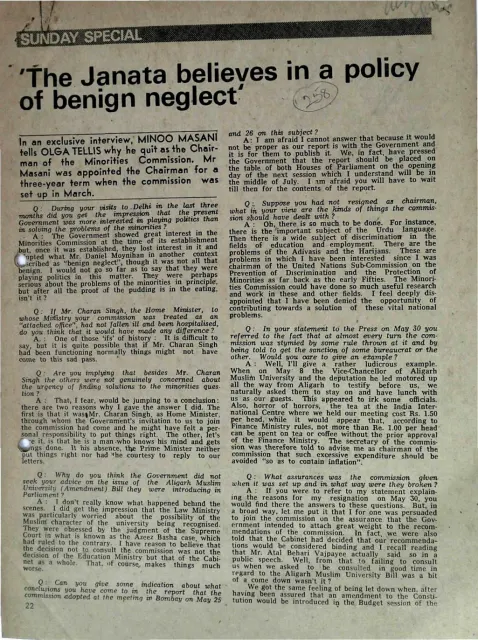
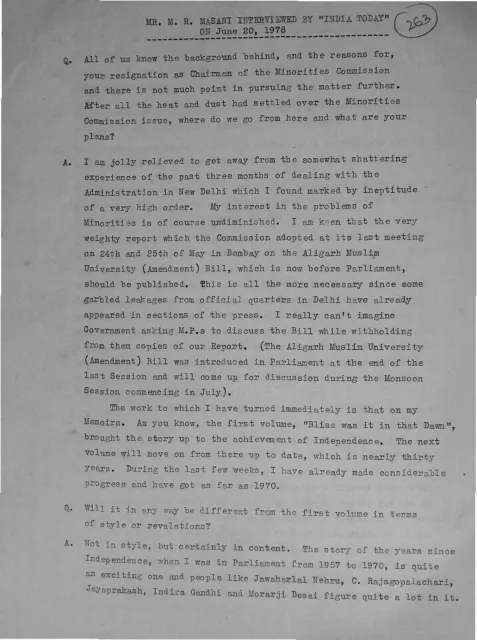
MR. M. R. MASANI INTERVIEWED BY “SUNDAY” MAGAZINE
By Minoo Masani
“SUNDAY” MAGAZINE
12 pages
Summary
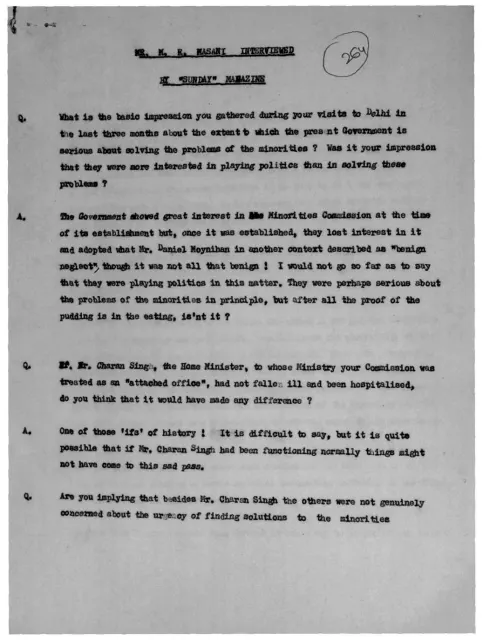
In this interview, M. R. Masani explains his resignation as chairman of the Minorities Commission by arguing that the government failed to give the body meaningful authority, attention, or institutional support. He says that the government initially showed interest in the Commission but subsequently adopted what Daniel Moynihan called “benign neglect.” Masani rejects the suggestion that the government was merely playing politics, while insisting that its seriousness about minority problems must be judged by its actions, including its failure to respond to the Commission's letters and to consult it on the Aligarh Muslim University (Amendment) Bill.
Masani attributes particular importance to the absence of Home Minister Charan Singh, whom he describes as a decisive figure who might have taken personal responsibility for resolving the situation. He criticises the failure to honour assurances that the Commission's recommendations would receive substantial weight, that its existence would be made permanent and independent through constitutional amendment, and that it would be consulted on relevant legislation. He identifies unfinished work concerning Urdu, discrimination in education and employment, and the conditions of Adivasis and Harijans. The interview closes with Masani defending public criticism of the Janata government as necessary to prevent a backlash toward authoritarianism, and arguing that although the minorities problem cannot be solved completely, serious work can reduce the alienation experienced by minorities.
Transcript
Summary
In this interview, M. R. Masani explains his resignation as chairman of the Minorities Commission by arguing that the government failed to give the body meaningful authority, attention, or institutional support. He says that the government initially showed interest in the Commission but subsequently adopted what Daniel Moynihan called “benign neglect.” Masani rejects the suggestion that the government was merely playing politics, while insisting that its seriousness about minority problems must be judged by its actions, including its failure to respond to the Commission’s letters and to consult it on the Aligarh Muslim University (Amendment) Bill.
Masani attributes particular importance to the absence of Home Minister Charan Singh, whom he describes as a decisive figure who might have taken personal responsibility for resolving the situation. He criticises the failure to honour assurances that the Commission’s recommendations would receive substantial weight, that its existence would be made permanent and independent through constitutional amendment, and that it would be consulted on relevant legislation. He identifies unfinished work concerning Urdu, discrimination in education and employment, and the conditions of Adivasis and Harijans. The interview closes with Masani defending public criticism of the Janata government as necessary to prevent a backlash toward authoritarianism, and arguing that although the minorities problem cannot be solved completely, serious work can reduce the alienation experienced by minorities.
Key points
- Masani characterises the government’s treatment of the Minorities Commission as neglect after an initial show of interest.
- He links the Commission’s difficulties to the absence of Home Minister Charan Singh and to the Prime Minister’s failure to answer its letters.
- He criticises the government’s decision not to consult the Commission on the Aligarh Muslim University (Amendment) Bill.
- He says the Commission could have undertaken research on Urdu, discrimination in education and employment, and the problems of Adivasis and Harijans.
- He recalls assurances that the Commission’s recommendations would be treated as binding or given great weight, and that its independence would be secured constitutionally.
- He defends his resignation as a matter of self-respect after repeated government inaction.
- He argues that democratic criticism of the Janata government is preferable to leaving criticism exclusively to authoritarians.
- He maintains that the minorities problem is difficult but that serious efforts can reduce alienation and advance national integration.
Metadata and summary are AI-extracted from the source PDF and reviewed for editorial accuracy. The original work is available via the Read PDF tab above (where present); paragraph-level citation inside the PDF is deferred to a future engagement.