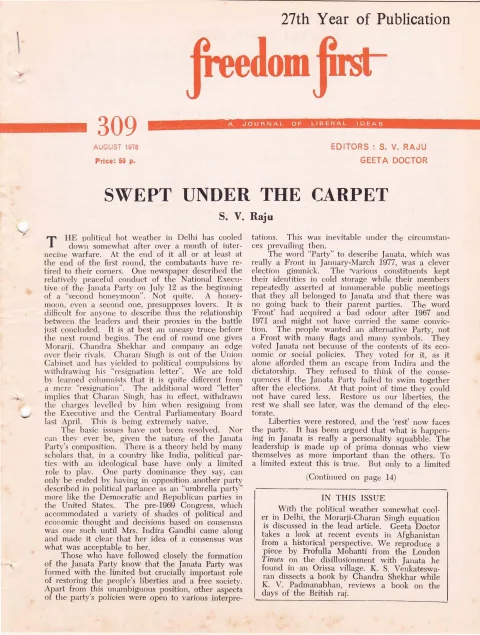
periodical issue
Freedom First
A Journal of Liberal Ideas
Edited by S. V. Raju
Published for the Democratic Research Service by J. R. Patel, Associate Editor, Freedom First at 127, M. Gandhi Rd., Bombay 400 023 (Phone: 273914) and printed by him at States' People Press, Ghoga Street, Fort, Bombay-400 001. · Bombay · 1978
16 pages
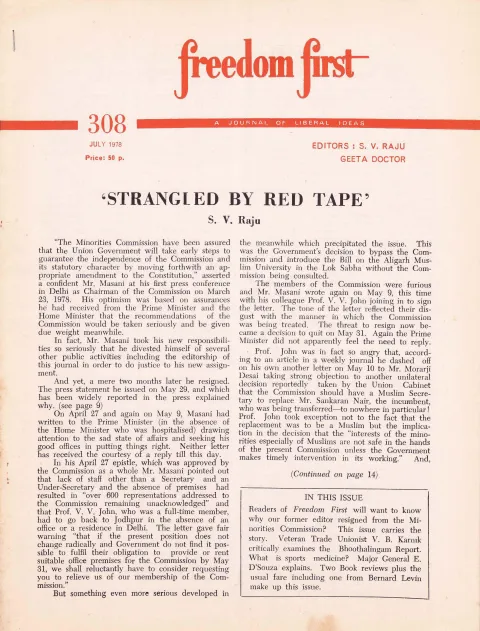
Freedom First
Summary
This is the complete July 1978 issue (No. 308) of Freedom First, the Bombay-based classical-liberal monthly, edited by S. V. Raju and Geeta Doctor. The issue centres on the resignation of Minoo Masani from the chairmanship of the newly created Minorities Commission, covered both in Raju’s lead editorial ‘Strangled by Red Tape’ and in Masani’s own press statement reproduced verbatim; both describe how the government bypassed the Commission on the Aligarh Muslim University Bill and failed to honour assurances of independence, staff, and premises. Other contributors take on a wide range of subjects: Geeta Doctor and S. V. Raju’s ‘Frankly Speaking’ column mocks Morarji Desai’s foreign trips and Atal Behari Vajpayee’s UN speech, and separately muses on Bombay’s telephone exchange renaming; an unsigned SVR piece needles a windfall reward paid to Chandra Shekhar and mulls the ‘Seven Year Itch’ and the Breach Candy pool controversy; V. B. Karnik critiques the Bhoothalingam Study Group’s wage, income and price policy report; Bernard Levin’s syndicated Times column indicts Western apologists for the Khmer Rouge genocide in Cambodia; Maj. Gen. E. D’Souza writes on the emerging field of sports medicine in India, timed to the opening of a Bombay sports-medicine centre; a World News page covers Solzhenitsyn’s Harvard commencement address and a study on spinal discs; two book reviews assess V. V. John’s essay collection on Indian education (Muriel Wasi) and Rajeev Dhavan’s book on the 42nd Constitutional Amendment (Nawaz Mody); a reader’s letter from Homeyar Jal Tavaria laments the quality of democratic leadership; and the back page compiles miscellaneous quotations under ‘With Many Voices’ alongside a subscription form.
Key points
-
S. V. Raju’s “Strangled by Red Tape” and Minoo Masani’s own press statement document Masani’s May 29, 1978 resignation as Chairman of the Minorities Commission after only three months, citing broken assurances of consultation, statutory independence, staff and premises, and the government’s introduction of the Aligarh Muslim University Bill without consulting the Commission.
-
V. B. Karnik critiques the Bhoothalingam Study Group’s wage, income and price policy report, noting its recommended national minimum wage of Rs. 100 rising to Rs. 150 over seven years and concluding it fails to address the core problem of redistributing national income from a wealthy minority to the impoverished majority.
-
Bernard Levin’s syndicated column indicts Western apologists for the Khmer Rouge genocide in Cambodia, naming SOAS lecturer Malcolm Caldwell and New Statesman writer James Fenton for downplaying the killings, and comparing their denial to Holocaust deniers.
-
Maj. Gen. E. D’Souza writes on the emerging field of sports medicine in India, timed to the opening of a Bombay sports-medicine centre, citing Indian athletes whose careers suffered from the lack of such expertise.
-
A World News item reports Alexander Solzhenitsyn’s June 1978 Harvard commencement address “A World Split Apart”, in which he criticised both Western and Soviet societies for spiritual exhaustion.
-
Muriel Wasi reviews V. V. John’s The Great Classroom Hoax, praising his refusal to be taken in by shams in Indian higher education while faulting his impractical proposals on the three-language formula.
-
Nawaz Mody reviews Rajeev Dhavan’s The Amendment — Conspiracy or Revolution, noting his neutral stance on the 42nd Amendment’s constitutional validity despite condemning its “moral ineptitude”.
-
A reader’s letter from Homeyar Jal Tavaria argues democracies worldwide face a crisis of leadership and calls for “managerial/technocrat” politicians rather than career lawyer-politicians.
Essays
’Strangled by Red Tape’
By S. V. Raju
S. V. Raju’s lead article recounts the brief, troubled three-month tenure of Minoo Masani as Chairman of the Minorities Commission. It details Masani’s letters of April 27 and May 9 to the Prime Minister (joined by Prof. V. V. John) warning that the Commission lacked staff and office premises and had been bypassed on the Aligarh Muslim University Bill, and the further anger caused by a unilateral Cabinet decision on replacing the Commission’s Muslim Secretary. The piece frames Masani’s May 29 resignation as the product of government neglect and bureaucratic obstruction.
- Masani accepted the Minorities Commission chairmanship on an honorary basis on March 23, 1978, expecting a three-year term, but resigned after only two months.
- He and the Commission wrote to the Prime Minister on April 27 warning about lack of staff, absence of office premises, and over 600 unacknowledged representations.
- The government introduced the Aligarh Muslim University Bill in the Lok Sabha without consulting the Commission, precipitating the resignation threat.
- On May 9, Masani and Prof. V. V. John wrote again, turning the threat to resign into a firm decision to quit by May 31.
- Prof. John separately objected to a Cabinet decision to replace the Commission’s Muslim Secretary, Mr. Sankaran Nair, without consultation.
Frankly Speaking … (Mr. Desai Goes Abroad / For name’s sake)
By SVR / G.D.
The ‘Frankly Speaking’ column (unsigned initials SVR and G.D.) offers two short satirical items. The first mocks Morarji Desai’s foreign travels, his moralising tone despite his own extravagances (a vegetarian banquet for non-vegetarian British guests, a costly all-vegetarian state visit), and contrasts his U.N. speech unfavourably with the concurrent World Cup football matches; it also notes Atal Behari Vajpayee’s Hindi-language U.N. address caused controversy. The second item, ‘For name’s sake,’ recounts the comic confusion caused by Bombay’s telephone exchange renumbering and the naming of the new Malabar Hill exchange building’s lane as ‘Alexander Graham Bell Marg.’
- Criticises Morarji Desai for preaching austerity while incurring costs such as an all-vegetarian banquet for non-vegetarian British guests in London.
- Notes the irony of Desai’s live U.N. telecast playing to a half-empty hall while the World Cup football was underway in Buenos Aires.
- Recalls Vajpayee’s Hindi speech at the U.N. sparking a protest melee reported by the Times of India.
- Describes Bombay’s phone number change and the renaming of a lane to Alexander Graham Bell Marg, drawing a comparison to Madras’s ‘Barber’s Bridge.‘
A Windfall For Chandra Shekhar / The Seven Year Itch / A Touch of Class
By SVR / G.D.
A further set of short unsigned (SVR/G.D.) opinion pieces: one on a reward payment to Chandra Shekhar for tipping off authorities about the Birla group a decade earlier, contrasting government generosity in this instance with its slowness elsewhere and mocking the general practice of rewarding informants for smuggling detection; another, ‘The Seven Year Itch,’ riffs on Gail Sheehy’s book Passages and speculates about a biological basis for divorce cycles, segueing into commentary on the recurring controversy over the Breach Candy Swimming pool’s discriminatory membership practices in Bombay, including a letter-writer’s charge of similar discrimination at the Pransukhlal Mafatlal Hindu Swimming Bath. A third short piece, ‘A Touch of Class,’ begins a review of Raj Kapoor’s film Satyam Shivam Sundaram, continued later in the issue.
- Chandra Shekhar received a Rs. 43,000 reward (raising his total to that sum) for information given a decade earlier about the Birla group, prompting satire about socialist politicians profiting personally.
- Suggests government also consider raising and making tax-free the standard reward rate for informants on smuggled gold.
- Discusses the Breach Candy Swimming pool controversy over exclusion of Indians, contrasted with alleged discrimination against non-Hindus at the Pransukhlal Mafatlal Hindu Swimming Bath.
- Opens a review of Raj Kapoor’s Satyam Shivam Sundaram, praising it as a film ‘with a touch of class’ amid what the writer calls an industry of ‘costly rubbish.‘
Wage, Income and Price Policy: Bhoothalingam Study Group Report
By V. B. Karnik
V. B. Karnik critiques the Bhoothalingam Study Group’s report on wage, income and price policy. He argues the Group, chaired by S. Bhoothalingam and dominated by defenders of the economic status quo, was incapable of framing a genuinely just wage and income policy, though it deserves credit for not recommending an outright wage freeze. He walks through its recommendations: a national minimum wage of Rs. 100 rising to Rs. 150 over seven years, a rural minimum household income of Rs. 1800, gradual wage increases tied to GNP and productivity growth, proposed pay commissions to address inter-sectoral wage disparities, and support for collective bargaining bounded by a Bureau of Incomes and Prices, which Karnik warns could undermine bargaining if paired with a binding adjudication body. The piece (continued on pages 13 and 15) also covers workers’ anger over the Group’s rejection of extending bonus entitlements to groups like railway and postal employees, the ceiling proposals on income (Rs. 2000/month suggested by labour member A. N. Buch versus the Group’s own Rs. 6000/month wage ceiling), and Karnik’s conclusion that the report fails to address the core problem of redistributing national income from a wealthy minority to the impoverished majority.
- Only one Study Group member, A. N. Buch of the Textile Labour Association, was committed to structural change; the rest defended the status quo.
- Recommends a national minimum wage of Rs. 100/month rising to Rs. 150 over seven years, and a rural household minimum income of Rs. 1800/year.
- Proposes wages increase in line with GNP and productivity growth and suggests new bodies (National Pay Commission, Pay Committee) to address wage disparities.
- Rejects extending bonus to workers not covered by the Bonus Act (e.g., Railway and P&T employees), despite Janata Party’s election manifesto describing bonus as deferred wage.
- Suggests a wage ceiling of Rs. 6000/month, while labour member Buch proposed a Rs. 2000/month ceiling on all incomes, earned and unearned.
- Karnik concludes the report fails to tackle redistribution of national income, the root of poverty.
The Evil That Men Do and the Men Who Call It Good
By Bernard Levin
Bernard Levin’s syndicated column from The Times of London (reprinted here) documents the Khmer Rouge’s genocide in Cambodia since 1975, describing forced labour, executions, starvation and mass killing of the population, and cites recent atrocities against Thai and Vietnamese villagers. He then turns to indict Western apologists for the regime — chiefly Dr. Malcolm Caldwell, a lecturer at SOAS, and journalist James Fenton of the New Statesman — for downplaying or excusing the killings, comparing their denial to Holocaust deniers such as an American scientist named Butz and the Very Reverend Lord Macleod of Fuinary’s praise of East Germany as a democracy. Levin concludes that people who deny available truths to defend indefensible ideologies reveal something dark and universal about human self-deception.
- Estimates Khmer Rouge killings may amount to ten per cent of Cambodia’s population through direct extermination or inhuman treatment since 1975.
- Describes forced labour, banned Buddhism, executed monks, and eyewitness accounts of atrocities including massacres of Thai and Vietnamese villagers.
- Names Dr. Malcolm Caldwell (SOAS lecturer) as a leading Western defender who insists Cambodia is a ‘peaceful democracy.’
- Cites James Fenton of the New Statesman as blaming America for driving Cambodian brutality.
- Draws a parallel to an American named Butz who denied the Holocaust, and Lord Macleod of Fuinary’s claim that East Germany is a democracy.
- Concludes that ideological need, stronger than facts, drives such denial of atrocity.
Sports Medicine
By Maj. Gen. E. D’Souza, PVSM (Retd)
Maj. Gen. E. D’Souza (PVSM, Retd.) writes on the emerging discipline of sports medicine in India, occasioned by the opening of a Bombay sports medicine centre at Balabhai Nanavati Hospital on June 5, 1978. He surveys cases where Indian athletes’ careers were damaged by the absence of sports-medicine expertise (triple jumper Henry Rebello in the 1948 Olympics, footballers Charles Cornelius and Michael Kindo, hockey player Govinda at the Montreal Olympics, and players at the 1978 World Cup Hockey tournament in Buenos Aires), and argues for mandatory sports-medicine screening, dedicated centres in other Indian cities, and university chairs in the subject.
- India has only one sports medicine facility, at the National Institute of Sport, Patiala, prior to the new Bombay centre.
- The new Bombay Sports Medicine Centre opened June 5, 1978 at Balabhai Nanavati Hospital, inaugurated by Maharashtra Chief Minister Vasantdada Patil.
- Cites historical cases of Indian athletes whose careers suffered due to lack of sports-medicine screening or care.
- Advocates mandatory sports-medicine specialists attached to national teams and a chair in sports medicine at Indian universities.
- Describes the centre’s planned services: weekly OPD, emergency care, and an initial fitness check-up system.
Why Masani Resigned (Statement to the press by Mr. Masani, May 29)
Minoo Masani’s own press statement of May 29, 1978, explaining his resignation as Chairman of the Minorities Commission. He describes three assurances made to him and colleagues that were not honoured: that government would consult the Commission on all relevant matters, that the anomaly of the Commission being an executive rather than statutory body would be corrected by constitutional amendment, and that the Commission would function independently of the Home Ministry executive. He details the Aligarh Muslim University Bill episode, unanswered letters to the Prime Minister, and the Commission’s lack of office premises and staff, concluding that continuing as Chairman under these conditions would damage the Commission’s credibility.
- Masani resigned after three months rather than the three-year term he had accepted honorarily.
- Three assurances were broken: consultation on minority matters, statutory independence via constitutional amendment, and independence from Home Ministry control.
- The Aligarh Muslim University Bill was introduced without Commission consultation despite prior requests.
- The Commission lacked office premises and adequate staff throughout its three-month existence.
- Despite handicaps, the Commission produced a definitive report on the Aligarh Muslim University (Amendment) Bill before Masani’s resignation.
World News (‘A World Split Apart’ / ‘Discs’ Make People Taller At Night)
An unsigned World News page reprints two wire/press items: an account of Alexander Solzhenitsyn’s June 1978 Harvard commencement address, ‘A World Split Apart,’ in which he denounced both Western and Soviet societies for spiritual exhaustion and criticised Western media, materialism and lack of resolve; and a short item from The Times, London on scientific research suggesting spinal discs cause people to be measurably taller at night.
- Solzhenitsyn’s Harvard speech criticised Western society as similar to the communist world in its ‘suffocation of spiritual life.’
- He said he could not recommend the West as a model for Russia’s transformation.
- He criticised the Western press, weak politicians, and the U.S. anti-war movement’s role regarding Vietnam and Cambodia.
- A separate item reports research by Dr. Alice Maroudas and Professor Malcolm Jayson on spinal discs and diurnal height changes.
Reviews: The Great Classroom Hoax And Other Reflections on India’s Education (V. V. John)
By Muriel Wasi
Muriel Wasi reviews The Great Classroom Hoax and Other Reflections on India’s Education by V. V. John (Vikas Publishing House, 1978). She praises John’s refusal to be taken in by shams in Indian education and his readable, journalistic style, but notes his experience is almost entirely at the college and university level, limiting the value of his criticism for schooling more broadly. She finds him obsessed with excellence and concerned with social justice and freedom, but predicts the book will have limited public impact because his proposed solutions (e.g., on the three-language formula) are less admirable than his diagnoses, and because his tone belongs to an earlier generation.
- The book collects V. V. John’s journalistic essays on Indian education, some written during the Emergency.
- Wasi praises John’s unwillingness to be taken in by shams and his topical criticism of Indian post-secondary education.
- She critiques that his experience is limited to college/university level, reducing relevance to schooling.
- She finds his proposed solution on the three-language formula formally imperfect and impractical.
- She predicts the book will have limited public impact due to John’s outdated tone.
Reviews: ‘The Amendment - Conspiracy or Revolution’ by Rajeev Dhavan
By Nawaz Mody
Nawaz Mody reviews Rajeev Dhavan’s book The Amendment — Conspiracy or Revolution (Wheeler Publishing, 1978). She finds Dhavan in a ‘dilemma,’ condemning the ‘moral ineptitude’ of the 42nd Amendment while remaining oddly neutral about its constitutional validity, and criticises the book’s careless errors and lack of in-depth analysis, though she credits its appendices as useful. She summarises Dhavan’s account of the Amendment’s history, the curtailment of judicial review, the Emergency-era ‘underground document’ advocating a Presidential system, and concludes that the Janata Party’s promise to fully repeal the 42nd Amendment has been only partially fulfilled through the 43rd and (mislabeled by Dhavan) 44th Amendment Bills, with the pending 45th Amendment Bill addressing remaining issues like referendum provisions.
- Dhavan condemns the 42nd Amendment’s ‘moral ineptitude’ but is neutral on its constitutional validity, a stance Mody calls a dilemma.
- The review criticises the book for careless errors, being hastily written, and lacking in-depth analysis, though it commends the appendices.
- Discusses the Amendment’s curtailment of High Court powers, creation of tribunals outside the courts, and government attempts to declare ‘partial’ Emergency.
- Notes Dhavan’s factual error: it was the 44th, not the 43rd, Amendment Bill that sought deletion of Art. 31-D.
- Concludes that no Janata-led compromise fully addressing the Amendment’s damage is achievable given political arithmetic in the Rajya Sabha.
Letter
By Homeyar Jal Tavaria
A reader’s letter from Homeyar Jal Tavaria argues that democracies worldwide suffer a crisis of leadership, citing Jimmy Carter’s ineffectual first year, the UK’s economic decline, and France’s near turn to communism. He argues India’s Janata government has failed on the socio-economic front and calls for ‘managerial/technocrat’ politicians rather than career politicians drawn mainly from law, who he argues are ill-suited to managing modern economic and social problems.
- Argues most democracies face a crisis of leadership on the economic front, citing Carter, the UK, and France as examples.
- Criticises the Janata government for failing on the socio-economic front.
- Calls for ‘managerial/technocrat’ politicians capable of diagnosing and solving problems, rather than lawyer-politicians focused on rules and regulations.
With Many Voices
The ‘With Many Voices’ back-page feature compiles short quotations from world and Indian public figures published between March and June 1978, on subjects ranging from bureaucracy and sycophancy to Emergency-era politics and religion, drawn from sources such as The Times, The Statesman, Time, India Today and the Indian Express. The page also carries the subscription form for Freedom First, published by the Democratic Research Service, Bombay.
- Includes quotations from Margaret Thatcher, Menahem Begin, Jimmy Carter, Morarji Desai, Rajmohan Gandhi, Subramaniam Swamy, and B. R. Ambedkar (via H. R. Khanna), among others.
- One quotation from Rajmohan Gandhi in Himmat contrasts alleged ‘oppression’ during the Emergency with ‘depression’ afterward.
- Includes the Freedom First subscription form, listing the Democratic Research Service address at Maneckji Wadia Bldg., Bombay.
- The issue’s imprint states it is published for the Democratic Research Service by J. R. Patel and printed at States’ People Press, Bombay.
Generated by the v1.5 extraction pipeline. Awaiting editorial review.
Metadata and summary are AI-extracted from the source PDF and reviewed for editorial accuracy. The original work is available via the Read PDF tab above (where present); paragraph-level citation inside the PDF is deferred to a future engagement.