speech · parliamentary
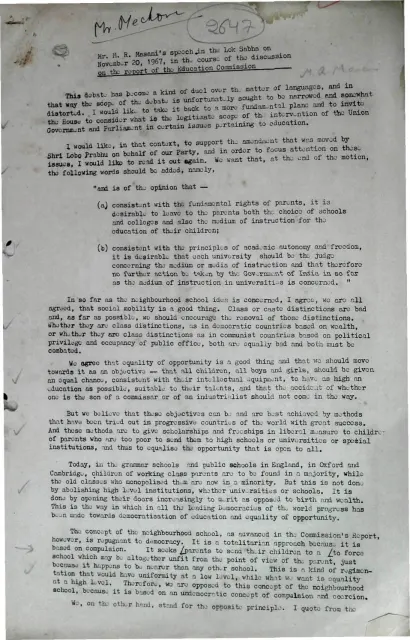
Mr. M. R. Masani's speech in the Lok Sabha on November 20, 1967, in the course of the discussion on the report of the Education Commission
By Minoo Masani
1967
6 pages
Summary
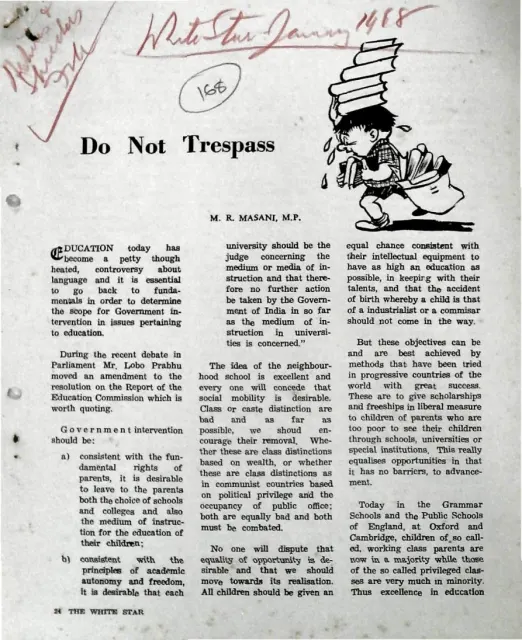
In this six-page Lok Sabha speech of November 20, 1967, M. R. Masani argues that the Education Commission debate has been reduced to a dispute over language and should instead be considered as a question of the proper limits of Union and parliamentary intervention in education. He supports parental choice of schools and medium of instruction, equal opportunity through scholarships and fellowships rather than compulsory uniformity, and the autonomy and academic freedom of universities. He particularly attacks the proposed neighbourhood-school system as coercive and undemocratic because it would force parents to send children to a school selected by the state or by proximity.
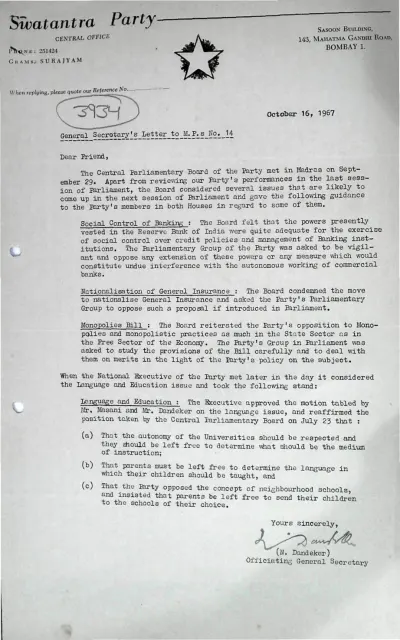
Masani grounds his position in fundamental rights, Article 30’s protections for minority educational institutions, and the Swatantra Party’s commitment to parental educational choice and institutional autonomy. He maintains that universities should decide their own medium of instruction in response to parents, students, and local communities, without political pressure from Parliament, the Education Ministry, or the University Grants Commission. The speech broadens this argument into a general warning against the extension of political patronage and governmental interference into education, culture, literature, sports, and economic life, while calling on government to provide neglected free and compulsory primary education instead.
Key points
- Masani reframes the language controversy as a question of constitutional limits on government intervention in education.
- He defends parents’ freedom to choose schools, colleges, and the medium of instruction for their children.
- He supports equality of opportunity through scholarships and fellowships rather than abolition of high-level institutions.
- He rejects the neighbourhood-school proposal as compulsory, coercive, and inconsistent with democracy.
- He invokes Article 30 to defend minority communities’ rights to establish and administer educational institutions of their choice.
- He argues that universities should determine their own medium of instruction and other academic affairs.
- He criticises political interference and patronage in education and culture, while urging government to concentrate on primary education.
Metadata and summary are AI-extracted from the source PDF and reviewed for editorial accuracy. The original work is available via the Read PDF tab above (where present); paragraph-level citation inside the PDF is deferred to a future engagement.