essay
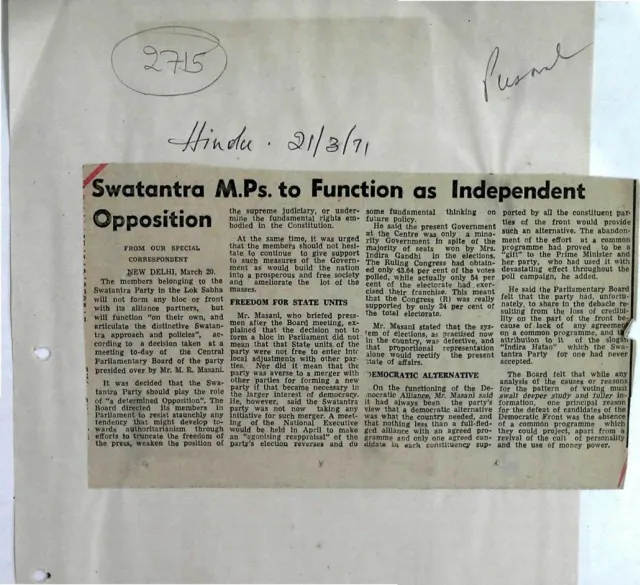
Swatantra M.Ps. to Function as Independent Opposition
Hindu · New Delhi · 1971
1 pages
Summary
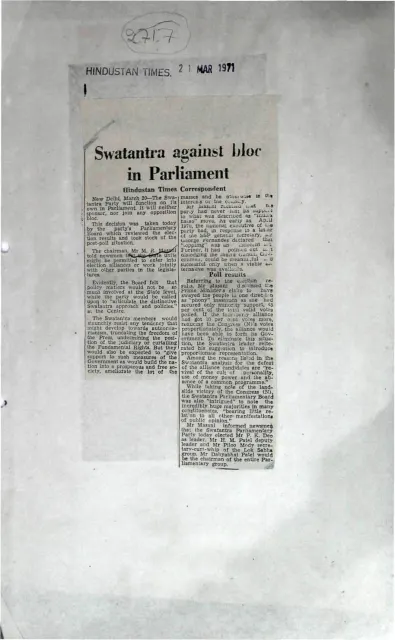
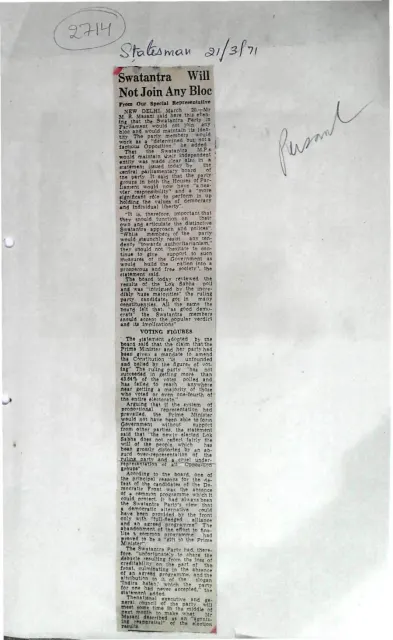
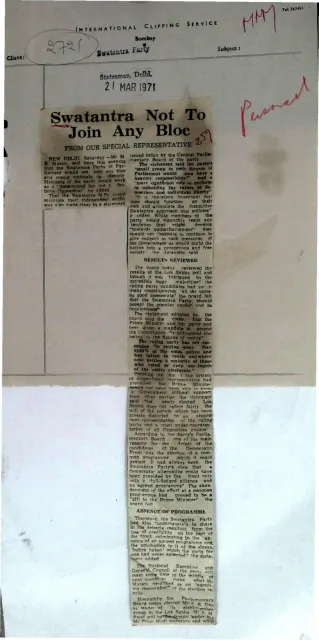
This newspaper report describes the Swatantra Party’s decision to have its members in the Lok Sabha function independently rather than form a bloc with other opposition parties. At a Central Parliamentary Board meeting chaired by M. R. Masani, the party urged its MPs to act as a “determined Opposition,” resist authoritarianism, protect fundamental rights, and support legislation that would build a prosperous and free society. The report also notes the party’s opposition to merger proposals and its intention to reassess its electoral strategy after the election results.
The article presents the Swatantra Party as a possible democratic alternative to the Congress, while reporting Masani’s criticism of the party’s electoral performance and organisation. It attributes the Congress’s strength to its association with Mrs. Indira Gandhi and says the party’s proposed alternative would depend on constituent parties providing a credible programme. The clipping ends with criticism of opposition candidate selection, the absence of a common programme, personality-based politics, and the use of money power.
Key points
- Swatantra MPs are to function independently in Parliament rather than join a united opposition bloc.
- The party defines its parliamentary role as a “determined Opposition” resisting authoritarianism.
- Its stated objectives include protecting fundamental rights and supporting a prosperous and free society.
- M. R. Masani rejects the idea that Swatantra should merge with other parties before the election results are assessed.
- The report describes a proposed democratic alternative to the Congress as dependent on a common programme and coordinated constituency-level efforts.
- Masani attributes the Congress’s electoral strength partly to Mrs. Indira Gandhi’s personal appeal.
- The article criticises opposition disunity, weak candidate selection, personality politics, and the use of money power.
Metadata and summary are AI-extracted from the source PDF and reviewed for editorial accuracy. The original work is available via the Read PDF tab above (where present); paragraph-level citation inside the PDF is deferred to a future engagement.