essay
The Opposition: Problems and Prospects
Reprinted from Economic and Political Weekly, Vol VIII, Nos 42 and 43, October 20, 1973. Pagination as in original advertisements excluded. · 1973
6 pages
Summary
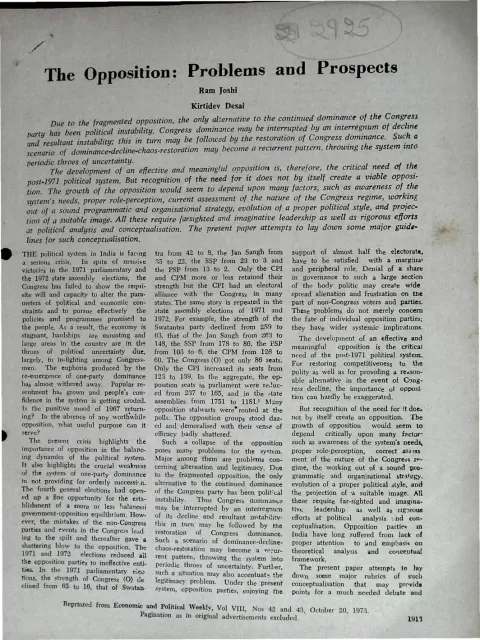
Ram Joshi and Kirtidev Desai argue that India’s post-1971 political system requires an effective opposition to prevent the cycle of Congress dominance, decline, instability, and renewed dominance. They attribute the opposition’s weakness to fragmentation, ideological rigidity, poor organisation, weak institutionalisation, inadequate leadership, and the absence of a coherent programme. Although opposition parties retained substantial electoral support, they failed to convert votes into parliamentary seats or build a stable alternative to Congress.
The essay proposes consolidation around broad ideological and programmatic affinities, while warning against both doctrinaire purity and an indistinguishable “me-too” stance. It calls for stronger inter-party coordination, decentralised and federal party structures, wider social mobilisation, sustained public education, clearer policy alternatives, younger leadership, and a more credible pro-people political style. The authors also emphasise systemic constraints: Congress can absorb oppositional demands, social groups may shift allegiance to the ruling party, and conflicts between government and opposition are often resolved through policy adjustment rather than changes of rulers. The concluding sections present opposition-building as a difficult but necessary undertaking, requiring parties to become a larger and more effective political entity.
Key points
- The fragmented opposition makes political instability the main alternative to continued Congress dominance.
- Opposition parties lost parliamentary and assembly seats despite retaining a substantial share of the vote.
- The principal organisational failures are excessive plurality, ideological dogmatism, weak institutionalisation, and a narrow support base.
- The authors advocate consolidation based on broad ideological affinity and practical programmatic coherence.
- A viable opposition requires leadership renewal, a flexible programme, stronger inter-party coordination, decentralisation, and wider social mobilisation.
- The opposition must articulate policy alternatives on economic management, elections, political finance, democratic practice, and state autonomy.
- Congress’s adaptive capacity and broad social base create systemic obstacles to opposition growth.
- The essay concludes that small, outdated opposition parties must develop into a wider political entity capable of providing an effective counterweight to Congress.
Metadata and summary are AI-extracted from the source PDF and reviewed for editorial accuracy. The original work is available via the Read PDF tab above (where present); paragraph-level citation inside the PDF is deferred to a future engagement.