book
LOOKING AFTER THE TRIBE
4 pages
Summary
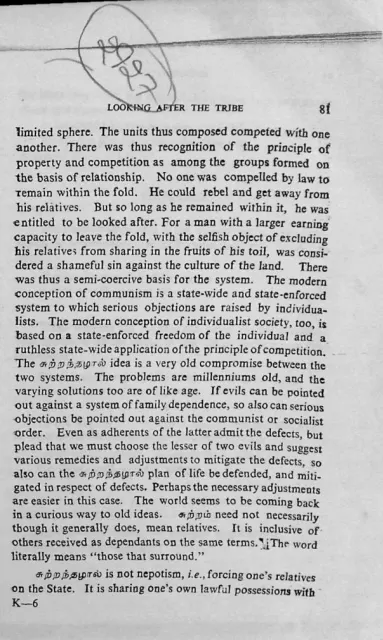
The rendered pages contain Chapters 53 and 54 of Looking After the Tribe. Chapter 53 examines the Indian cultural expectation that individuals should preserve and materially support their relatives. It presents the family as an economic and social unit in which members contribute according to their capacity and are maintained in roughly equal status. The text contrasts this arrangement with both state-enforced communism and aggressively individualist competition, arguing that the Tamil idea of collective family support represents an older compromise between the two systems.
The chapter defends distributing the benefits of wealth among relatives and dependants as a deliberate social arrangement rather than mere moral charity. It links mutual support to social happiness and uses the example of crows sharing food to illustrate a disposition toward collective prosperity. It also advises those whose relatives have left them to examine and remedy their own defects, while distinguishing legitimate family support from nepotism and the misuse of public resources. Chapter 54 turns to vigilance, warning that success can produce dangerous complacency. Its maxims stress continual alertness, the limits of wealth as protection, and the need to test returning associates before restoring confidence.
Key points
- Chapter 53 treats care for relatives as a moral and socio-economic obligation rooted in Tamil classical culture.
- The family is presented as a unit whose members contribute according to capacity and share in a common standard of maintenance.
- The text positions family-based communal support as a compromise between state-wide communism and unrestricted individualist competition.
- Sharing wealth with relatives and dependants is defended as a purposeful plan of life that produces mutual support and social happiness.
- The discussion distinguishes legitimate support for relatives from nepotism, especially the diversion of state resources to family members.
- The chapter advises self-examination when relatives desert someone and counsels against rejecting them when they return for their own interests.
- Chapter 54 argues that vigilance is necessary in every sphere and that achievement can generate harmful neglectfulness.
- The final maxims recommend testing those who return before restoring confidence and emphasize that wealth cannot secure the careless.
Metadata and summary are AI-extracted from the source PDF and reviewed for editorial accuracy. The original work is available via the Read PDF tab above (where present); paragraph-level citation inside the PDF is deferred to a future engagement.