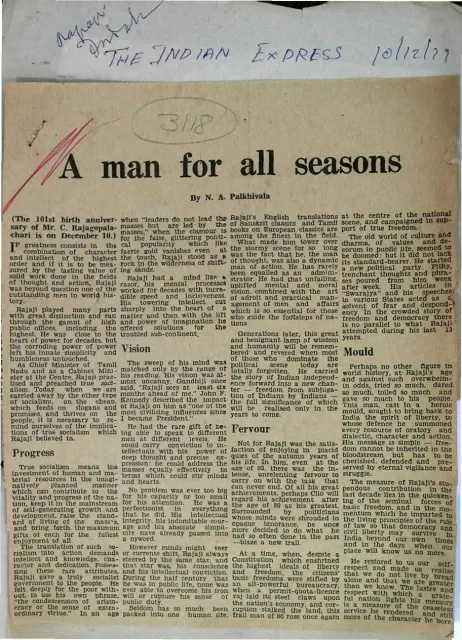
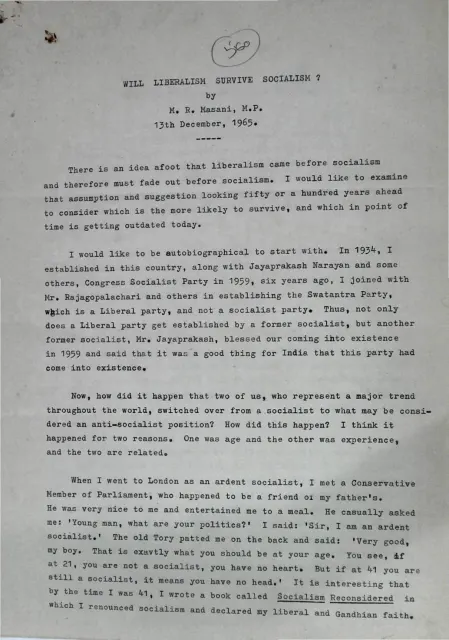
essay
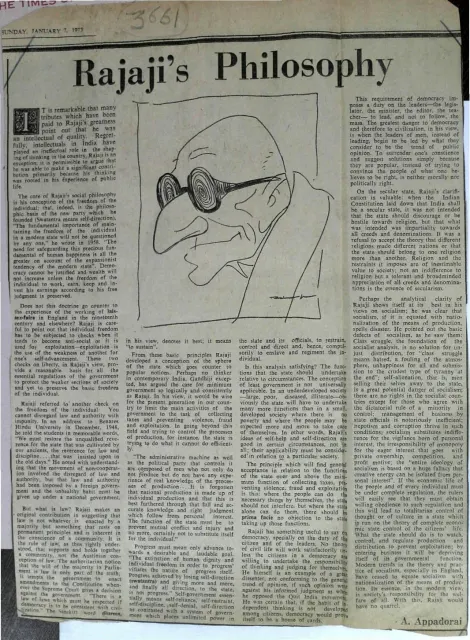
Rajaji’s Philosophy
THE TIMES OF INDIA · 1973
2 pages
Summary
In the rendered newspaper article, A. Appadorai presents C. Rajagopalachari’s social philosophy as an unusually consistent defence of individual freedom, self-direction, and limited government. Rajaji’s liberalism is described as grounded in public experience rather than abstract intellectualism: freedom is necessary for human happiness, while state expansion cannot by itself produce prosperity. The article distinguishes legitimate law and authority from majority rule, arguing that constitutional principles and individual judgment must constrain government. The article then develops Rajaji’s preferred sphere of government. The state should provide only the minimum functions that individuals cannot perform efficiently themselves, while avoiding excessive taxation, economic regulation, and direct control of production. Democracy, in this account, requires leaders to exercise independent judgment rather than follow popular opinion, and citizens must cultivate the capacity for self-government. The article also records Rajaji’s opposition to socialism and Marxist class analysis, his criticism of state ownership and bureaucratic control, and his defence of secularism as impartiality toward all religions. The second rendered page is a January 6, 1973 Swatantra Party letter requesting copies of newspaper issues concerning Rajaji’s hospitalisation; it is administrative correspondence rather than part of the philosophical argument.
Key points
- Rajaji’s philosophy is presented as a defence of individual freedom and self-direction. The article links human happiness and prosperity to freedom rather than state expansion. Law is distinguished from mere majority rule and is tied to enduring principles within a community. Government should be limited to functions individuals cannot perform efficiently themselves. The article criticises socialism, state ownership, bureaucratic control, and Marxist class analysis. Democracy requires leaders and citizens to exercise independent judgment rather than follow public opinion. Rajaji’s secularism is defined as state impartiality toward all religions and denominations.
- The second page is a Swatantra Party administrative letter requesting newspaper issues from the period of Rajaji’s hospitalisation.
Metadata and summary are AI-extracted from the source PDF and reviewed for editorial accuracy. The original work is available via the Read PDF tab above (where present); paragraph-level citation inside the PDF is deferred to a future engagement.