pamphlet · working paper
A Note on the Future of Swatantra Party
5 pages
Summary
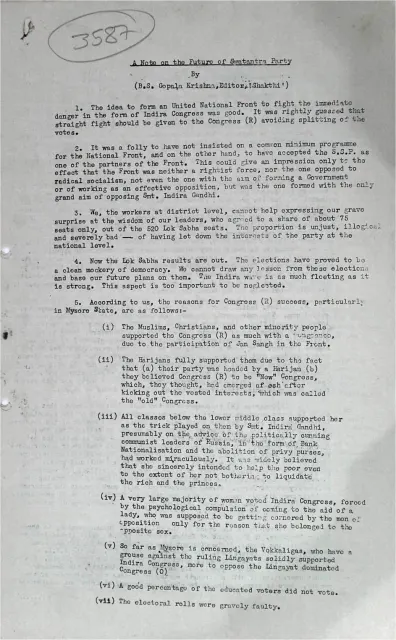
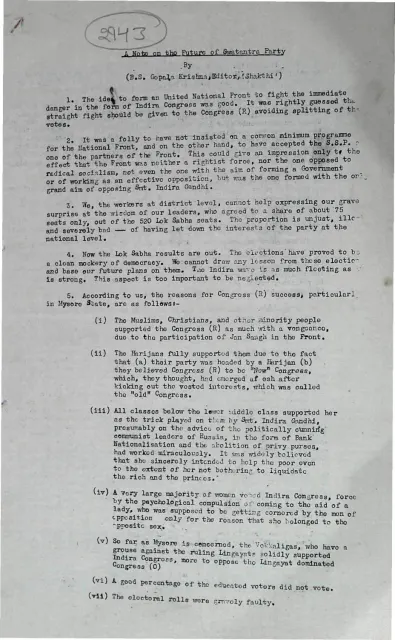
This five-page memorandum, attributed to B.S. Gopal Krishna, evaluates the Swatantra Party’s position after the Lok Sabha elections and argues that its immediate task is organisational renewal rather than opposition for its own sake. It criticises the decision to enter a United National Front without a common minimum programme, questions the allocation of approximately 75 seats among the partners, and interprets the Congress (R)‘s success—especially in Mysore State—as a primarily pro-Indira vote rather than a clear endorsement of either socialism or rightist ideology. The note attributes Congress (R)‘s appeal to minority support, Harijan voters, lower and lower-middle classes, women, regional anti-Lingayat sentiment, non-voting educated citizens, and defective electoral rolls.
Key points
- The memorandum says the United National Front was a sound response to the immediate danger posed by Congress (R), but faults the Swatantra Party for accepting the arrangement without a common minimum programme.
- It interprets the election results as evidence of personal loyalty to Indira Gandhi rather than a settled pro-socialist or anti-rightist public ideology.
- It warns that a country of 55 crores cannot depend on one individual and urges Swatantra to present itself as a responsible governing alternative, not merely an opposition party.
- It predicts that Congress (R)‘s internal diversity, personal rivalries, and ideological differences will eventually produce a split and create political disorder if no credible alternative emerges.
- It identifies weak contact between national leaders and district workers as a central organisational failure within Swatantra.
- For Mysore State, it recommends regular district meetings, recruitment, political instruction, local fundraising, candidates in all 212 constituencies, and a total campaign fund of 25 lakhs.
- It calls for scientifically planned campaigning and for the national headquarters to extend the Mysore organisational model to other states, including Madras, Andhra, Orissa, Rajasthan, and Gujarat.
Metadata and summary are AI-extracted from the source PDF and reviewed for editorial accuracy. The original work is available via the Read PDF tab above (where present); paragraph-level citation inside the PDF is deferred to a future engagement.