essay
A Note on the Future of Swatantra Party
5 pages
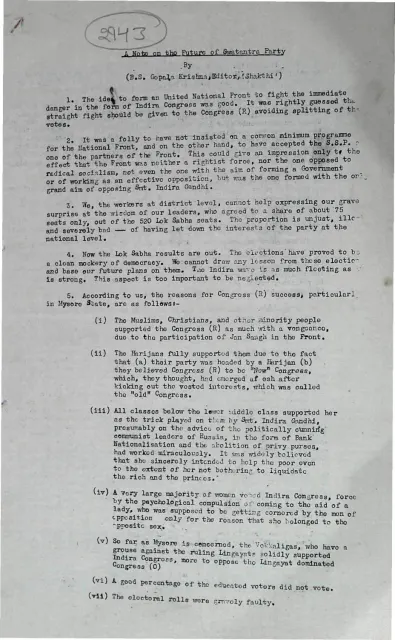
Summary
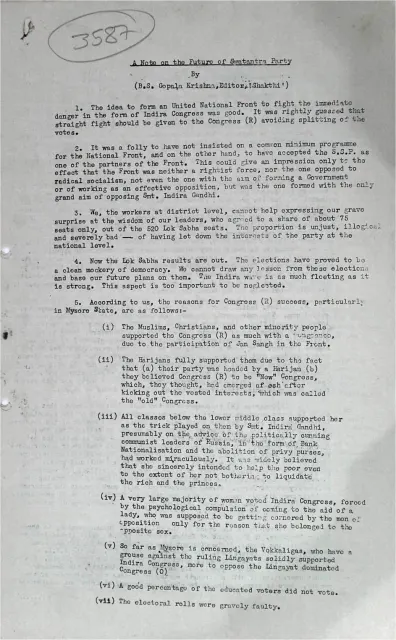
In this five-page note, B.S. Gopal Krishna argues that the Swatantra Party must reassess its position after the Lok Sabha elections and rebuild itself as a credible alternative to Indira Gandhi’s Congress (R). He approves the idea of a United National Front but criticises the absence of a common minimum programme and the decision to accept the S.S.P. as a partner. The election result, he contends, reflected personal loyalty to Indira Gandhi rather than either socialist or rightist ideology, and he attributes Congress (R)’s success to minority and Harijan support, lower-middle-class expectations, women’s voting patterns, regional caste alignments, non-voting educated voters, and defective electoral rolls.
Key points
- The Swatantra Party should not define itself merely as an opposition force; it must offer a constructive programme of governance.
- The author interprets the Congress (R) victory as a personal mandate for Indira Gandhi rather than a clear endorsement of socialism or right-wing ideology.
- The note warns that the Congress (R) coalition is held together chiefly by the pursuit of power and may fragment through personal rivalries and ideological differences.
- The Swatantra Party is described as organisationally weak, with insufficient contact between national leaders, state units, district workers, and individual members.
- The proposed remedy is sustained national-leader touring, regular workers’ meetings, recruitment, political education, fundraising, and contesting all 212 constituencies in Mysore State.
- The suggested Karnataka campaign should be scientifically planned, publicly educational, and directed against the dangers of an insincere socialist government.
- The paper recommends extending the Mysore organisational model to other states, including Madras, Andhra, Orissa, Rajasthan, and Gujarat.
Metadata and summary are AI-extracted from the source PDF and reviewed for editorial accuracy. The original work is available via the Read PDF tab above (where present); paragraph-level citation inside the PDF is deferred to a future engagement.