Summary
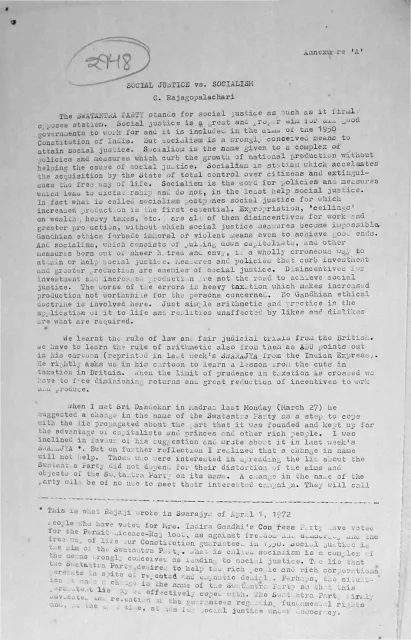
In the rendered pages, C. Rajagopalachari distinguishes social justice from socialism. He presents social justice as a constitutional and moral objective, but argues that socialism is a misconceived instrument because state control, nationalisation, expropriation, price controls, heavy taxation, and restrictions on investment weaken production, incentives, and individual freedom. He maintains that increased production is a prerequisite for social justice and that Gandhian ethics reject coercive or immoral means even when the intended ends are desirable.
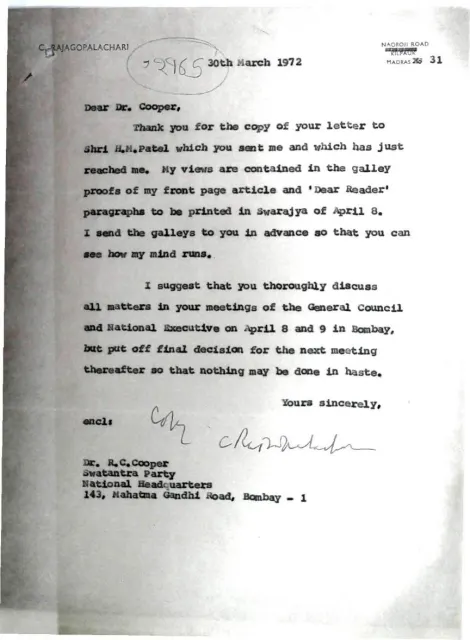
In the rendered pages, Rajagopalachari extends this economic argument into a defence of constitutional liberty and the Swatantra Party. He warns that excessive taxation and state power produce diminishing returns and erode the free way of life guaranteed by the Constitution. The annexed political texts, dated April 1 and April 8, 1972, urge Swatantra supporters to explain the party’s position clearly, resist what he describes as communist drift and emerging dictatorship, preserve parliamentary and extra-parliamentary resistance, and pursue the party’s mission without concern for electoral success or failure. The pages also frame the issue in Cold War terms, warning against India’s drift toward Communist China’s imperialism and asserting that the Indo-Soviet Treaty would not protect India.
Key points
- Social justice is treated as a legitimate constitutional objective, while socialism is rejected as an ineffective and coercive means of achieving it.
- State control, nationalisation, expropriation, price controls, and heavy taxation are presented as threats to production, investment, incentives, and freedom.
- The text argues that increased production must come before effective social-justice measures.
- Gandhian ethics are invoked to reject immoral or violent methods even when pursued for desirable ends.
- The British rule of law and fair trials are contrasted with the need to learn the economic lesson of diminishing returns from excessive taxation.
- The Swatantra Party is urged to defend the 1950 Constitution and resist the concentration of power and alleged communist drift.
- The annexed political statements emphasize perseverance, moral values, and resistance independent of electoral success.
- India’s international position is presented through an anti-communist warning concerning Communist China’s imperialism and the limits of the Indo-Soviet Treaty.
Metadata and summary are AI-extracted from the source PDF and reviewed for editorial accuracy. The original work is available via the Read PDF tab above (where present); paragraph-level citation inside the PDF is deferred to a future engagement.