essay · statement of principles
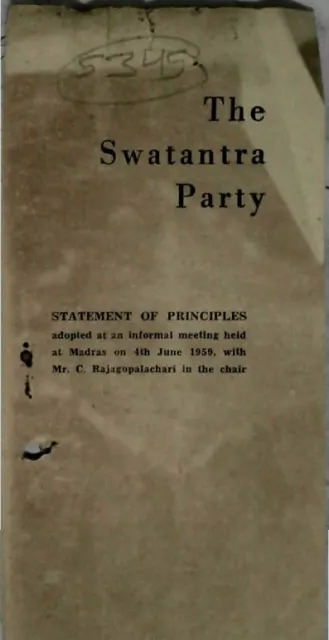
The Swatantra Party
STATEMENT OF PRINCIPLES
INLAND PRINTERS, BOMBAY · Bombay · 1959
4 pages
Summary
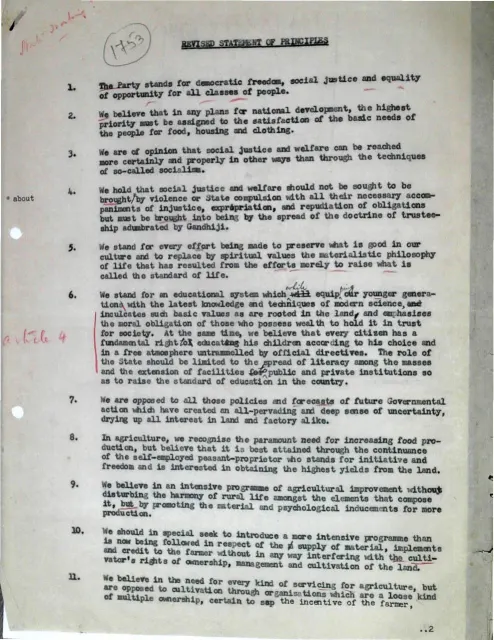
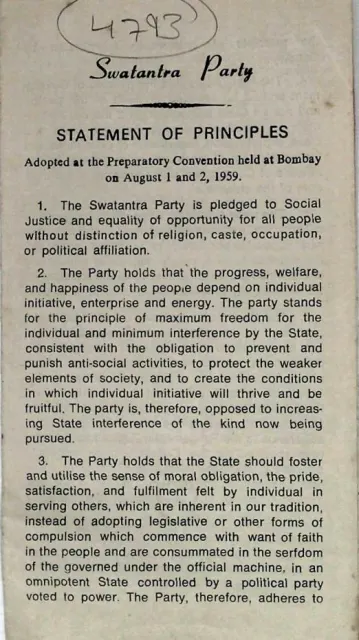
This four-page statement presents the Swatantra Party’s 19 principles, adopted at an informal meeting in Madras on 4 June 1959 with C. Rajagopalachari in the chair. It argues that social justice and welfare are better pursued through non-socialist means than through state compulsion, expropriation, or repudiation of obligations, and invokes Gandhi’s doctrine of trusteeship alongside a call to replace materialist values with spiritual ones.
The principles defend private property, freedom of trade and employment, fair compensation, competitive enterprise, and safeguards against excessive taxation, inflation, bureaucratic expansion, and indiscriminate government planning. In agriculture, the statement favors self-employed peasant proprietors, higher production through material and psychological incentives, and protection of cultivators’ ownership and management rights. It supports limiting state enterprise to areas where private initiative is difficult, and concludes by calling for a broad-based opposition party to safeguard democracy and promote decentralized industry and administration.
Key points
- The statement rejects socialism, state compulsion, expropriation, and repudiation of obligations as the primary means of achieving social justice.
- It combines Gandhi’s doctrine of trusteeship with an appeal to spiritual values against materialist economic goals.
- It defends freedom of property, trade, employment, and just compensation, including restoration of constitutional guarantees.
- It criticizes heavy taxation, deficit financing, foreign loans, inflation, bureaucratic expansion, and broad governmental planning.
- Its agricultural principles favor self-employed peasant proprietors, private ownership, and production incentives rather than collective or multiple ownership.
- It supports competitive private enterprise while restricting state enterprise to essential services or pioneer industries where private initiative is difficult.
- It proposes decentralized administration and a broad-based opposition party to safeguard democracy.
Metadata and summary are AI-extracted from the source PDF and reviewed for editorial accuracy. The original work is available via the Read PDF tab above (where present); paragraph-level citation inside the PDF is deferred to a future engagement.