interview
AN INTERVIEW WITH MINOO MASANI
1974
6 pages
Summary
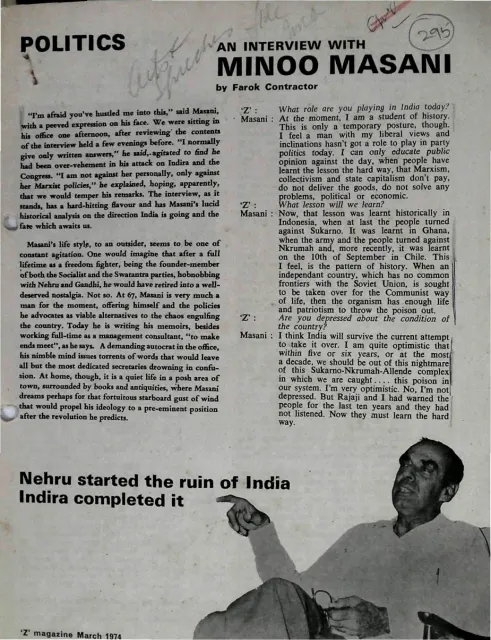
This March 1974 interview presents Minoo Masani as a liberal critic of Indira Gandhi, Congress, Marxism, collectivism, and state capitalism. Masani argues that India is undergoing a historical crisis caused by centralized economic management and authoritarian political methods, but remains optimistic that the country will eventually reject the “Sukarno-Nkrumah-Allende complex” and survive as a free society. He describes himself as a radical rather than a conservative, while insisting that liberal capitalism and Marxism are the only coherent alternatives and that there is no viable middle path.
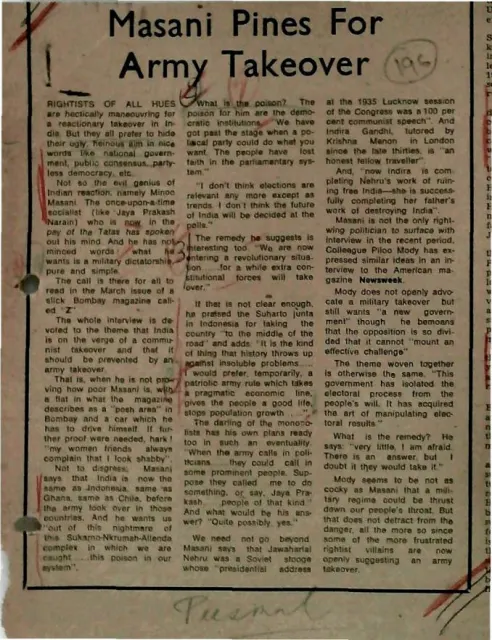
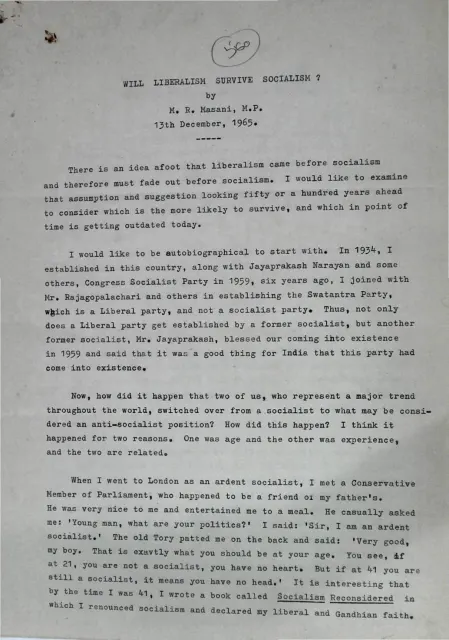
Masani defends the possibility of a temporary, patriotic military government with a pragmatic economic programme if the alternative is a Communist takeover, though he says democracy should be restored within a defined period. He attacks Communist infiltration, Congress’s alleged abandonment of Gandhian principles, inflationary planning, and the failures of the Soviet model. The interview also turns autobiographical: Masani recounts his movement from aggressive socialism to anti-Marxism, his association with Jayaprakash Narayan, his refusal to become a political “stooge” under Nehru, his modest lifestyle, and his continuing commitment to free speech, states’ rights, and political alternatives. The final rendered page is an unrelated advertisement, not part of the interview.
Transcript
Summary
This March 1974 interview presents Minoo Masani as a liberal critic of Indira Gandhi, Congress, Marxism, collectivism, and state capitalism. Masani argues that India is undergoing a historical crisis caused by centralized economic management and authoritarian political methods, but remains optimistic that the country will eventually reject the “Sukarno-Nkrumah-Allende complex” and survive as a free society. He describes himself as a radical rather than a conservative, while insisting that liberal capitalism and Marxism are the only coherent alternatives and that there is no viable middle path.
Masani defends the possibility of a temporary, patriotic military government with a pragmatic economic programme if the alternative is a Communist takeover, though he says democracy should be restored within a defined period. He attacks Communist infiltration, Congress’s alleged abandonment of Gandhian principles, inflationary planning, and the failures of the Soviet model. The interview also turns autobiographical: Masani recounts his movement from aggressive socialism to anti-Marxism, his association with Jayaprakash Narayan, his refusal to become a political “stooge” under Nehru, his modest lifestyle, and his continuing commitment to free speech, states’ rights, and political alternatives. The final rendered page is an unrelated advertisement, not part of the interview.
Key points
- Masani presents liberalism as an alternative to Marxism, collectivism, and state capitalism.
- He attributes India’s crisis to centralized political and economic power under Indira Gandhi and Congress.
- He predicts that India will eventually reject authoritarian and Communist models and remain a free society.
- He controversially considers a temporary patriotic military regime preferable to a Communist takeover, provided democracy is restored.
- He links inflation, unemployment, and food shortages to Indian planning, especially the framework associated with Mahalanobis.
- He recounts his transition from socialism to anti-Marxism and his break with Nehru over Soviet-aligned policies.
- He defends states’ rights, a rural social base for the Swatantra Party, and the importance of a freer press and viable political alternatives.
Metadata and summary are AI-extracted from the source PDF and reviewed for editorial accuracy. The original work is available via the Read PDF tab above (where present); paragraph-level citation inside the PDF is deferred to a future engagement.