Summary
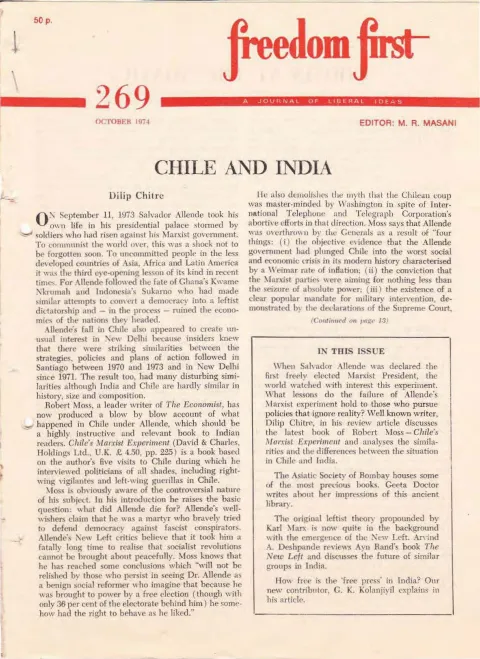
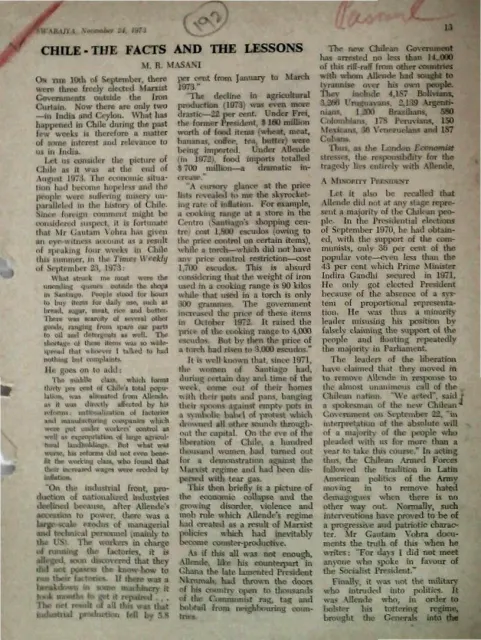
In these two pages, M. Masani examines the economic and political collapse of Chile under Salvador Allende, presenting it as a warning against Marxist government and centralized economic management. He describes inflation, shortages, declining agricultural and industrial production, state intervention, and popular unrest, including demonstrations by women protesting empty shops. The article also emphasizes that Allende was elected with only a minority of the popular vote and that the new government arrested thousands, including foreign nationals, while imposing what Masani characterizes as tyrannical rule.
Masani rejects the interpretation that the military takeover represented an isolated or anti-democratic aberration. He argues that Chile’s experience demonstrates the dangers of importing socialist models without regard to local conditions, and compares the Chilean crisis with Ghana, Indonesia, China, the Dominican Republic, and India’s Telangana episode. The closing argument is that a nation cannot survive unless it resists Soviet arms and military assistance with patriotic determination. The article is reproduced from Freedom First.
Key points
- Masani presents Chile’s economic crisis as the consequence of Allende’s Marxist policies and government intervention.
- The article cites severe inflation, food shortages, imports, agricultural decline, and falling industrial production.
- Women’s street demonstrations are described as a symbolic protest against empty shops and economic breakdown.
- Masani argues that Allende did not command a majority of Chilean voters and that the military acted in response to a broad national demand.
- The new regime’s arrests and treatment of political opponents are used to characterize Allende’s government as tyrannical.
- The article compares Chile with Ghana and other countries that, in Masani’s view, suffered after adopting communist models or accepting Soviet support.
- Masani concludes that resistance to Soviet arms and military assistance is necessary for national survival.
Metadata and summary are AI-extracted from the source PDF and reviewed for editorial accuracy. The original work is available via the Read PDF tab above (where present); paragraph-level citation inside the PDF is deferred to a future engagement.