periodical issue
Freedom First
A Journal of Liberal Ideas
By S. V. Raju
Published for the Democratic Research Service by J. R. Patel, Associate Editor, Freedom First at 127, M. Gandhi Road, Bombay 1 (Phone: 254341) and printed by him at Inland Printers, 55 Gamdevi Road, Bombay 7. · Bombay · 1974
16 pages
Freedom First
Summary
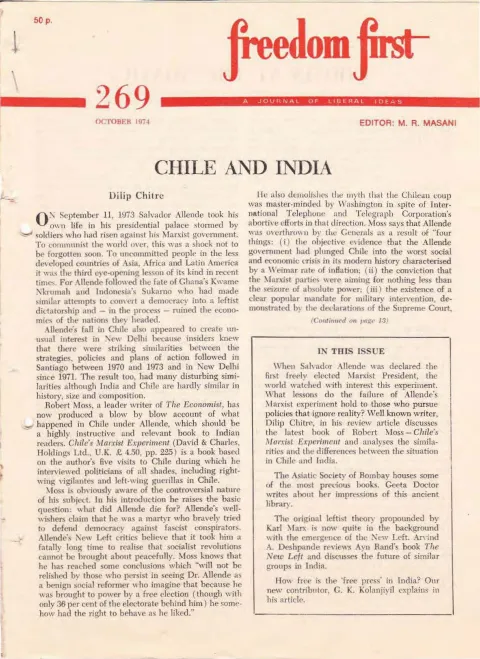
Freedom First No. 269 (October 1974), edited by M. R. Masani, is a full 16-page issue of the Bombay-based journal of liberal ideas, and the rendered pages cover the entire issue cover to cover. The lead piece is Dilip Chitre’s review-essay ‘Chile and India,’ which uses Robert Moss’s book Chile’s Marxist Experiment to draw an extended, anxious parallel between Salvador Allende’s fall and Indira Gandhi’s post-1971 concentration of power, arguing that India’s ‘socialism’ is a crony arrangement between the ruling elite and big capitalists rather than a genuine Marxist project, and that unlike Chile, Indian capitalists have profited from statism rather than being attacked by it. Geeta Doctor contributes a whimsical, gothic essay on the statuary and dust of the Asiatic Society library in Bombay. Arvind A. Deshpande reviews Ayn Rand’s The New Left and surveys India’s own New Left currents (Naxalites, the Dalit Panthers, the Yuvak Kranti Dal, the ‘Magova’ Marxist group), finding most of them derivative, alienated from ordinary Indians, and short on constructive method. G. K. Kolanjiyil’s ‘Freedom: To Publish or to Print’ is a sustained polemic against the self-censorship, timidity and government-friendliness of the mainstream Indian press, contrasted with the small papers and with the American press’s willingness to challenge its own government. The issue also carries two book reviews (an anthology of new Indian writing edited by Adil Jussawalla, reviewed by Pervin Mahoney; and a British industrial-relations text on productivity bargaining, reviewed by Rusi J. Daruwalla), two letters on the Bharatiya Lok Dal merger and defections from the Swatantra Party, a reprinted exchange of letters between AFL-CIO president George Meany and Alexander Solzhenitsyn, and the regular ‘With Many Voices’ page of quotations closing the issue with a subscription coupon.
Key points
-
Dilip Chitre’s “Chile and India,” reviewing Robert Moss’s Chile’s Marxist Experiment, argues Indira Gandhi’s post-1971 concentration of power parallels Allende’s Chile in squeezing the judiciary and press, but that Indian “socialism” is a crony arrangement benefiting capitalists rather than a genuine Marxist project, and calls for decontrol and decentralisation rather than military or further leftist takeover.
-
Geeta Doctor’s “Ghosts at the Asiatic” is a gothic-toned essay on the neglected grandeur and colonial-era statuary of Bombay’s Asiatic Society library.
-
Arvind A. Deshpande reviews Ayn Rand’s The New Left approvingly and surveys India’s own New Left currents, finding the Naxalites Calcutta-bound romantics, the Dalit Panthers caught between ideology and welfare work, and the “Magova” Marxist group guilty of upper-caste condescension and mockery of Jayaprakash Narayan.
-
G. K. Kolanjiyil’s “Freedom: To Publish or to Print” argues the Indian press’s freedom is largely illusory, accusing national dailies of double standards toward foreign versus Indian leaders and of suppressing stories on Nepal and Chittagong to protect newsprint quotas.
-
Pervin Mahoney reviews Adil Jussawalla’s anthology New Writing in India, praising Bhalchandra Nemade’s contribution while identifying translation as the collection’s central weakness compared to its directly-English poems.
-
Rusi J. Daruwalla reviews a British text on productivity bargaining, Productivity Agreements and Wage Systems, summarising its grounding in Maslow, Herzberg, McGregor and Likert.
-
Letters cover R. N. Singh Deo’s downplaying of Biju Patnaik’s corruption as mere “improprieties” and S. V. Raju’s account of the Bharatiya Lok Dal’s formation from the dissolution of the Swatantra Party and other groups.
-
A reprinted exchange between AFL-CIO president George Meany and Alexander Solzhenitsyn sees Meany invite Solzhenitsyn to tour the United States as a labour-movement guest, an invitation Solzhenitsyn politely declines to conserve his energy for recovering his country’s unwritten history.
-
The closing “With Many Voices” page quotes commentary on Nixon’s resignation and Watergate-era morality alongside Solzhenitsyn’s observation that Moscow and Leningrad have become the world’s most uninformed cities.
Essays
Chile and India
By Dilip Chitre
Dilip Chitre reviews Robert Moss’s Chile’s Marxist Experiment and uses it to draw a sustained, uneasy analogy between Allende’s Chile and Indira Gandhi’s India. He summarises Moss’s account of why the Chilean generals overthrew Allende (economic collapse, a Marxist bid for total power, a judicial mandate for intervention, and leftist efforts to subvert the armed forces), and rejects the CIA/ITT conspiracy explanation. Chitre then argues Chile’s crisis is ‘relevant’ to India: both saw an omnibus ruling party captured by crypto-Marxist ideologues, both saw the judiciary, press and dissent squeezed, and both dressed statist economics in socialist language. But he identifies one crucial difference — Chilean capitalists were frontally attacked, while Indian capitalists have colluded with and profited from state socialism, making the Indian arrangement ‘a parody of free enterprise’ rather than a copybook Marxist experiment. He closes by rejecting both a military and a further leftist takeover as solutions, and calls instead for decontrol and decentralisation.
- Moss’s book explains Allende’s overthrow as driven by economic collapse, a Marxist bid for total power, a Supreme Court-endorsed popular mandate, and leftist subversion of the army, not a CIA/ITT plot.
- Chitre draws close parallels between Congress’s capture by crypto-Marxist ideologues after 1971 and the Marxist takeover of Allende’s coalition.
- The judiciary, press and opposition were squeezed in both Chile and Congress-era India (supersession of judges, newsprint controls, MISA).
- Key difference: in Chile big business was attacked by the state; in India leading capitalists have profited from and colluded with ‘socialist’ policy, making Indian socialism feudal in form and function.
- Chitre rejects both a military takeover and a further leftward lurch as solutions to India’s problems, and instead calls for decontrol and decentralisation of the economy.
- He frames Allende’s Marxism as a genuine (if failed) doctrinaire experiment, while India’s ‘Marxist experiment is not even meant to be Marxist.‘
Ghosts at the Asiatic
By Geeta Doctor
Geeta Doctor’s ‘Ghosts at the Asiatic’ is a discursive, gothic-toned essay on the Asiatic Society library in Bombay, formerly the Town Hall. She describes the building’s neglected grandeur — pigeon-fouled reading rooms, dispirited newspapers on display boards, and a hall of nineteenth-century marble statuary of colonial worthies (Jagannath Shankarshett, Sir Jamsetji Jijibhoy, the Marquis of Cornwallis, Mountstuart Elphinstone, Charles Forbes, Jonathan Duncan) rendered by sculptors more interested in drapery and gesture than character. She recounts anecdotes about the statues’ checkered provenance (a bust left in a packing case for three years) and closes with a personal, half-joking account of sitting alone in the eerie stillness of the Oriental Research Room, imagining the statues coming to life.
- The essay profiles the physical decay and ‘aura of malevolence’ of the Asiatic Society building, once Bombay’s Town Hall.
- It catalogues the hall’s marble statues of British-era worthies — Jagannath Shankarshett, Jamsetji Jijibhoy, Cornwallis, Elphinstone, Charles Forbes, Jonathan Duncan — and their sculptors.
- Anecdotes highlight the arbitrariness of the statuary’s commissioning and neglect, including a bust left in storage for three years.
- Charles Forbes, credited with helping suppress female infanticide, is ironically consigned to an isolated room.
- The piece ends with the author’s own experience of eerie stillness while studying in the library’s Oriental Research Room.
The New Left: A Journey from Ignorance to Cocksure Ignorance
By Arvind A. Deshpande
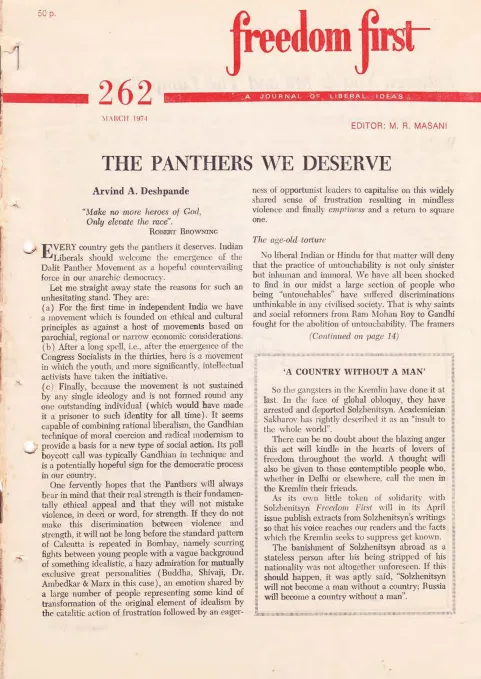
Arvind A. Deshpande reviews Ayn Rand’s The New Left: Anti-Industrial Revolution, praising Rand’s forceful anti-collectivism while noting her tendency to exaggerate and her likely limited appeal beyond the American middle class. He worries that the U.S. may become ‘an island surrounded by a vast leftist sea’ as radical currents deepen in Europe. Turning to India, Deshpande surveys the domestic New Left — the Naxalites (dismissed as Calcutta-centred armchair romantics out of touch with Bengal’s own civic failures), the Dalit Panthers (caught between ideology and welfare work), the Yuvak Kranti Dal (non-Marxist, under-theorised on economics but promising on social reform), and the ‘Magova’ group of self-styled Marxists (accused of upper-caste condescension and parroting borrowed rhetoric, including sneering references to Jayaprakash Narayan as a ‘cultural-freedomwalla’). He recommends Philip Spratt’s Hindu Culture and Personality over rote quotation of Marx and Lenin, and closes hoping for young Indians who will act on poverty rather than merely theorise about it.
- Deshpande credits Ayn Rand’s The New Left with intellectual force against collectivist and totalitarian thought, while flagging her exaggeration and narrow appeal.
- He anticipates that European social democrats will keep drifting further left under pressure from inflation, pollution, youth alienation and poverty.
- India’s Naxalites are portrayed as Calcutta-bound romantics whose ‘consciousness’ ignores the city’s own civic failures and needs Mao to remind them of rural poverty.
- The Dalit Panthers are described as caught in an ‘agonising choice’ between ideology and welfare work.
- The Yuvak Kranti Dal is praised for rejecting totalitarian methods but criticised for weak economic thinking.
- The ‘Magova’ Marxist group is accused of upper-caste condescension, alienation from Indian realities, and mocking J.P. Narayan as a ‘cultural-freedomwalla.’
- Deshpande recommends Philip Spratt’s Hindu Culture and Personality as a better guide than repeated quotation of Marx and Lenin.
Freedom: To Publish or To Print
By G. K. Kolanjiyil
G. K. Kolanjiyil’s ‘Freedom: To Publish or to Print’ argues that the Indian press’s vaunted freedom is largely illusory, quoting Jean Francois Revel’s critique of French media self-censorship as equally applicable to India. He accuses national dailies of pillorying Nixon and Agnew while shielding the Indian President and Prime Minister from equivalent scrutiny, of underplaying stories embarrassing to the government (the Kidwai-Nehru role in Nepal, Indian military activity in Chittagong), and of colluding with the government over newsprint quotas at the cost of covering the opposition. He contrasts this with smaller papers, which broke stories the nationals suppressed, and closes by asking whether the Indian press has genuinely lived up to its self-proclaimed role as watchdog of democratic freedom, given its coverage of the 1974 railway strike and its complicity in ‘furthering the national interest’ around the 1962 China war.
- Kolanjiyil applies Jean Francois Revel’s critique of French television’s fear of news and truth directly to the contemporary Indian press.
- National dailies are accused of double standards: fierce criticism of foreign leaders (Nixon, Agnew) alongside deference to India’s own President and Prime Minister.
- Examples of suppressed or downplayed stories include the Kidwai-Nehru role in Nepal’s ‘revolution’ and Indian troop movements in the Chittagong hill tracts.
- Smaller, less ‘responsible’ papers are credited with breaking stories (the Kittur episode, harassed writers’ viewpoints) that national dailies avoided.
- The press’s self-censorship around the 1962 India-China war and the 1974 railway strike is presented as evidence it prioritises ‘national interest’ framing over informing citizens.
- Kolanjiyil concludes that a free press is only meaningful if it actually functions as a watchdog of other liberties, which he doubts the Indian press has done.
Reviews: A Mixed Bag (New Writing in India, ed. Adil Jussawalla)
By Pervin Mahoney
No summary was extracted for this article. Listed for completeness.
Reviews: Productivity & Wage (Productivity Agreements and Wage Systems, by D.T.B. North and G.L. Buckingham)
By Rusi J. Daruwalla
Pervin Mahoney reviews New Writing in India, an anthology edited by Adil Jussawalla, calling the collection uneven but valuable for making otherwise inaccessible contemporary Indian writing available in English. She praises standout selections such as Bhalchandra Nemade’s The Cocoon and criticises weaker ones, including an overly brief extract from Qurratulain Hyder’s River of Fire and derivative pieces by Balraj Manra and P. Lankesh built on borrowed ‘alienation.’ She dwells at length on the difficulty of translation, arguing that the anthology’s directly-English poems (Kamala Das, Gieve Patel) land far more vividly than translated ones, though she credits editor Jussawalla for choosing selections on literary rather than political grounds.
- Mahoney calls Jussawalla’s anthologising task an impossible ‘Hercules’ labour’ and finds the collection deliberately partial rather than exhaustive.
- Bhalchandra Nemade’s The Cocoon is singled out as an outstanding, self-contained extract.
- The Qurratulain Hyder extract from River of Fire is judged too brief to let its Partition-era protagonist’s plight register.
- Balraj Manra’s The Box of Matches and P. Lankesh’s Bread are criticised as derivative treatments of ‘alienation’ unassimilated into art.
- Translation is identified as the anthology’s central weakness: English-language poems by Kamala Das and Gieve Patel are far more vivid than translated poets like Vinda Karandikar and Dhoomil.
- Mahoney credits Jussawalla for choosing extracts on literary rather than political criteria, despite an introduction with ‘ominous rumblings’ of fashionable Marxism.
Letter: Birds of a Feather
By S. Gopalakrishnan
Rusi J. Daruwalla reviews Productivity Agreements and Wage Systems by D.T.B. North and G. L. Buckingham, a 1969 British text reprinted as a handbook for Indian labour-wage negotiators. The review summarises the book’s account of productivity bargaining as a wage-work exchange between labour and management resting on comprehensive analysis of production, economics, sociology and earnings, and notes its grounding in the motivation research of Maslow and Herzberg and the management philosophies of McGregor and Likert, before describing its practical treatment of wage-structure design and negotiation.
- The book under review is a reprint of a 1969 British standard work on productivity bargaining, aimed at Indian wage-agreement formulators despite its English-conditions focus.
- Productivity bargaining is defined as a wage-work exchange requiring detailed studies of the full industrial relations situation, not just a short-term ‘buy-out’ of restrictive practices.
- The authors draw on Maslow’s and Herzberg’s employee-motivation research and the management philosophies of Douglas McGregor and Rensis Likert.
- The book’s later sections cover wage-structure design, negotiation, and implementation of productivity agreements.
Not Merger But Surrender
By S. V. Raju
Two letters to the editor appear under the heading ‘Letter.’ S. Gopalakrishnan’s ‘Birds of a Feather’ mocks R. N. Singh Deo’s defence of Biju Patnaik as mere ‘improprieties’ rather than corruption, noting that Singh Deo was himself subsequently found guilty by a commission, and warns that both ruling and opposition parties risk sliding toward fascism. S. V. Raju’s ‘Not Merger But Surrender’ recounts the formation of the Bharatiya Lok Dal (BLD) from the merger or dissolution of several parties including the Swatantra Party, describes Charan Singh’s reassurances to BKD loyalists, and reports on related splits (the United Goans, Chimanbhai Patel’s Gujarat party) and R. N. Singh Deo’s being found guilty of ‘illegal, improper, arbitrary and malafide acts’ by the Mitter Commission.
- Gopalakrishnan criticises R. N. Singh Deo’s defence of Biju Patnaik as downplaying corruption to mere ‘improprieties,’ noting Singh Deo was himself later found guilty.
- The letter warns that both ruling and opposition parties in India risk becoming ‘birds of the same feather’ tending toward fascism.
- Raju details the formation of the Bharatiya Lok Dal (BLD) on 29 August from a ‘trail of split parties,’ including the dissolution of the Swatantra Party.
- Charan Singh reassures BKD loyalists that the party has only expanded, not dissolved, keeping its symbol and flag.
- Related party splits are reported: the United Goans splitting over Erasmo De Sequeira, and Chimanbhai Patel’s Gujarat party’s failed merger talks with the BLD.
- R. N. Singh Deo is reported to have been found guilty of ‘illegal, improper, arbitrary and malafide acts’ by the Mitter Commission.
s Nobel lecture that
This item reprints an exchange of letters between AFL-CIO president George Meany and Soviet dissident Alexander Solzhenitsyn. Meany, invoking Solzhenitsyn’s Nobel lecture that ‘there are no internal affairs left on this crowded earth,’ recalls the American labour movement’s documentation of Soviet forced-labour camps and the GULAG network, and extends a formal invitation for Solzhenitsyn to tour the United States as a guest of the American trade union movement, with opportunities to travel and speak freely. Solzhenitsyn’s reply politely declines, citing the need to conserve his limited physical and spiritual energy for his main literary project — recovering his country’s unwritten history — while thanking Meany for the gesture.
- Meany’s letter invokes Solzhenitsyn’s Nobel Prize lecture line that ‘there are no internal affairs left on this crowded earth’ to justify the American labour movement’s concern with Soviet repression.
- Meany recalls the AFL’s historic documentation of Soviet forced-labour camps and its role in prompting the UN Economic and Social Council’s Ad Hoc Committee on Forced Labour.
- Meany extends a formal invitation for Solzhenitsyn to tour the United States as a guest of the American trade union movement, with free opportunity to travel and speak.
- Solzhenitsyn’s reply agrees in principle with the ‘no internal affairs’ idea but declines the invitation, citing limited physical and spiritual capacity after being ‘forcibly torn’ from his homeland.
- Solzhenitsyn says he can only spare energy for his main literary project of recovering his country’s unwritten history.
Solzhenitsyn-Meany Correspondence
By George Meany / A. Solzhenitsyn
‘With Many Voices’ is the issue’s closing page of curated quotations under a Tennyson epigraph, drawing from Time, The Economist, Quest and the Economic & Political Weekly on subjects ranging from Nixon’s resignation and Watergate-era morality to Mrs. Gandhi’s governance, Solzhenitsyn’s remarks on Soviet insularity, student power, and Naga insurgency. The page closes with the journal’s subscription coupon.
- The page compiles brief quotations from Time, The Economist, Quest and other publications, framed by an epigraph from Tennyson.
- Several quotations concern Nixon’s resignation and the moral standing of the U.S. after Watergate.
- Quotations from ‘D. in Quest’ comment critically on Mrs. Gandhi’s governance and India’s ‘poverty of policies.’
- A quotation from Solzhenitsyn (via Quest) observes that Moscow and Leningrad have become the most uninformed cities in the world.
- The page ends with a subscription form for Freedom First, published by the Democratic Research Service.
Generated by the v1.5 extraction pipeline. Awaiting editorial review.
Metadata and summary are AI-extracted from the source PDF and reviewed for editorial accuracy. The original work is available via the Read PDF tab above (where present); paragraph-level citation inside the PDF is deferred to a future engagement.