essay
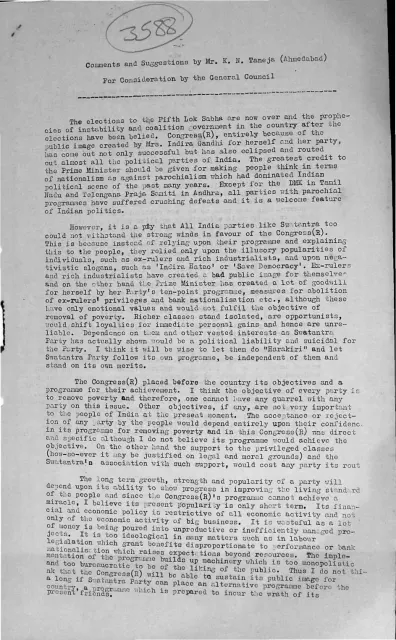
Comments and Suggestions by Mr. K. N. Taneja (Ahmedabad)
For Consideration by the General Council
Ahmedabad
2 pages
Summary
This two-page submission by K. N. Taneja of Ahmedabad assesses the Swatantra Party after the Fifth Lok Sabha elections. Taneja credits Indira Gandhi and Congress(R) with successfully presenting their programme as nationalist and anti-parochial, while arguing that most parties with parochial platforms suffered decisive defeats. He criticizes Swatantra’s reliance on the personal popularity of ex-rulers, wealthy industrialists, and slogans rather than on a clearly explained programme, and warns that dependence on vested interests is politically damaging.
Taneja argues that Swatantra should define itself as a party of the middle classes, peasant proprietors, small business, professionals, managers, and self-employed people. The proposed programme combines opposition to monopolistic big business, bureaucratic control, and ex-ruler privileges with support for small enterprise, professional management, agricultural investment, and reduced state interference. He also emphasizes the effects of inflation and the falling value of the rupee on fixed-income middle-class groups. The paper concludes that Swatantra must demonstrate its independence from vested interests and build a practical, all-India programme focused on removing poverty and improving living standards.
Key points
- Taneja interprets Congress(R)‘s electoral success as evidence that nationalist and anti-parochial appeals resonated with voters.
- He argues that Swatantra’s dependence on ex-rulers, wealthy industrialists, and personal popularity has weakened its public image.
- The paper presents poverty removal and improved living standards as the central objectives of political programmes.
- Taneja criticizes restrictive economic policy, excessive state control, bureaucratic administration, and inefficient public projects.
- He recommends that Swatantra present itself as a party of middle-class groups, peasant proprietors, small businesses, professionals, and self-employed people.
- The proposed strategy includes reducing protection for big business, supporting small enterprises, professionalising private-sector management, and directing savings toward agriculture.
- The paper calls for public mobilisation around inflation, including criticism of business practices and organisation of commodity supply at reasonable profits.
- Taneja concludes that Swatantra can rebuild its image only through unequivocal independence, demonstration, opposition, and action.
Metadata and summary are AI-extracted from the source PDF and reviewed for editorial accuracy. The original work is available via the Read PDF tab above (where present); paragraph-level citation inside the PDF is deferred to a future engagement.