essay · working paper
THE STRATEGY FOR THE GENERAL ELECTION
1966
6 pages
Summary
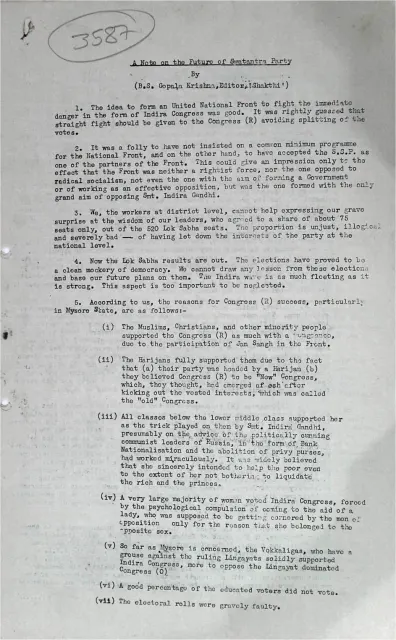
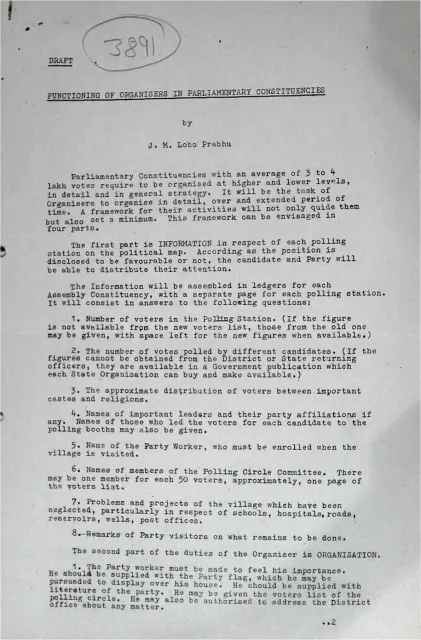
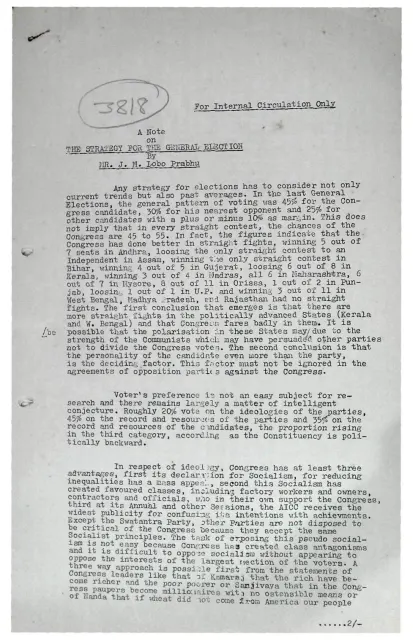
In this six-page internal-circulation note dated 1 May 1966, J. M. Lobo Prabhu develops an electoral strategy for the Swatantra Party. He begins from voting patterns in the previous general elections, arguing that candidate preference, party records and resources, regional polarisation, and the strength of Communist opposition all shape outcomes. He estimates that voters respond in varying proportions to party ideology, party performance and resources, and the personal record of candidates, while a large non-voting population remains to be reached.
Key points
- The note treats candidate personality and record as potentially more decisive than party affiliation in closely contested constituencies.
- It recommends presenting Congress’s socialism as a form of state-created class privilege that benefits organised groups and entrenched interests.
- The policy critique targets high taxation, inflation, economic controls, nationalisation, excessive administrative interference, and corruption.
- The Swatantra alternative is framed as full competition, legitimate private property, incentives for investment, bottom-up planning, and wider ownership rather than expropriation.
- The note proposes rural housing, employment, property rights for tenants and workers, and opportunities for landless labourers as ways to build support among rural voters.
- It analyses voter blocs, including lower castes, voters influenced by landlords or local leaders, educated and middle-class voters, and those who do not vote.
- It recommends strict protection of ballot secrecy, action against election offences, publicity about government performance, village-level campaigning, and careful use of candidate records.
- The concluding argument is that Swatantra can succeed by presenting itself as the party of an open society and equality of opportunity rather than as a party serving the rich.
Metadata and summary are AI-extracted from the source PDF and reviewed for editorial accuracy. The original work is available via the Read PDF tab above (where present); paragraph-level citation inside the PDF is deferred to a future engagement.