
Summary
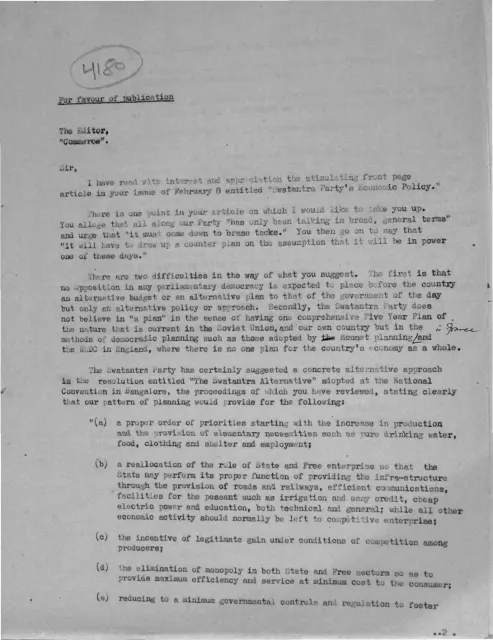
In this two-page letter dated New Delhi, February 18, 1964, M. R. Masani responds to an article in Commerce titled “Swatantra Party’s Economic Policy.” He rejects the claim that the party has spoken only in broad terms and must prepare a complete alternative budget before it can govern. Masani argues instead that an opposition party should set out alternative policies and approaches, not necessarily an alternative government budget or a single comprehensive economic plan.
Masani outlines the Swatantra Party’s concrete planning alternative: prioritising basic necessities and employment; reallocating responsibilities between the state and free enterprise; encouraging legitimate profit under competition; eliminating monopolies in both sectors; reducing government controls and regulation; maintaining price stability through monetary discipline; reforming taxation to encourage saving, investment, and employment; and ensuring remunerative agricultural prices. He cites figures from his 1963 parliamentary speech to argue that meeting basic needs would require major increases in food-grain and cloth production, a higher growth rate, and an economic framework combining family farming, competitive private enterprise, and essential industrial and trade controls.
Key points
- Masani disputes the claim that the Swatantra Party has offered only vague economic ideas.
- He distinguishes an opposition party’s alternative policy approach from a fully costed alternative budget.
- The Swatantra alternative prioritises drinking water, food, clothing, shelter, employment, and other elementary needs.
- The letter advocates a division of labour between state-provided infrastructure and competitive private enterprise.
- It calls for eliminating monopolies, limiting governmental controls, maintaining monetary discipline, and reforming taxation.
- Masani links basic-needs provision to sharply increased food-grain and cloth production and a growth rate of 7 or 8 per cent annually.
- He presents family farming and competitive private enterprise, combined with minimum industrial and trade controls, as a route to economic growth.
Metadata and summary are AI-extracted from the source PDF and reviewed for editorial accuracy. The original work is available via the Read PDF tab above (where present); paragraph-level citation inside the PDF is deferred to a future engagement.
People in this work
Related across the archive
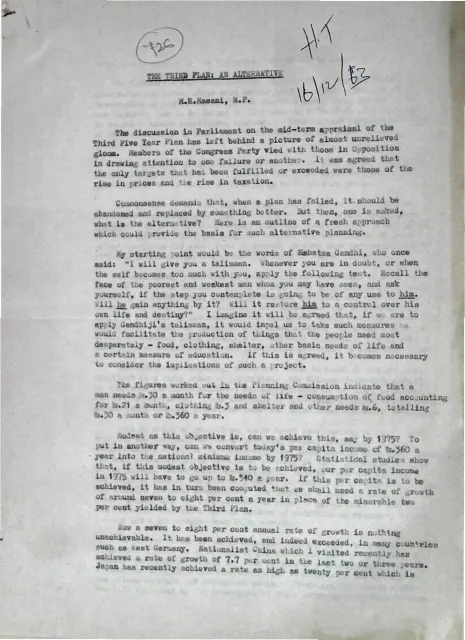 Primary workTHE THIRD PLAN: AN ALTERNATIVE
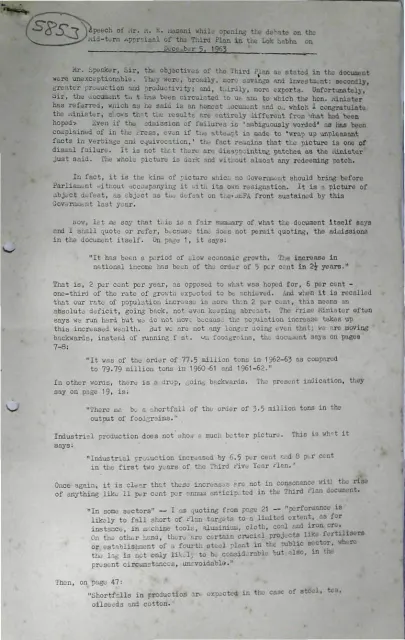 Primary workSpeech of Mr. M. R. Masani while opening the debate on the mid-term appraisal of the Third Plan in the Lok Sabha on December 5, 1963
 ExcerptThe Liberal Budget: Building an Equitable Society
 ExcerptEconomic Reforms In India: Where Are We And Where Do We Go?