essay
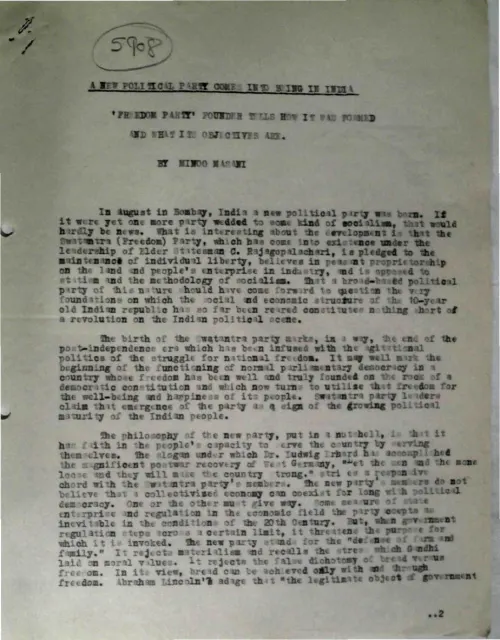
A New Political Party Comes into Being in India
AND WHAT ITS OBJECTIVES ARE
By Minoo Masani
9 pages
Summary
The rendered pages combine an affidavit, a Toyota Land Cruiser advertisement, and a contemporary magazine article by Minoo Masani, “A New Political Party Comes into Being in India: ‘Freedom Party’ Founder Tells How It Was Formed.” The article presents the formation of the Swatantra (Freedom) Party in Bombay in August, describing it as a response to the Congress party’s socialist orientation and as a political organization committed to individual liberty, private enterprise, peasant proprietorship, and parliamentary democracy.
Masani argues that the party rejects statism, collectivized farming, excessive taxation, bureaucratic licensing, and state monopolies in food distribution. It advocates a self-employed peasantry, expanded private enterprise, a limited role for state enterprise in heavy industry and national services, and a mixed but predominantly market-oriented economy. The article also frames the party as explicitly anti-Communist, warning that Congress policies could make Communism more respectable while insisting that Swatantra could offer Indian voters an alternative to the Congress–Communist binary. The pages end with Masani’s cautious forecast that the party’s prospects will depend on building a broad, grassroots movement among farmers and the urban middle classes.
Key points
- The article describes the creation of the Swatantra Party in Bombay and identifies C. Rajagopalachari as its principal leader.
- Swatantra is presented as a defender of individual liberty, private enterprise, peasant proprietorship, and parliamentary democracy.
- Masani criticizes Congress economic policy for excessive planning, taxation, licensing, bureaucracy, and state intervention.
- The article opposes land ceilings, collectivized or cooperative farming imposed by the state, and a government monopoly over wholesale food-grain trade.
- The party supports incentives for agricultural production, secure ownership, credit, irrigation, tools, seed, and fertilizer.
- In industry, Swatantra favors private enterprise and balanced development, with state enterprise limited chiefly to heavy industries and national services.
- The party rejects Communism and argues that Congress policies are unintentionally preparing the ground for Communist influence.
- Masani believes the party’s electoral future depends on mobilizing small farmers and middle-class voters rather than relying primarily on big business.
Metadata and summary are AI-extracted from the source PDF and reviewed for editorial accuracy. The original work is available via the Read PDF tab above (where present); paragraph-level citation inside the PDF is deferred to a future engagement.