Summary
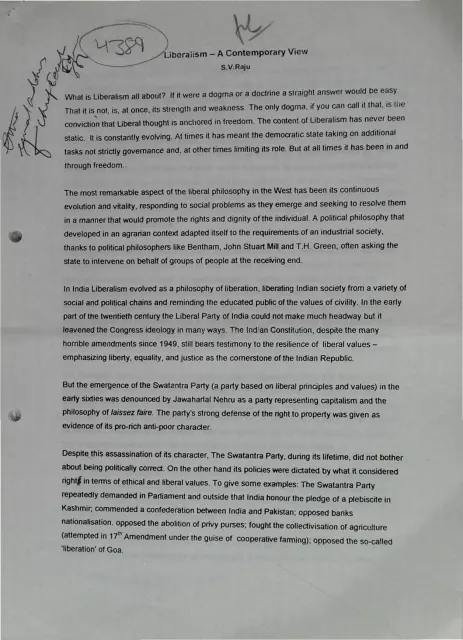
In the rendered pages, S. V. Raju argues that liberalism is not synonymous with laissez-faire or with a State reduced to a “night watchman” role. He presents European liberalism as a revolt against arbitrary authority, dogma, mercantilist restrictions, and the absence of a clear boundary between individual rights and government functions. In the rendered pages, liberalism instead requires constitutionalism, the rule of law, protection of property and personal freedom, and a pragmatic State able to provide infrastructure, regulate markets where necessary, and preserve the conditions of a free economy. Raju draws on Adam Smith, Ludwig von Mises, Giovanni Sartori, and other political thinkers to distinguish liberal capitalism from both unregulated private power and centralized planning.
In the rendered pages, Raju contrasts Western Europe’s established pluralist institutions with the political and social conditions of developing countries, especially India. He attributes India’s democratic vulnerability partly to authoritarian social traditions, caste hierarchy, familial obedience, weak habits of independent thought, and the concentration of political authority around charismatic leaders. The speech also criticizes post-independence economic planning, nationalisation, bureaucracy, licensing, quotas, inflation, unemployment, and expanding State control, while defending private enterprise and property rights. Its closing argument links constitutional liberties—including freedom of speech, association, equality before the law, and independent courts—to economic advancement and social security, warning that governments that suppress liberal safeguards in the name of development ultimately betray the people they claim to liberate.
Key points
- Liberalism is presented as a constitutional doctrine of individual liberty, not as unqualified laissez-faire.
- The State should protect law, property, peace, and personal freedom while supplying infrastructure and regulating abuses that obstruct competition.
- Western European pluralism is contrasted with the weaker democratic traditions and institutional strains of developing countries.
- Raju links India’s political vulnerability to caste hierarchy, social deference, familial obedience, and the concentration of authority in charismatic leaders.
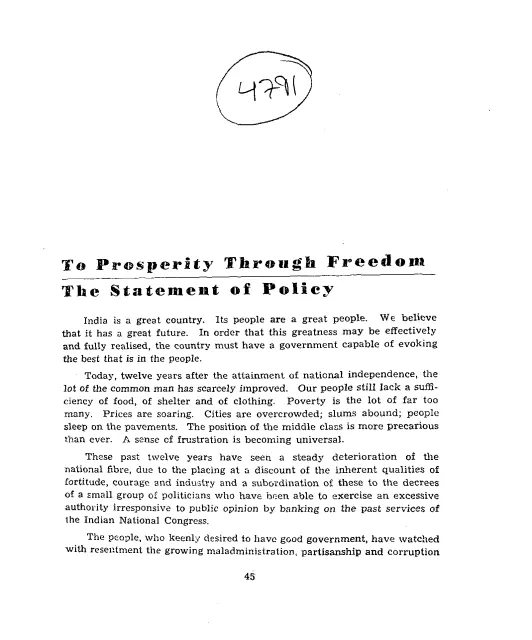
- The speech criticizes planning, nationalisation, licensing, quotas, bureaucracy, and expanding State control as impediments to economic development.
- Private enterprise, competitive markets, and individual initiative are defended as necessary for prosperity, but within a constitutional and regulatory framework.
- Judicial review, Fundamental Rights, free elections, opposition parties, and independent institutions are treated as essential protections against State overreach.
- The conclusion argues that constitutional liberty and economic and social progress are mutually dependent rather than opposed.
Metadata and summary are AI-extracted from the source PDF and reviewed for editorial accuracy. The original work is available via the Read PDF tab above (where present); paragraph-level citation inside the PDF is deferred to a future engagement.